
Measurement is one of the most important activities in PR. If you can’t measure success, then how do you prove the value that PR can add? Measuring the reach and impact of traditional media can be tricky all on its own. While you may land a story in the front page of The New York Times or place an advertisement on a highly trafficked website, how do you prove these placements are driving real value for businesses and propelling the people who come across them to action? And how, in this day and age, do you then quantify the impact and reach of social media, which presents a whole new challenge in measuring effectiveness?
Today, businesses increasingly leverage social media as a platform to announce news, bolster their brands and engage with target audiences. In fact, many organizations are beginning to invest in social media departments, hiring staff solely dedicated to supporting the company’s Twitter, Facebook and blogging engagements. If used correctly and strategically, social media can be an effective tool to increase your company’s visibility and thought leadership. But how do you really know you’re making an impact, influencing your audience and achieving results?
While it’s not a perfect science, fortunately, there are several tools to help measure your return on investment. About a year ago, we shared our thoughts on some of these tools in a blog called, “Becoming Proficient in Measuring Social Media.” However, as the infusion of social media continues and technology and features used to measure influence grow in sophistication and usability, we felt it was time to revisit the subject.
Social Media Examiner shares five free tools that offer easy ways to keep track of your influence on Twitter and beyond.
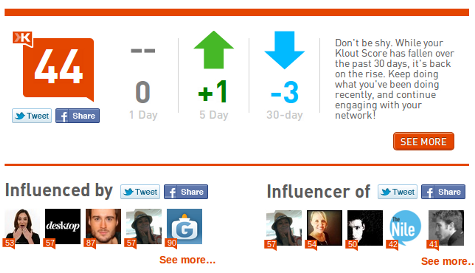
- Klout is perhaps one of the more well-known resources for measuring social media influence. Using data from your Twitter, Facebook, and more recently your LinkedIn and Foursquare accounts, Klout evaluates users’ behavior with complex ranking algorithms and semantic analysis of content to measure the influence of individuals on social networks. Klout’s influence score is based on a user’s ability to drive action through tweets, mentions, and more, as well as friends and followers.
- TwentyFeet is another tool that pulls data from Facebook and Twitter and presents results in easy-to-read graphs. Its statistics are fairly similar to Klout’s, factoring in friends and followers, retweets and status comments as a method of measuring influence. TwentyFeet is a great way to get a quick overview of your activity and influence over a period of time. It’s also a great tool to get in-depth information about your followers.
- Crowdbooster uses your existing data to determine when your posts will receive the most interaction, and have the most influence on your audience. It then recommends the best times for you to tweet the following day. The dashboard also includes a graphic overview of your account, which shows the number of replies, retweets, likes and comments received and the number of people reached.
- TweetStats is incredibly easy to use and is a tool that allows you to enter any Twitter handle, so you can check multiple accounts or compare other user accounts to your own. TweetStats focuses on your own Twitter activity and delivers a page of graphs detailing the different ways you interact with Twitter and the topics where you’re most influential.
- My Web Career analyzes data from Twitter, Facebook, LinkedIn, Quora and web search results to determine your “Career Score.” The score is based on the size of your network, your overall social media presence and the strength and reliability of your connections. It also provides insight into exploring your network and discovering the best way to take advantage of your connections.
What’s my personal favorite? I think Klout provides the most comprehensive value, while still being user friendly. Have you tried any of these tools? Are there any others you’d recommend? Please share!