
Insights for Leaders Navigating
Visibility, Credibility, and Growth.
From media strategy to reputation management, we explore the trends shaping public perception and share the approaches that drive measurable results for growing brands.
In today’s digital era, media pitches are often directed toward non-print outlets, whether they are online-only publications, blogs or mobile news applications. In PR, it can be tempting to direct the same pitch to multiple types of outlets, especially if you’re pitching to different versions of the same publication. For example, you might question why one would pitch differently to the online and print formats of The New York Times—they’re basically the same thing, right?
Wrong. Digital platforms have a different set of interests and goals than their traditional print counterparts. A major aim is not only driving traffic to their content, but also distributing that content across the Internet through web-sharing and social-media tactics.
To meet these ends, digital outlets tailor their content specifically for web readership. What works well for print doesn’t always transfer successfully to digital platforms, where content is typically shorter in length, more attention-grabbing and more concise. When your pitch appears in an online reporter’s or blogger’s inbox, their decision whether to write is influenced by factors unique to digital publishing—to be successful, it’s helpful to address these.
How can you amp up your pitch for digital outlets? Caysey Welton, editorial assistant for PRNews, offered tips about the topic in a recent article. I’m listing three of Welton’s five tips below (I highly recommend you visit his full article for further reading) to set you on your way to the perfectly crafted digital pitch.
Welton’s tips:
1. Consider the virality of your topic.
The success of digital publishing relies largely on ad revenues, which in turn depends on the ability to direct readers to content via SEO (Search Engine Optimization). Eye-catching headlines and engaging multimedia content are therefore increasingly important for digital content. Consider what factors make your pitch SEO-friendly, and make them apparent. Writing about a popular topic, brand or major trend? Mention this in your subject line. If you can’t see why your story should be shared across the web, neither can the reporter.
2. Research is key.
It’s a given, but particularly important in digital pitching—read up on the publication, its style and audience, as well as the voice of the specific reporter. Pitching to a conversation-style blog? Be professional, but less formal in your pitch. The digital publishing realm is also highly divided into specialty topics, so make sure you’re targeting a reporter who follows the correct beat to avoid your pitch landing on deaf ears.
3. Educate the writer.
With the rise of the Internet, just about anyone with a computer and a few resources can produce news via blogs and contributed content. However, just because a writer has interest in a particular beat and a wide reach does not mean they know everything imaginable about that topic. It’s your job to fill the journalist or blogger in with background and context while still being concise and to-the-point.
As a PR professional, you may have been told to “think like a journalist” when constructing a pitch or strategizing media relations. Nowadays, this type of thinking requires understanding the key differences between digital and print publishing. Just as reporters cater their writing for different formats, so should PR professionals tailor their pitches to the particular platform type. Of course, traditional pitching tactics are still important, but do consider these suggestions when drafting your next digital pitch to avoid it landing in a reporter’s (digital) recycle bin.
Verdiem, one of our Seattle-based clients, delivers IT energy efficiency solutions for mid-sized to enterprise customers across vertical industries. One of the reasons we love working with Verdiem is because they have compelling and timely stories to tell.
For example, Verdiem’s Surveyor allows customers to lower their operating expenses, sometimes significantly, by reducing energy waste using Verdiem software. Verdiem can point proudly to its many customer success stories, including Partners HealthCare, which is saving over $1.2 million per year on its energy bills using Verdiem.
And that fits nicely into the growing concern of environmental sustainability in the business world. Even the federal government has now mandated that U.S. commercial and government buildings must significantly reduce energy consumption. Verdiem is contributing to the reduction in energy consumption, such as that seen by Partners, by continuing to deliver new, innovative solutions to market and offering stellar support to its customer base – all of which are excellent fodder for PR.
Through announcements, contributed content and creative story pitches, Communiqué PR was able to generate 21 articles since spring 2012 to raise awareness about the growing need for IT energy management and Verdiem’s successful solutions.
Below is a list of those 21 publications, along with links to the articles.
- Environmental Leader, “Verdiem adds international energy rate coverage to IT management software”
- ZDNet, “Power management software tracks multinational energy rates”
- Geekwire, “Keeping your workplace culture on the cutting edge”
- Seattle Business, “Changing your company’s culture can boost your bottom line”
- Techtarget, “No escaping networked-based IT power management”
- Government Technology, “How to save money by automating CPU power cycles”
- Journal of Business, “Software cuts energy use by city’s computer system”
- The Spokesman Review, “Spokane Public Schools district software pays big dividends”
- Seattle Times, “First there was Xbox, now there is Vbox”
- TMCnet Smart-Grid, “Save your energy with Verdiem’s IT and facility power management platform”
- Efficient Energy, “Integrated solution for energy savings in buidings and IT”
- West Penn Post-Gazette, “Sleeping computers bring savings”
- Xconomy, “New finance models for NW cleantech, sustainability as VC wanes”
- Government Technology, “Power management software helps Spokane, Washington go green”
- Health Management Technology, “Manage IT energy use and save cash along the way”
- Health Management Technology, “IT energy management: A no brainer for healthcare organizations”
- HealthLeaders, “Conserve energy to preserve margin”
- Washington Post, “Firms turn to IT to track energy consumption, cut costs”
- Government Computer News, “Printer analyzer can help keep energy phantoms at bay”
- Xconomy, “Seattle roundup”
- Energy Manager Today, “Printers, PCs hog energy at enterprises”
We are excited to continue our work with Verdiem, to aid their efforts in raising more awareness and supporting them in their business objectives.
Anne Lindberg
We were pleased to learn recently that our client Nintex, a global leader in workflow solutions and project management was named to Gartner’s list of “Cool Vendors in Program and Portfolio Management, 2013.” The exclusive report, authored by analysts Robert A. Handler, Matt Light, Jim Duggan, Daniel B. Stang, Donna Fitzgerald, and Elise Olding, highlights innovative vendors and their products and services selected by Gartner analysts.
The basis for the honor is the value Nintex Workflow software offers enterprises in terms of efficiency and cost savings via its process automation and project management software. Its product has been adopted by more than 4,000 organizations in 90 countries. In late 2012, we worked with Nintex’s marketing team to develop an analyst outreach plan for Nintex Workflow for Project Server, one of the company’s key software products. The product has only been on the market since December 2010, but was gaining traction and attention quickly from partners including Microsoft and was ready for greater visibility among reporters and analysts.
The way Nintex was able to capture the attention of the analysts demonstrates the importance of planning, storytelling, and having customers ready and willing to speak about the benefits of their product.
In January we began outreach to key analysts at Gartner, Forrester and IDC and secured briefings with five analysts over the course of January and February to demo Nintex Workflow for Project Server and provide information about updates in the 2013 version. We also sent out a press release to key media in the project management industry and briefed them about the continuous investment and innovation Nintex was providing its customers.
A large part of the Nintex story is how the company’s end users – the business managers and project managers – are able to automate their workflows and data collection. Automating routine tasks through workflow allows them to spend more time on mission-critical tasks like ensuring public transportation safety, tending to the medical needs of patients, and bringing new products to market.
Nintex has a number of partners and customer willing to speak about their experience with the product, which enables our public relations team to bring life to the story when briefing analysts and reporters. We were able to provide references to analysts and reporters from partners eager to speak about the company’s value as a business partner who is committed to fast roll outs, continuous refinements, and understanding the needs of project managers. Nintex also provided end-users case studies that reported increased efficiency and cost savings, including a 20 percent reduction of time spent in meetings, up to 50 percent faster project completion times, and hundreds of thousands of dollars in savings in IT support.
The success of this analyst and media relations plan for Nintex Workflow for Project Server supports a tenet that is critical in telling a cool story: Show us, don’t just tell us. Innovative solutions, happy customers, supportive partners and fans of your product are what make your company cool indeed.
I recently received my latest issue of The Strategist, a quarterly publication from the Public Relations Society of America. In it, I was pleased to see an article discussing the benefits of hiring an external PR agency over an internal PR staff. It’s a question we at Communiqué PR hear regularly: “Why should I hire you and not someone in-house?”
It’s an excellent question and certainly worth exploring. Some of the arguments presented in the article include:
- Sustained focus: An external PR agency likely has a staff supporting your business. Depending on your budget, this could be a couple people to more than a handful. Should a crisis arise for your business, your agency PR team can divide and conquer. One person can handle reactive media inquiries pertaining to the current issue, while the other person (or people) can continue focusing on your proactive media relations – the positive stories that take time to come to fruition, but which ultimately help balance the potentially negative coverage, and resulting negative perceptions, that come with a crisis situation.
- Breadth: An in-house PR practitioner knows your business inside and out. But they also often know only your industry beat reporters. A PR agency account member, on the other hand, has experience with reporters in a number of industries focused on various beats. What if your IT company suddenly wanted to target K-12 organizations or higher ed institutions? The agency rep probably already knows the education reporters and will have more success when pitching because the relationship is established. And because they’re talking to a multitude of reporters every day, they have insights that can’t be gleaned through Cision or other database searches. The agency rep knows which journalist wants to write a story about cybersecurity while their editor wants them to focus on the stock market. And they can help make that knowledge work for you.
- Independence: Reporters often like multiple sources when writing a story. If you’re in-house, you don’t always have the connections to provide more sources to a reporter; however, a PR agency staffer has an arsenal of clients that could be provided as sources. The reporter saves time because they don’t have to seek out more contacts and the agency staffer strengthens the relationship with the reporter while helping your company get the story.
But those aren’t the only reasons. Consider the following as well:
- Perspective: Agency staffers can approach product launches and other news with valuable perspective not often gained when in-house. The agency pros can ask tough questions about what makes something newsworthy and understand whether media will find it notable. Sometimes when working in-house, there’s a possibility that you become a die-hard fan of your company and believe everything about it is newsworthy. Unfortunately, that’s rarely the case. But the agency team can provide counsel on how to make something as newsworthy as possible, and/or offer guidance on the best way to communicate the news for the most ROI.
- Creativity: While in-house PR practitioners can be creative, a PR agency has more brainpower to tap for the most creative ideas. From seasoned PR professionals to new college graduates, agency staffers can combine experience with out of the box ideas to get a solution that works for your business.
- Multiple specialties: When you hire a team in-house, you limit your capabilities. You’ll rarely find a PR pro who is gifted at media relations, crisis management, social media and analyst relations. But with a PR agency, you can have a number of resources to rely upon, all of whom have particular specialties and passions that can benefit your business.
What are some additional pros and cons of hiring a PR agency? If you’re considering hiring a PR firm, give us a call. We’d be happy to talk through our capabilities and what we can do for your business.
Additional Communiqué PR blog posts you might find helpful:
- Thinking about Investing in PR? Five Questions to ask your Potential Agency
- Internal vs. External PR Roles
- Strategic Public Relations Excerpt: Picking your PR Team Wisely
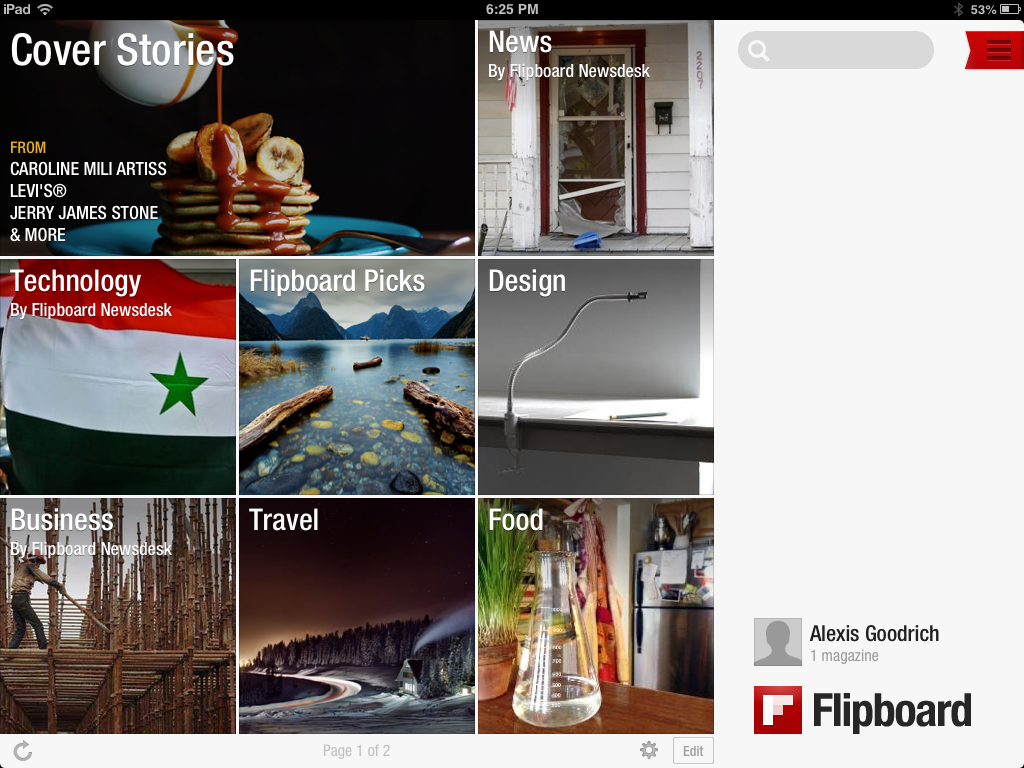
In this rapidly evolving age of information, the way in which media is consumed is constantly changing. Readers’ attention spans are limited and with only 24 hours in a day it makes sense to filter out relevant information from spam — finding the “signal” in the “noise.” Flipboard, an online, magazine-formatted social mobile app, does just that. Users can create “customized” magazines or follow others’, based on industries and topics of interest. Magazine content is also shareable, giving users the option to post to their social media sites or email to friends. Magazines are curated by “flipping” content from anywhere on the web seamlessly into niche-focused flipboards. What makes this app even more successful is the ease of use; with just a swipe of the finger you can access a myriad of content. The combination of personalized content and aesthetic ease make this app a game changer.
To date, over 53 million users have “flipped” through upwards of 6 billion pages a month. And with over 500,000 personalized magazines created, there are flipboards devoted to grilled cheese sandwiches, pre-1998 Porches and 20th-century architecture — nothing is too obscure! For businesses looking to leverage this app and share their own flipboards, there are some best practices to keep in mind.
First, the 80/20 rule. Users are less likely to subscribe to a flipboard that is only dedicated to one brand or message. It’s important, therefore, to have a mix of related content, with 80 percent flipped from across the web and 20 percent dedicated to brand promotion and content. For example, take Levi’s flipboard: The brand has done an excellent job pulling from social media sites and providing a well-rounded magazine dedicated to Levi fashion. As the magazine opens up on its first page there is a post from a Pinterest user on ways to wear a Levi denim shirt next to a photo of Rihanna rocking a pair of 501s. Flip to the next page and there is a Levi’s YouTube video promoting its recent Liberty London line flipped next to a tweet from actress Kate Bosworth, who is wearing a Levi’s jacket. The mixture of brand and user content from across the web makes this flipboard attractive to fashionistas and Levi aficionados.
Levi’s Flipboard.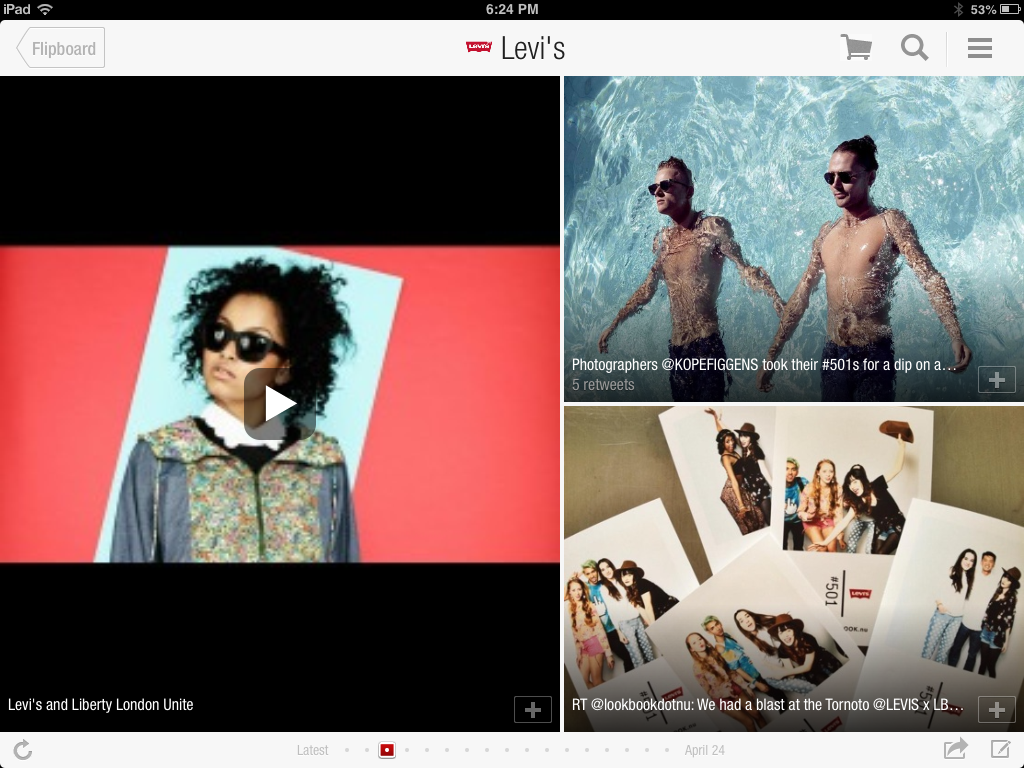
Social media can play a large role in attracting visitors to your magazine. Flipboard makes it easy by consolidating your Twitter, Facebook, Instagram, or Google + feed into a magazine into which you can then “flip” your brand flipboard posts. Likewise, Flipboard is searchable by hashtags, letting you access and share related content easily. Tweeting your flipboard link will help increase subscribers and your board’s visibility across platforms.
Another example of social media integration into Flipboard is the creation of a magazine based on an event or hashtag. Let’s take the Consumer Electronics Show that happens annually in Las Vegas. The hashtag #CES is easily searchable, and you can create a magazine devoted to housing important social media posts as well as relevant articles from the convention. Subscribing to the CES flipboard will give readers an encompassing view of important events happening as well as consumer insight. The use of these types of filters and organizational tools is shaping the way we consume media.
Finally, it’s important to be transparent about who is curating your board, and include some personal twists. I recently created a flipboard, Discovering Dentistry, for the dental website I publish, and the tag line is, “All things dentistry with a twist of food, technology, and community.” Readers know from the title that this magazine is dedicated to dentistry, but because of my personal interests (food, technology, and community) I find ways the two intersect. For example, I included an article about “Foods For Healthier Teeth” to appeal to my foodie side. Similarly, I “flipped” an article on “The 5 Best Dental Apps” for dentists to use in their offices, because I’m interested in how apps and technology can change the dental industry. It’s this type of media melting pot that makes Flipboard both unique and extremely useful.
Discovering Dentistry Flipboard.
These best practices will get you started on your brand’s flipboard but it’s important to stay relevant and flip content daily. Engage with and subscribe to others’ magazines to build a community and utilize social media to increase your following. Happy flipping!
About the author: Alexis Goodrich is the brand manager at Best Dentist Guide, a free guide that helps in selecting the best professional for your dental needs. Subscribe to her flipboard, Discovering Dentistry or follow her on twitter, @thedentistguide
In this age of rapid technical and social innovation, where “new” is deemed as “best,” and the next big thing is always around the corner, norms in the workplace are evolving at a similarly rapid pace. While much of this innovation has led to improvements in the workplace, some of the ways in which things were done “back in the day” were not broken and required no fixing. In fact, evidence points to how, in some instances, going “old school” may just be the most innovative idea on the table.
In his article, “Old-School Business Practices Worth Bringing Back,” (Harvard Business Review blog; April 11, 2013) John Coleman highlights five mid-20th-century business practices that are worth resurrecting. Below are highlights:
- Dress well. Business culture, particularly in the U.S., has grown increasingly casual over the years, but recent studies have shown a connection between dressing well and professional success. That doesn’t mean we need to spend lots of money or return to the formality of a three-piece suit, “But it might mean trading Dwight Schrute for Don Draper once in a while and aspiring to an occasional concern for aesthetics,” says Coleman.
- Make meetings distraction-free. Active, engaged participation in meetings – whether by phone or in person – is on the decline with distractions from smart devices. Coleman cites a study in which half of all respondents admitted to checking their phones in meetings and suggests that participants are “dumbed down” by distraction. Avoiding distraction from modern devices would enable participants to become more fully engaged and meetings would be more productive. “It can also shorten meeting length,” says Coleman, “as participants push for conclusion when they get bored rather than passing the time playing Angry Birds.”
- Lengthen lunch. While eating lunch at your desk may make sense during particularly busy times or in an effort to get home early for a family commitment, more leisurely lunch breaks might also contribute to your productivity. Coleman cites expert opinion that people who take lunch breaks in general are healthier and more productive. And finding more time to connect with colleagues over a long lunch can strengthen relationships at work, also contributing to greater workplace productivity.
- Be punctual. Back in the day before mobile phones, punctuality was essential because there simply wasn’t a way to let someone know you were running late. With the convenience of modern technology, we often think it’s OK to run late or push back a meeting as long as we text or email in advance to let the other participants know. However, being on time still influences how others view us. It signals to others that we are reliable and we value their time. It can also decrease the costly impact of wasted time. In fact, Coleman cites a study that found staff lateness costs the UK economy £9 billion per year!
- Take a real vacation. Much has been written on the benefits of taking vacations and truly disconnecting from the workplace. Given the ever-present connection provided by smartphones, this might be truer today than it was back in the 1950s. It’s worth stepping back and reminding yourself to safeguard your vacation how and when you can. If done right, the end result should be physical and mental rejuvenation, which can lead to greater productivity upon your return to the workplace.
While these basic ideas make perfect sense to most of us, the implementation is often much harder in the current business climate. At Communiqué PR, we strive to put these old-school principles into practice. If the collective workforce does their part to change themselves and speaks up to create change within their organization, norms can slowly shift. According to Coleman, we may all be happier and more productive as a result.