
Insights for Leaders Navigating
Visibility, Credibility, and Growth.
From media strategy to reputation management, we explore the trends shaping public perception and share the approaches that drive measurable results for growing brands.
Here at Communiqué, we not only use Twitter to keep up to date on local, national and world news and trends, but to also monitor coverage and public perceptions on behalf of our clients. In order for us to keep track of everything, we needed a powerful application that could handle multiple accounts and established searches. To accomplish this task, we have come to rely on TweetDeck. While there are certainly other options such as HootSuite and Twitterific, TweetDeck allows users to break down accounts, groups and searches into separate columns, making viewing streams easy and quick. It even allows you to integrate your Facebook, LinkedIn, Foursquare, Buzz and MySpace accounts all for free.
Recently, TweetDeck was updated to version 0.35. While no cosmetic changes were made, this update brought a number of useful changes for users such as the ability to cross-post Twitter updates longer than 140 characters. To do this, the user must have both a Google Buzz and Twitter account. Then while posting an update through TweetDeck, the user selects both the Buzz and Twitter accounts, and continues to type more than 140 characters. Once the update is sent on TweetDeck, the full message will be posted to your Buzz account and the tweet will contain the first 116 characters with a link to the full update on Buzz.
Another update that is useful to users is the support for t.co links in the main feed. T.co is Twitter’s proprietary URL shortening service. The difference between t.co and other URL shortening services like bit.ly and ow.ly is that, each link shortened by t.co is checked against a list of malicious sites to identify malware, phishing attacks and other harmful activity. If there is potentially harmful information at the URL destination, the user is warned. Also, in TweetDeck, when a user hovers the cursor over a t.co link, they will be given the full URL preview. This feature is beneficial because as Twitter gains more popularity, hackers will begin using it more and more often to attack users. This is just an extra step that Twitter and TweetDeck, have put in place to help prevent any of these attacks.
While these two additions were the highlight of the recent update, many other features were added and bugs were fixed. For example, now users can add a trending topics column in TweetDeck. Also added was support for previewing and uploading images directly in TweetDeck via Plixi, a photo sharing service. If you are looking for a powerful, feature packed Twitter application, I highly recommend checking out TweetDeck.
We would also love to hear what Twitter applications you use. Leave us a comment with your suggestions below.
As a PR professional it can be challenging keeping up with the onslaught of tools and resources available to help uncover editorial opportunities, pitch and distribute news, measure and monitor social media campaigns and gather information on speaking and award opportunities.
Beyond the HAROs and Cisions’ of the world, we thought it would be useful to put together our top picks for unique tools every PR professional should consider having in their arsenal to efficiently and effectively add value to PR campaigns and initiatives.
MatchPoint – MatchPoint allows PR professionals to search for journalists who write about what they’re pitching, by adding the pitch to the search box. For a monthly subscription fee, users can identify reporters and bloggers based on what they actually have written, not solely on their beat or title as listed in many online media databases.
Press Kit’n – Press Kit’n is a tool for publishing social media releases and maintaining an online news presence. While many organizations typically have a website designer/master, this is a great tool for smaller companies or start-ups that are looking to affordably create a newsroom. The service features a variety of customizable templates, an RSS feed, which enables journalists to easily subscribe to the newsroom and Twitter functionality so readers can easily tweet news from the newsroom.
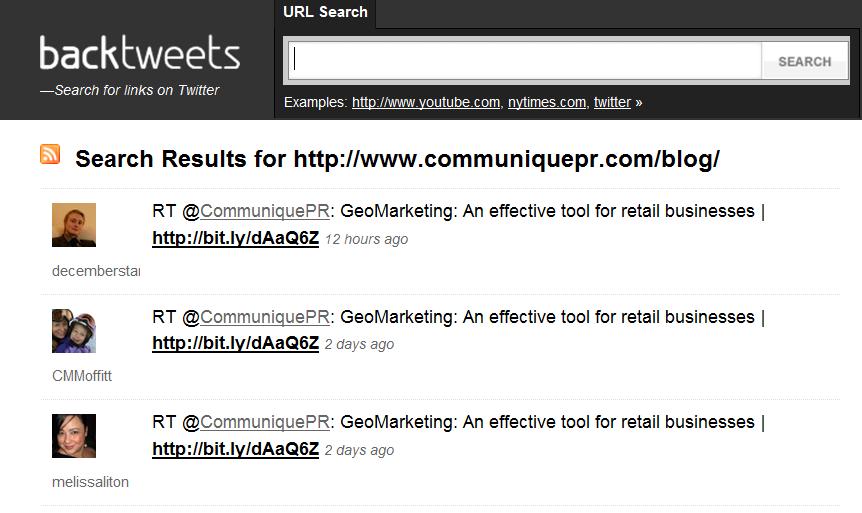
Backtweets – A free tool that provides a quick snapshot of every tweet that has ever contained a link or reference to a particular URL. As a test, I did a search for all tweets that include the Communiqué PR blog URL and found more than 52 links to the blog via Twitter. Backtweets could be incredibly valuable to track a particular campaign to see how much traffic has been driven to a website as a result of Twitter activity.
MediaOnTwitter – MediaOnTwitter is similar to other lists such as MuckRack and JournalistTweets which are excellent tools for finding journalists on to follow on Twitter. The reason I like this particular site is it is simple and straightforward to use. You can easily sort the list by name, publication, title or country making it simple to quickly find journalists. Additionally, you can add media to the list and also search for journalists in other countries including Canada, Australia, U.K., France, Russia, South Africa and more.
AwardSync – We’ve written about AwardSync previously, but it’s worth mentioning again. It is a free database of awards opportunities. This free service enables award organizers to post information and publicize industry award programs making it easy for organizations and PR professionals to find awards relevant to their specific industry and vertical market. We recently tested the service and found it offers intuitive search functionalities much like Google and can be a valuable resource when developing awards programs for clients.
Alltop – I use this search engine from time to time to get a quick snapshot of what’s being written about around a particular topic. According to its website, Alltop, “The purpose of Alltop is to help you answer the question, “What’s happening?” in “all the topics” that interest you.” I did a quick search for “iPhone” which brought back stories from the top blogs covering the iPhone. While it does not bring back results for everything, if you’re looking for stories/blog posts around a general topic you can usually get a good snapshot here.
Not all tools are created alike and as technology evolves, I anticipate these tools will only become more comprehensive. It will be important for PR professionals to continue experimenting with these tools, providing feedback and selecting the tools that make the most sense for their objectives.
Do you have a ‘must-have’ PR tool to share? Let us know about it!
With the proliferation of smartphones, location-based marketing is the latest buzzed about topic. Recently, an article in the Wall Street Journal explained how companies with retail outlets such as restaurants, retail stores and other small businesses can use location-based social networks to increase foot traffic to their storefronts.
Location-based social networks, such as Facebook Places, foursquare, Gowalla, and Brightkite allow users to share their locations through their phones’ GPS and “check in.” These check-ins allow consumers to share with their friends and social networks what shops or restaurants they visit. This provides marketers with an opportunity to engage with these consumers in a more direct manner.
After a customer checks in at a store, their recent geo-location updates are accessible to the store manager including frequently visited stores based on their Mayor status as well as if customers posted any tips about what they like or don’t like in the store. For example a Bluebird Ice Cream patron recently posted, “Get the snicker doodle ice cream because it is damn tasty!” This provides businesses with instant insight into customers’ preferences.
Businesses can easily leverage these networks to help build awareness, increase store traffic, drive sales and connect with customers.
Here are four ways businesses can leverage location-based social networks:
1. Getting the word out there. Hyper-local marketing has never been so easy. Just letting people know that you are in the neighborhood can draw them to the store. For instance, a person standing on Broadway, a thriving a
rea in Seattle, can check into FourSquare to get a list of all the nearby restaurants and access information from their networks of friends, as well as special offers from the surrounding establishments.
2. Offer something special. Specials can entice customers into your business. For instance, Mediterranean Express on Broadway in Seattle lures customers by offering, “First 5 customers who check in before 11:45 a.m. will get a free soda with their meal.” Whereas Juicy Couture’s current offer entices customers to check in at the store and show the manager to receive a free sample of its Peace Love & Juicy Couture fragrance.
3. Build loyalty. The ability to build loyalty and attract repeat business is the key to successful geo-marketing campaigns. With these networks, companies can give customers a reason to keep coming back. Recently, PCC was offering a free cookie to shoppers when they check in three times. Consider these other giveaways:
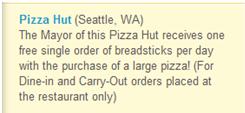


4. Get consumer insights. Real-time data about users – such as gender, frequency of visits, time of day they check in, total number of unique visitors – provides invaluable insight into consumer behavior that marketers can leverage to tweak campaigns. For instance, if more men visit an electronic store between 7 to 10 p.m. then the store manager could consider offering services that would be of higher interest to men rather than women.
To get started, a business owner or marketing manager should first create a profile for the business on the network, or if a profile already exists in the database then they can claim it, and ensure it is complete and accurate. He or she can then encourage customers to check in online by placing prominent signs in the store, or at the cash register, as well as on Twitter and Facebook.
Once you get started, there are many possibilities. Don’t wait. Leverage location-based marketing to drive your business now!
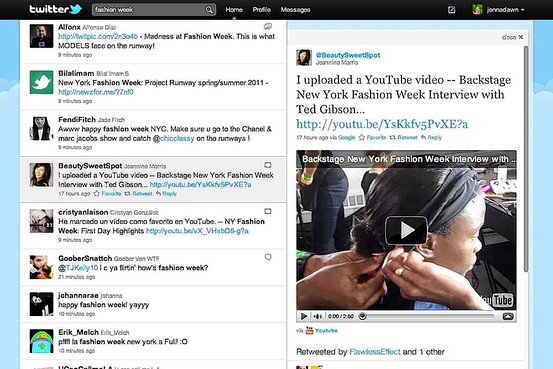
By now, most people are aware that Twitter is currently rolling out several new features, which have now been dubbed the “new Twitter.” Personally, I’m still among the unlucky few who still don’t have the new updates (Twitter is slowly rolling them out to everyone) – despite the fact that I run four Twitter accounts for various clients and personal reasons. With that said, I’ve read many of the reviews and rants on the new features (namely embedded videos and photos and the ability to drill down on a user without refreshing the page), and I want to summarize some of the trends I’m seeing.
The people who love the new platform and features:
- Overall, advocates of the features appreciate that Twitter has taken notice of the many complaints people have about the web interface. Additionally, many believe the new platform will encourage fresh ways of consuming digital content which is good for advertising. Someone in my personal Twitter stream summed up the overall sentiment in this group nicely by saying, “If Twitter’s plan with the new roll-out was to make it more addicting, they have succeeded marvelously!”
- All Things Digital’s Katie Boehret was pleasantly surprised by the new features. Boehret notes, “So I was surprised to find that the new site offers a good number of fresh features that enhance the social-network experience. The site now works a lot like its own app, with fewer clicks needed to navigate and more ways to see content without leaving the current Web page. The site is noticeably faster with more pleasing visuals and easier ways to follow or unfollow others.”
- ClickZ sees dollar signs in the new interface saying, “This design will attract more readers rather than tweeters, as information on Twitter is now much easier to consume for the average user. And what are readers great for? Readers consume digital advertising.” With the improved ability to consume digital content, it won’t be long before advertisers figure out a way to leverage the new Twitter to reach consumers.
- Additionally, The New York Times’ Paul Boutin thinks positively of the redesign due to the emphasis on exploring content and simplifying the search functionality, two things that are regularly on a Twitter user’s gripe list.
The people who think the new platform and features are lacking:
- Overall, proponents of the new features, argue this is too little too late – A common complaint when companies roll-out features after many months of public issues.
- ZDNet’s Jason Hiner thinks Twitter should have spent its time and efforts on other aspects of the platform. Contrary to popular opinion that the company denies it is a “social network,” Hiner wished Twitter would have created more conversation-friendly features such as threaded conversations and the ability to vote.
- Another opinion from cyber security experts say, “the more new features Facebook and Twitter add, the more spammers can be expected to search out fresh security holes — and exploit them until technicians respond,” according to USA Today.
Overall, I think the new features have been positively received. By making the Web interface more interactive and visually appealing, Twitter.com has reinserted itself into the race for the best application to access Twitter feeds. However, when it comes to upgrading and understanding a company’s needs for the platform, I think they’ve still missed the mark. Social media managers do not want to log onto the website every time they want to check their stream or make a tweet. The instant access provided by third-party applications such as Seesmic or Tweetdeck is much more business friendly. Additionally, many social media managers, like me, maintain more than one Twitter handle, which is nearly impossible on the current Web version unless you want to log on and off each time you toggle accounts.
Do you have the new Twitter? What do you think so far? Do you think my opinion will change once I’m able to experience it first hand?
In the past two weeks several of our clients have asked us about link baiting, the practice of creating valuable content for one’s website that encourages people to link to it from other websites. This practice is popular with some companies and individuals because the quantity and quality of inbound links are two of the many metrics used by a search engine ranking algorithm to rank a website – meaning the company with more quality inbound links will appear higher in searches via Google or Yahoo.
To learn more about the practice and pitfalls of link baiting, we reached out to several experts and learned the following:
- It’s acceptable. There is nothing wrong with the practice of link baiting from a moral or ethical practice. In fact, according to Joel Johnson, with Response Mine Interactive, “the practice of link baiting is one of the few forms of link building approved by Google, which endorses a model of links based upon content.” He went on to explain link baiting has the potential to create a substantial number of powerful links. So, all in all, this has the potential to be one of the safest and strongest forms of link building.
- Nonetheless, the practice of link baiting is not without challenges. One of the pitfalls is that creating compelling content can be time and resource consuming. Furthermore, it is not easy to figure out what content is going to be commented on or capture people’s attention. An organization may invest considerable time developing content that it believes is going to be successful in attracting link backs only to find it falls flat and is a costly failure.
- Stay within the spirit of your brand. From a corporate reputation or thought-leadership perspective, organizations need think about their overarching objectives when creating content for link baiting. Clearly, one does not want to create provocative content to drive link backs at the expense of alienating key audiences. Posting controversial material on one’s website as a ploy to drive comments or links can backfire if the content does not support your organization’s brand or thought leadership goals. One way to ensure content is supportive of an organization’s goals is to involve the PR or communications team in a discussion about it.
- Remember your reputation can be enhanced (or damaged) by the company you keep. When engaging in the practice of link baiting, it is essential that a company review each link before just accepting the link back. You want to avoid accepting links from sites creating spam as these links will clutter up your website and have the potential to damage your organization’s character. One SEO expert recommends only linking to sites that have a Google page rank of three or more and that you feel provide excellent value. Click here for a free page rank checker.
Like any other marketing tactics, when done right link baiting or link building can be very effective, however, it can also be expensive and time consuming. Attention-grabbing or gimmicky content is likely to attract the wrong traffic so be careful when engaging in this practice. Remember if you’re authentic, truly adding value or providing useful information to key audiences you are likely to see people naturally commenting and linking back to your content.
Earlier this week I attended a panel discussion called, “Piercing the Clouds: Emerging Opportunities in Cloud Computing” sponsored by the MIT Enterprise Forum. The panel featured cloud computing experts from Microsoft, Amazon, Google and Real Networks to discuss the opportunities, pitfalls and trends surrounding cloud computing.
Cloud computing is defined by Wiktionary as, “Computing in which services and storage are provided over the Internet (or “cloud”) and can include popular Web-based services such as Gmail, Pandora, Facebook and YouTube, virtual server storage solutions such as Amazon Web Services and product development tools such as Google Apps.”
The panel experts agreed that cloud computing is one of the most significant disruptive technologies in recent memory and it is here to stay. In fact, analyst firm Gartner predicts the cloud computing market is, “poised for strong growth through 2014, when worldwide cloud services revenue is projected to reach $148.8 billion.” One of the panel observations I found to be interesting is that the proliferation of mobile computing devices including mobile phones, iPads and e-readers has been one of the key drivers of consumer-driven cloud computing apps. However, the panelists believe that cloud computing will penetrate the enterprise further as the barriers surrounding trust and reliability of accessing content are broken and companies begin to view of cloud computing as a business model rather than a trend.
One thing is clear, cloud computing is not just a trend but represents a significant shift in how we access information and content. We work with several clients in various industries that touch the cloud and it will be interesting to see how this technology will evolve both consumption of content, and business models for organizations.