
Insights for Leaders Navigating
Visibility, Credibility, and Growth.
From media strategy to reputation management, we explore the trends shaping public perception and share the approaches that drive measurable results for growing brands.
A recent article in PRWeek titled “Client Service Remains a Staple for Smaller Firms” makes a great case for why small PR firms are the best choice for many companies, especially in a down economy. The article points out several reasons why small firms have a competitive edge, including:
Client Service – Small firms can provide senior account executives for every client. These executives are accessible, quick to respond and they forge close relationships with clients.
Budget – Boutique PR firms can do “everything a large firm can with a more reasonable budget,” Scott Phillips of Chicago-based Phillips and Associates. They have less overhead and can therefore charge very reasonable rates. Small firms can also quickly scale the budget up or down depending on a client’s needs.
Dedication – Each client matters a great deal to a smaller firm, and they are willing to go the extra mile to exceed expectations and garner great results.
As companies reassess their PR budgets and strategies and consider hiring a small firm, there are a few important points to consider. We recommend asking the following questions before selecting a PR team:
Is your business complementary with their current portfolio or clients?
What experience does the PR person or firm have in your industry?
Are they passionate about what you’re doing?
Are they asking smart questions throughout the process?
Do they have the capability and bandwidth to do a good job?
We recognize that selecting a new team can be a difficult process and have developed a white paper to help organizations understand the various approaches and options available to them when faced with building and evaluating a high-performance PR team. The paper discusses the different processes for selecting a PR team, the advantages of each process, how to evaluate a potential candidate or agency and tips for building solid relationship with your PR team.
To receive a free copy of the white paper “Selecting a Winning PR Team: A Strategic Approach,” please e-mail [email protected].
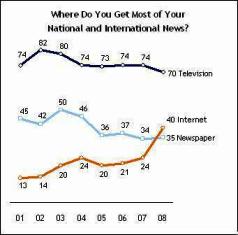

While television still remains to be the leading news source, you will notice a steady decline as shown in the Pew Research Center graph located to the right.
As the Internet continues to rise as a leading news source among consumers, it’s important from a PR perspective for organizations to keep in the mind the possibilities that exist for reaching audiences and sharing news via the Internet.
Given the widespread adoption of broadband in the home and the continued shift online print publications and newspapers are pursuing (read our past blog entry here), the survey results come at no surprise.
First, news online is now more mainstream than newspapers. A positive print article
about your organization in the New York Times will still earn high recognition, however, an article appearing in the New York Times online has the potential for reprints, pick-up and user comments -providing you with insight from readers.
Second, online outlets provide more flexibility for time. Online journalists are more likely to cover breaking news as it happens versus long-lead publications that often work 30 to 90 days in advance.
Third, the Internet has opened the door to blogs and social networking -creating even more ways for organizations to share news and connect directly with their customers. Many blogs that attract the masses (Tech Crunch, Digital Duo, mocoNews) also receive article reprints in newspapers such as Wall Street Journal, New York Times and the Washington Post.
As you evaluate the best medium to share information about your organization, keep in mind the mainstream reach of the Internet and the possibilities for reaching your target audience.
An editorial board is a group of people, usually at a print publication, who set the tone and direction of the newspaper or magazine. They are chartered with preparing the paper’s editorials and they determine what the publication will say on a range of issues as well as dictate which issues or political candidates the publication will endorse.
At a newspaper, this group usually consists of the editorial page editor, editorial writers, opinion editors and the managing editor. Sometimes, the editorial board also includes the publisher and the owner of the newspaper.
A successful editorial board informs, educates and inspires its readers. Editorial boards meet on a regular basis to discuss current news and trends both locally and nationally. The editorials are often written by individual board members in consultation with their colleagues.
There are great benefits to meeting with an editorial board. It is an excellent way to build or improve your relationship with the editor and publication, as well as tell your side of a story. Consider requesting a meeting with the editorial board when:
- Your company is about to break a sensitive news story and you want to provide background information and present your point of view before the story appears. If done successfully, this can help sway editorial coverage in favor of your company.
- The publication has been printing unfavorable pieces about your company and you want to share your perspective.
- Your company has a new executive team member or an important initiative that you want to introduce to the board.
- There is a pressing issue that you believe deserves broad community support. By providing insight on an issue affecting community members, you can help establish thought leadership and raise awareness of your company.
For instance, we are engaging the editorial boards with the Seattle Times and the Seattle Post-Intelligencer to educate them about the implications of proposed budget cuts. We believe the new two-year state budget proposed by Governor Christine Gregoire deserves further attention as it will have detrimental implications on several non-profit organizations, including the Washington Poison Center (WAPC). Our goal is to help these editorial boards understand how a reduction in WAPC’s non-profit’s funding will impact our local community and to encourage them to write about this topic.
Other experienced PR practitioners shared their point of view about working with editorial boards.
Andy Bowen, president of Clearview Communications + PR Inc., believes in order to be considered for editorial endorsement or criticism, the issue that is being presented must have been previously covered by the media. He explains, “The issue must be of genuine public importance and in debate for an editorial board to consider endorsement or criticism.”
Sabrina Kidwai, media relations manager for the Association for Career and Technical Education, recommends conducting a watchdog project prior to the meeting to “monitor how they are covering your issue and bring that information into the meeting. It is helpful to do your homework and know how they have covered issues in the past.”
For examples of editorials written by the Seattle Times’ board members, check out the following links:
- Joni Balter, “Gregoire-Rossi: Ridiculously Close“
- Bruce Ramsey, “A Map of Delinquent Mortgages“
- Lynne Varner, “Saving Seattle Schools“
We hope this information is helpful as you consider when to engage with editorial boards. For more tips on how to secure the meeting, or best practices when working with these groups, please call us at (206) 282-4923 ext. 112.
We also would love to hear from you if you have experience working with editorial boards that you’d like to share with us.
Facebook is becoming the first stop for many people when they want to learn about the latest news in their community. Individuals are reporting on the events in their communities with photos and personal commentary, making Facebook an excellent source for local happenings and news.
We witnessed this phenomenon first hand in Seattle when individuals reported on the weather conditions during the December snowstorm and most recently during the storms which caused significant flooding throughout our state. Friends reported on which streets were being plowed, where flooding had occurred, as well as road and school closures. They also shared information about how they were coping with power outages or cabin fever.
Clearly, sharing information on Facebook is not restricted to weather conditions – friends share information about their interests, hobbies and travel schedules. There are some posts that focus on the mundane, daily activity of life, but many posts provide timely insights and perspective into relevant happenings. Recent examples include posts covering industry tradeshows such as CES and Macworld, how to deal with the onslaught of people in D.C. for the inauguration and updates on political events, appointments and scandals. After all, an individual’s Facebook network is more likely to report on items that are more relevant to him or her. Given this, Facebook has become a source for relevant, timely and specific news.
Facebook is not the only site providing this level of personalized news to consumers. There are a number of growing sites where people, intentionally and unintentionally, act as citizen reporters and share information with their networks, such as Twitter, LinkedIn, Big Canvas PhotoShare, Sweat365 and many others.
As more and more consumers participate in social media sites, traditional media outlets will need to adapt to address this increased level of competition. In addition, companies looking to raise awareness should be evaluating how to leverage these Web sites in an effective, authentic and productive way.
One of the most popular New Year’s resolutions is to save money. In fact, The Today Show recently asked their readers to share their money resolutions for 2009 and received a flood of responses. Viewers’ resolutions included:
1. Assess what you have and make use of it.
2. Look great for less.
3. Save money on entertainment without forgoing fun.
4. Pay down debt instead of accumulating more stuff.
5. Be a savvy comparison shopper.
6. It’s actually kind of easy being green.
7. Devise a budget – and stick to it!
8. Remember to take advantage of the points and rewards you’ve earned.
9. Discover the magic and wonder of thrift stores.
10. Distinguish needs from wants.
I think this list is good, but it is missing another import concept around learning and saving. We all know that one of the best ways keep your mind sharp and have fun is to learn something new, but with the economy in a downward spiral many people can’t justify discretionary spending on fun classes or the pursuit of a new hobby.
We are excited to share that one of our clients, Learn and Save, is making it easier to try something new and save money. Specifically, the company has created a new consumer networking Web site bringing how-to tutorials, high-quality information and coupons to consumers.
We helped the company with its debut on Jan. 1, 2009 and have received very positive feedback from journalists and consumers alike. Thus far, the following news outlets have developed stories on Learn and Save:
1. TechFlash, “Learn and Save, an eHow Rival that Promises to Save People Money”
2. KOMO 1000 – Aired an interview with Charlie Gillette, chief executive officer of Learn and Save on Jan. 2.
3. Gadgetell, “Learn and Save Aims to Help Both the Consumer and the Company”
4. King 5, “Web Sites That Claim to Save you Time, Money”
5. MyFox Tampa Bay, “Consumer Lawyer: Learn to Save“
Several more local and national stories are currently in the works.
Consumers shared the following insights about how they’re using Learn and Save as well other related Web sites, such as www.ebates.com, www.couponcabin.com, www.istorez.com, www.fatwallet.com and www.Valpak.com, which are all aimed at helping individuals save money.
“As an avid coupon clipper, I’m always on the lookout for ways to spend my dollars more efficiently and appreciate hearing helpful tips about products I’m considering purchasing,” said Kayla Sando, Learn and Save customer. “I love that Learn and Save provides me with a one-stop destination where I can learn about the topics I like while at the same time gain access to relevant coupons.”
Yvonne Maffei, in Chicago, believes “the Learn and Save concept is a good one: tutorial descriptions, useful tips, related links and products all on one page is great. It gives the reader everything he or she needs in one spot. Readers get the video to learn, the links to continue learning and products to buy related to that topic.” She just hopes in the coming months they’ll add more coupons and make them stand out more.
If you are interested in writing about Learn and Save, please feel free to e-mail me at [email protected] and I’ll be delighted to put you in touch with a consumer or Charlie Gillette, CEO of Learn and Save.
A recent article in the Boston Globe examined how the economic climate is impacting healthcare. In the article, Reporter Lisa Wangsness cites a recent CNN poll that shows the economy as the most important issue currently facing the country, with healthcare coming in second. Despite the poll, Lisa states, “Many health policy specialists and political strategists say the two issues are inseparable in people’s minds.”
It’s no surprise that many people associate the two together. Changes in the economy directly impact healthcare access for individuals and families alike. With the unemployment rate rising, more families will continue to loose their healthcare insurance and will struggle as they take on the responsibility of paying for pricey healthcare premiums.
Furthermore, the impact for families who have children with chronic conditions – those who have an increased risk for a chronic physical, developmental, behavioral, or emotional condition requiring health and related services – can be devastating. Often these groups are the first to suffer during an economic downturn when ongoing medical attention and supervised care is essential. According to the Department of Health, this population faces medical costs approximately six times higher than those of children without chronic conditions.
From a PR perspective, economic recessions provide an opportune platform for organizations to address social issues such as healthcare and social security that are typically top of mind with many individuals. Organizations have an opportunity to voice how their product or service is helping people to get through these tough times. In some instances, it may be an education that you are providing to the public about how the recession is impacting a particular industry.
One of our clients, Seattle Children’s Hospital, is a great example of an organization that is proactively leveraging the recession to educate the public about children with special needs.
For example, during a recent lecture at the hospital, Dr. John Neff, director for Center for Children with Special Needs, illustrated how families with children who have special needs are significantly impacted during a recession and what the community can do to support this group.
Children’s also recently produced a podcast which examined the healthcare reform plans of former presidential nominee John McCain and President-elect Barack Obama. The podcast provides valuable information for parents looking for more specific information about how McCain and Obama’s policies would affect their healthcare coverage.
These are a few examples of how an organization like Children’s can effectively address social issues during a recession. To learn more about how you or your organization can have an active voice during the economic downturn, please contact us at (206) 282-4923. Alternatively, you can make a donation for Children’s here.