

In the Internet age, most people often act quickly and pass along information via social media, before they even verify that the information is accurate. We’ve all see the fake Amber Alerts for missing children or the faux-images that fly around Facebook and Twitter, such as the one picture to the right comparing Prince William and Kate Middleton to Cinderella and Prince Charming. These types of misinformation or inaccuracies rarely cause serious or physical harm, but they can be damaging when it comes to causing panic or spreading lies about a company. So, what do you do when there is misinformation floating around on social media about your company?
As an example, McDonald’s was recently the center of a Twitter hoax when unknown parties began circulating an official-looking image on Twitter that appeared to be from the popular chain restaurant claiming that they were charging African American customers $1.50 more due to a string of robberies. Even though this image was quickly discovered to be false (it had been circulated in 2010 as well), it didn’t stop the mass of people tweeting and retweeting the image, which led many people to become enraged with McDonald’s.
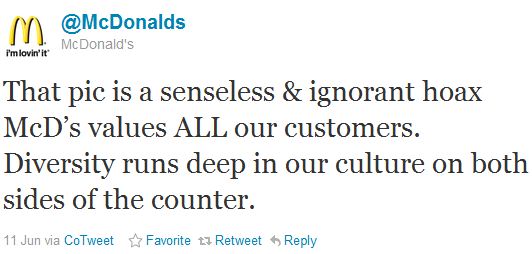
In response, McDonald’s quickly posted a tweet letting people know that the image was a senseless hoax, and that the company valued the diversity of its customers and employees. After the image continued to circulate, McDonald’s posted another, more-direct tweet saying that the image was a hoax. While this didn’t stop the image completely – it’s hard to control what people do and don’t share on the Web – it did slow down the angry tweets. And, according to Ragan.com, most crisis communications experts felt that McDonald’s handled the situation well.
So what can your organization do if it finds itself in this situation? We’ve outlined a few easy steps to follow:
- Research the Situation. It’s important to make sure you fully understand what is being passed around. You don’t want to react with incorrect information. This could cause followers to think you are being deceptive.
- Act Quickly. Once you realize there is misinformation floating around, quickly gather the appropriate stakeholders and devise a plan of action. The longer you wait to give your side, the harder it will be to convince people you are correct. For more on this, see our recent post about crisis communication.
- Post a Statement. Make sure to upload a brief statement to Twitter, where everyone can see it. If there is a hashtag being used to discuss the crisis, it would be a good idea to reference it in your response so that everyone can easily find it.
- Monitor the Conversation. Watch to see what people are saying in response to your statement, and determine if an additional statement is needed.
While it’s impossible to completely stop something like this, you can’t ignore its existence either as silence is often equated with guilt. There will always be differing opinions on many subjects. The best a company can do is to react appropriately and in a timely fashion.