
Insights for Leaders Navigating
Visibility, Credibility, and Growth.
From media strategy to reputation management, we explore the trends shaping public perception and share the approaches that drive measurable results for growing brands.
Earlier this month former Wall Street Journal reporter and editor Jessica Lessin launched a technology and business news site – The Information – that got the media world buzzing. The Information costs a hefty $399 a year, or $39 a month, and offers no free content up front, which is one of the strictest paywalls on the market. At first most media professionals were skeptical, and some were even condescending toward Lessin’s lofty goals. But it got everyone in the media world thinking – in an era where content is fast and free, can Lessin carve out a niche audience among those who value quality over quantity?

Lessin decided to leave WSJ and start her own publication because she saw an opportunity to go after an underserved market, which she describes in a letter from the editor as “professionals in technology and in industries being upended by it.” Lessin told AllThingsD that her goal is to focus on deeper, more investigative analytic reporting instead of simply reporting the latest breaking news. The publication currently has eight full-time employees, all with impressive professional backgrounds.
Many media professionals are questioning The Information’s bold business model. Bigger, more established media outlets have tried less expensive paywalls in the past and failed and many newly established outlets have folded or struggled due to unsuccessful paywalls, such as the crowdfunded outlet Matter. The Information is also choosing not to host any ads, which means its only sources of revenue are its subscribers and investors.
But the boldness of The Information’s business model could be what makes it successful. Business Insider did the math and discovered that the publication only needs about 1,800 annual subscribers to break even, and if it garners 5,000 subscribers it will have a profit of $1 million.
The publication could easily acquire the number of subscribers it needs because it is aimed at professionals who are accustomed to paying for content that will help their businesses. If an employee makes the case that a subscription to The Information could help increase the company’s bottom line, the boss is unlikely to say no.
Regardless of whether The Information is successful, it is admirable that Lessin has taken the first step toward creating a sustainable publication that produces high-quality journalism.
Technology seems to be advancing at exponential speeds these days. Just look at the changes that have evolved from the first cell phones 30 years ago to today, where interactive smartphones provide us ways to communicate, navigate, and enjoy entertainment from the palms of our hands. So it comes as no surprise that seminal e-commerce company Amazon recently revealed its business plan to begin having unmanned drones deliver products to customers in the next four to five years.

This futuristic plan was announced by CEO Jeff Bezos on “60 Minutes,” which aired Sunday, Dec. 1, 2013. Clearly Amazon is a powerhouse in the e-commerce industry, which is why Bezos is constantly reinvesting the company’s profits into perfecting delivery and distribution. Bezos explained his vision to enhance delivery speed and efficiency with the development and deployment of drones, known as octocopters, which would be able to carry as much as five pounds of cargo within a 10-mile radius of an Amazon fulfillment center, according to the Seattle Times.
This announcement came just in time for Cyber Monday – a brilliant PR strategy might I point out. According to CBS, Amazon was expected to push more than 300 items per second on Cyber Monday. The prediction that many customers would take their business online in order to remove the fuss of Black Friday lines proved to be true. The Seattle Times stated that e-commerce spending increased 15 percent, resulting in $1.2 billion in sales. Amazon was surely a big component of those sales and the buzz surrounding the drone announcement likely drew curious consumers to the website.
Bezos’ announcement is being covered everywhere. People are interested in this highly successful company’s future projects, but this announcement is also getting tremendous amounts of coverage for the futuristic and innovative plan of drone usage. The general public is somewhat fearful, though, of unmanned aerial vehicles (think surveillance, crashes, etc.), but in reality they have the potential to improve the world. As the Wall Street Journal pointed out, drones could be used to assist reaching developing countries where adequate, safe road systems are lacking and supplies and medicine are still needed. Drones could also aid in disaster relief, where conventional transportation may no longer be an option due to the conditions. Essentially, the public’s fear surrounding drones may very soon be outweighed by the potential those devices have to aid and improve society.
Regardless of the future of drones, Amazon’s announcement is generating significant press coverage and will be on top of mind for consumers during the holiday season, helping fuel what will most likely be an overwhelmingly large number of sales for the e-commerce company. The coverage of Amazon will also further enhance Bezos’ image as a big tech thinker and innovator and will continue to help shape the image of the company moving forward. I am interested to see what the future holds for tech-savvy and forward-thinking Amazon, a company that has come so far in so little time.
Yesterday I was reading PR Week’s 15th anniversary issue and came across an article entitled “What will a PR agency look like in 15 years?” It was a compilation of comments about the future from some of today’s industry leaders: Gail Heimann, president of Weber Shandwick; Kim Hunter, president and CEO, Lagrant Communications; and Patrick Sandusky, chief communications and public affairs office with the US Olympic Committee, among others.

The article got me daydreaming about 2028. The United Nation has forecast that India will be the worlds’ most populous nation, scientists tell us a one-mile-wide asteroid will pass close to earth, and maybe we will all be driving electric cars. In terms of public relations, analysts project that the industry will grow. According to PR Week, the annual spend on public relations and word-of-mouth marketing services in the U.S. will grow at a compound annual growth rate of 14 percent between 2010 and 2015.
However, over the size of the industry, I am more curious about what the agency of the future will look like. What types of services will agencies offer? How will the mix of services differ in small, medium and large agencies? What will the talent pool look like?
Gail Heimann with Weber Shandwick thinks, “PR organizations will meet the need for true global activation and team flexibility by operating 24 hours a day, enabling people to work at whatever set of hours suits the needs of their clients and their own lifestyles.”
While I agree with Gail’s statement, I would be surprised, and frankly, disappointed, if it took us 15 years to get to true global activation and team flexibility. With the advancement of technology, I think firms are on the cusp of better global collaboration, activation and flexibility in the near future.
Perhaps I think this future is closer because of Communiqué PR’s own advancement in the past year with Smartsheet. Today, we are using Smartsheet’s cloud-based collaboration technology and it is transforming how we work. How we interact with partners, co-workers and clients has drastically changed in our past year using this tool. We use the intuitive project management tool to share information in real-time with our international PR partners, including agencies in the U.K., Germany and South Africa. The tool has also helped us more effectively leverage a talented team of freelancers in multiple states.
Collaborating with overseas partners or freelancers in our pre-Smartsheet era was arduous. It involved a lot of sorting through email to track information. With freelancers, we were swapping Excel spreadsheets to track the hours they were working. Now, they enter the information directly into Smartsheet and we can access it in real time. We never have to search email for the file. The information is in the cloud and accessible from our desktop PC, home PC, tablet or mobile phone.
Smartsheet is not the only solution. There are myriad web apps and services popping up that are changing how we accomplish tasks, and allowing us to work with the most talented people regardless of their location. Clearly, it is hard (if not impossible) to predict or conceptualize the long-term impact these new tools will have on the agency of the future. However, I believe we will see technology like Smartsheet help the agency of the future improve workflows, priority setting and organizational agility – and I think this future is closer than we think.
Finally, if in the next 10 or 15 years healthcare coverage becomes more affordable to individuals, I think more people will want to work in the PR industry on a part-time freelance basis. Collaboration tools will allow firms to tap the freelance people with the right experience to join account teams and seamlessly add value.
For more on this topic, please check out the following articles:
- How collaboration technologies are reshaping PR
- Managing Moving Parts: How to Collaborate in the Modern Workplace
What do you think the future will bring for PR firms? Please share your comments, and bookmark this page so you can re-read it on Jan. 1, 2028.
When I graduated from college last spring my career path looked more like a complicated maze with no clear direction. I have a background in communications and journalism, but at the time I wasn’t sure how to narrow down my interests to a specific career or how to go about searching for jobs.
My parents encouraged me to reach out to a family friend who owns a marketing and communications agency for guidance. He provided me with invaluable career advice, the best of which was to continue reaching out to people in the communications industry.
Once I realized the importance of building professional relationships I decided to learn more about networking. I came across a book called “Never Eat Alone,” by Keith Ferrazzi, that helped me realize that at its core networking is really just creating meaningful relationships with people. I learned a great deal about making connections from this book, but here are five of the most useful tips I picked up:
Dream with a deadline: If you set specific goals for yourself it’s much easier for others to help you get where you want to go. Ferrazzi refers to goal-setting as “dreaming with a deadline” and lays out a three-step plan for goal setting: find your passion, flesh it out with smaller goals you can achieve, and identify ways to establish connections with people already in that field. Once I realized that I wanted to pursue a career in public relations I reached out to the handful of people I knew who work in PR to learn firsthand about different segments of the industry: How is working at an agency different from working in-house? How does a large agency differ from a boutique? Each person I met with offered valuable insight and new people with whom to connect. The bigger my public relations network grew the closer I came to accomplishing my overall goal of breaking into the public relations industry.
Follow up or fail: The key to establishing a new professional relationship is following up. Ferrazzi says the follow-up is the hammer and nails of your networking toolkit. To ensure you don’t get lost in someone’s “mental attic,” Ferrazzi recommends sending a quick email within 12 to 24 hours of meeting them. Another way to quickly establish a connection is to immediately add new contacts on LinkedIn.
Stay in touch: The most important part of building and maintaining a professional network is staying in touch. Sending quick, casual greetings on a regular basis will keep the connection alive so the next time you see the person you won’t be met with a blank stare. In order to maintain secondary relationships, Ferrazzi recommends getting in touch three to four times a year. I have found that an easy way to do this is sending a birthday note or congratulating someone when they are promoted or start a new job.
Pay it forward: Networking is a two-way street. While you should always be looking for people to mentor and guide you, it is just as important to find others who you can help. If you hear of a job lead that would be perfect for one of your contacts, pass it on. If you meet someone who you think would be a beneficial contact for your colleague, introduce them.
Throw out work/life balance: In general, it’s important to find a happy medium between the hours you put into your job and the time you spend with family and friends. But when it comes to networking, there’s no need to separate your personal and professional life to keep them in balance. Since Ferrazzi’s career is relationship-driven, he says he doesn’t consider it a career but rather a way of life. Although most people don’t feel that way, it is common for your most valuable professional contacts to also be close friends or family. Communique is a shining example of this – our firm’s founders are sisters.
The essence of Ferrazzi’s message is simple – create as many meaningful relationships with as many people as possible. But building relationships is not always an easy task. Are there any networking tips you have found to be helpful?
A pretty significant chunk of our work in the PR industry is about solving problems. Perhaps the problem is huge: Your Fortune 500 client is facing a major PR headache and it’s your job to fix it. Or perhaps the problem is comparatively small: One of your team members is struggling to nail a pitch.
Either way, staying focused on solutions is a key part of being a successful PR practitioner. It’s a skill that employers look for in candidates, and being known as a solutions-oriented worker makes you a desired teammate and a strong contributor to your firm and to your clients.
But sometimes, when even the smallest problems start to stack up, it can be easy to slip into bad habits, give into the negativity that inevitably arises from time to time at any job, and to stop focusing on solutions. To avoid that, and to stay focused on the solutions, remember these tips:
- Ask the right questions. When you set out to find a solution to a problem, it’s important to be armed with the information you need. Your teammates, your boss and your clients probably have a lot of that information. Before you leave a meeting or hang up a phone, get the answers that you think you’ll need. To do that, and to be seen as a problem-solver, you need to ask the right questions. Don’t ask: “Is there anything else that I need to know before I start this project?” Be more specific. Identify what you see as problem areas or missing gaps in information that you can clear up immediately:
– “Who are our key audiences for this article?”
– “What are the business objectives we want to achieve with this proposal?”
- Don’t be afraid of “I don’t know.” Scientists quip that the phrase “I don’t know” is the driver behind discovery and experimentation. It’s inevitable that you will be faced with problems that you don’t know how to solve, or aren’t prepared to address, at various points in your career. This is especially true for young employees without years of experience under their belts. That’s when “I don’t know” comes in handy. Don’t be afraid to ask for help, but remember: There’s a difference between “I don’t know” and “I have no idea what I’m doing.” Make sure that your coworkers know that even if you aren’t sure how to solve a problem, you are bringing ideas to the table and are interested in finding the best solution. To do that, remember…
- … never present a problem without proposing a solution. This is particularly true when you are working with your manager or with a client. Even if you aren’t completely confident, you should always be prepared to propose a solution to a problem. Next time a client emails you with a problem, take five minutes to devise a solution before you take it to your boss’s desk. This shows that you’re focused on the big picture, that you are proactive, and that you are always looking around the corner to see what’s next.
- Stay confident in your skills. I’ll delve into a football metaphor here: When coaches start planning for a big game, facing a superior opponent, too many start to overthink their game plan. A coach with a talented stable of running backs might turn instead to the passing game to trick their opponent, trying to “pull out all the stops” to win the most unlikely of games, rather than focusing on their strengths and trusting their practice. The professional world isn’t that different. When searching for a solution, don’t lose sight of your strengths and the hard work that’s gotten you to where you are now. Trust in your ability and your team’s ability to find a solution to even the biggest problems.
To take a step further, I thought it would be interesting to ask a few of my connections in the PR world for their tips on staying solutions-oriented. Here’s what they had to say:
- “Take a step back. Oftentimes, teams get so caught up in the minutia of projects that they forget to look at the bigger picture, the root of the problem.”
– Communications manager at a national nonprofit
- “Take time to think about the long-term; it’s easy to get caught up in the day-to-day without planning your long-term strategy. Read what others are doing, not so you can copy their ideas but so that you can learn from them, build from there, and combine those ideas into your own approach.”
– Account manager at a Brooklyn-based digital agency
- “Build solutions around contingencies. Rarely in PR do things go the way we would expect. So it’s important to not be rigid in mapping out solutions, but to create flexible solutions that don’t crumble should one factor of your strategy or challenge change.”
– Director of digital strategy at a global communications agency
- “I put myself in other people’s shoes and consider what kind of questions and needs they are going to have that I should be able to answer or provide.”
– Public affairs specialist at a national fashion specialty retailer
- “It all comes down to communication. How well are you able to communicate with the client their needs and your capacity to fulfill them? If you can communicate well—and here I mean the ability to have a frank and open discourse—the details will help guide you.”
– Digital marketing manager, Democratic Senatorial Campaign Committee in Washington, D.C.
What are your tips for staying focused on solutions at work, even when problems are mounting up? Share them with us in the comments!
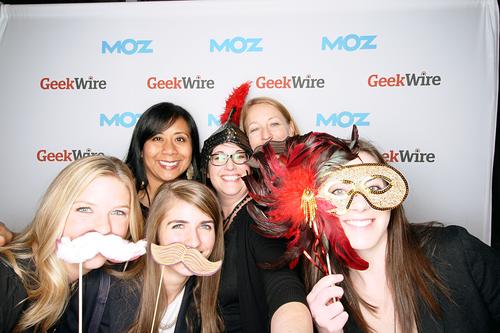
I recently attended the GeekWire Gala at the Museum of History and Industry (MOHAI) in South Lake Union. With more than 1,000 of Seattle’s tech industry professionals in attendance, GeekWire delivered an event to remember. From the amazing food to the lively DJ to the great conversation, there was no room for disappointment. As expected, the event kept up with the latest trends in technology, yet GeekWire still was able to add a personal touch.
With the recent success of car-sharing service Car2Go, GeekWire saw the perfect opportunity to partner with the innovative company for the event. To alleviate the anxiety of finding parking at this high- attendance event, Car2Go provided cars and easy drop-off locations. To create convenience for attendees, anyone who drove a Car2Go to the gala was offered VIP parking in the drop-off zone, which was very considerate given that winter has officially arrived.
After the hassle-free travel to the event, there was plenty by which to be entertained inside. My personal favorite was Mind Flex, a game that tested your brain waves against an opponent. After being assisted in placing a monitor on my temples and a clip on my earlobe, a battle ensued against my colleague, Sarah, to move a ball across a path toward the opposite side. Though I lost in this futuristic game, it provided entertainment and good laughs.
Also scattered throughout the venue were screens projecting a live Twitter feed. This allowed you to stay slightly connected with the masses of people by seeing pictures and reactions to the night’s events.
However, instead of allowing the Twitter feed to be dominated by people attending the event, GeekWire made it personal by responding to, what appears to be, every tweet. Looking at the outlet’s Twitter feed, it’s dominated by “thank yous” and “great photo.” Not only did they use technology to reach out to individual guests, but they also had GeekWire Chairman Jonathan Sposato at the front door introducing himself and welcoming guests as they arrived. As my first event of this magnitude, this aspect was comforting and a personal touch that I was not expecting.
The night overall was enjoyable and something I will look forward to next year. Technology can be perceived as cold and impersonal, but GeekWire was able to use it as tool to get personal as well as adding in some old school techniques. It seems they have found the perfect balance, and in a world often dominated by technology, a personal touch can go a long way.