
Insights for Leaders Navigating
Visibility, Credibility, and Growth.
From media strategy to reputation management, we explore the trends shaping public perception and share the approaches that drive measurable results for growing brands.
When training for a race, whether a 5K, half marathon or full marathon, you know how long the race is before you sign up and typically set a goal about finishing that will make you feel successful at the end. In the running world, we call it a “PR,” or personal record. As a runner, you set a training program to meet your desired goal and prepare for the race. You don’t just wake up one morning and decide to run a full marathon. This action of training and setting an expectation to ensure success is the same in public relations, the other “PR.”
During the beginning of a campaign, PR engagement or product launch, it is important to ensure that all parties are on the same page. To help guide you, consider the following tips:
- Build Consensus. Building consensus and shared expectations is key to a successful PR campaign. Success can mean different things to different people, so you want to make sure that everyone has the same vision. Additionally, setting expectations around roles, responsibilities and action items is crucial. This makes it clear who will own what.
- Consider Timing. As a best practice, set expectations around results and what success looks like in the planning phase. This will ensure that there are no surprises. As in running, you don’t want to prepare for a 5K, yet end up running a full marathon.
- Capture Expectations in Writing. Your specific communication method may vary based on the situation. But if you have a conversation on the phone, for example, it makes sense to send a recap of the conversation in email to have the expectations in writing if you need to refer back. In a fast-paced world, we are all juggling a lot of information, so it is helpful to have a record of commitments and deliverables.
As PR professionals, we all want to achieve success. But what we see as success may not be the same for our clients, so it is important to have the conversation early on to make sure everyone is working toward the same goal. Crossing the finish line is not enough.
Any tips you have for setting shared expectations?
I have a friend who, in college, used to play a game that involved the following: While driving, approach a red light at speed while bluffing to his passengers, “I’m not going to stop! I’m not going to stop!” In the nick of time we always stopped, of course, but each time it felt like we were just a bit closer to not stopping at all.
His game makes for a good metaphor about the political gamesmanship in Washington, D.C. this week—but rather than braking at the last second, our Congress blew through the red light and into a shutdown of the federal government.
“What we’ve got here,” I couldn’t help but think, “is a failure to communicate.” I’ve long believed that failures are really just learning opportunities—so, what can communications professionals learn?
Here are a few thoughts.
In politics, usually the loudest megaphone wins. That’s not always true outside of the Beltway. When it became clear that the federal government was headed for a shutdown, press releases from Capitol Hill began to fly, directing blame for the shutdown toward their colleagues, most trying to make their boss the loudest voice on the issue. This tactic may work in politics, but businesses with stakes far outside the D.C. echo chamber have different priorities. It can be challenging to get your message out in a crowded media environment, which makes it all the more critical to tailor your message to specific audiences and target the markets that have the greatest potential to help reach your business goals. A good public relations plan for your business should focus on reaching these key audiences and markets—not simply on being the “loudest” voice in the room.
In a crisis, look for ways to make advocates out of your customers. When I began my career as an intern in Washington, I was always on the lookout for a free lunch. During the shutdown, some D.C. businesses are providing just that. A popular hamburger joint on my old block is offering free burgers to furloughed government workers. A favorite D.C. haunt of mine, Kramerbooks Café, is offering happy hour prices all day (but notes that members of Congress pay double). A cold drink or a complimentary lunch might be just what furloughed workers need. These types of promotions give businesses a chance to show their human side and an opportunity to introduce themselves to new customers and fans. In situations like this one, find ways for your organization to connect with existing and new customers or clients. Even something as simple as messages posted on social media channels or a small promotion can turn customers into advocates for your business.
Never lose sight of what really matters in communications: people. There is a sense that folks in Washington, D.C. don’t spend a lot of time thinking about the impact of their actions on real people. In June, the polling organization Gallup asked Americans how much confidence they have in American institutions: 65 percent of respondents said they have “quite a lot” or a “great deal” of confidence in small businesses. On the other end of the spectrum, just 10 percent said the same about Congress. Do you think there’s a connection? Small businesses live and die by the satisfaction of their customers or clients. Beyond that, it’s crucial to maintain happy investors, partners and employees. When you’re brainstorming your next communications strategy, don’t forget that the audiences you are trying to reach are all made up of real people. Customers may not be driven by “moving the needle” for your business—but they will reward you if you put their wants and needs first. Employees, though, may be driven by the important role they play in helping your business succeed. Find what motivates your audiences and craft a communications plan that will connect with them.
Back up your message with action. Many people are, unsurprisingly, perturbed that members of Congress continue to take home salaries while so many federal workers are at home, furloughed. Some of the country’s biggest banks experienced a similar PR issue when the enormous salaries of executives were revealed in the midst of an economic crisis. The lesson? If your actions don’t match your words, your stakeholders are going to notice. It’s easy for a guy behind a desk in Seattle to criticize members of Congress for taking a salary—but a minor gesture can sometimes go a long way to repairing a damaged reputation.
Something tells me that Washington, D.C. will provide many more “learning opportunities” in the coming months and years. As communicators, we will no doubt stay tuned. For those of you in the Capitol, we hope you have a chance to take advantage of shutdown specials at some of D.C.’s local small businesses.
A little over two weeks ago my little sister, a student at University of Colorado at Boulder, sent me a link to a video of a river roaring through what is usually the calm creek near the campus. She then told me about the dramatic changes that had occurred to the city of Boulder due to the catastrophic flash floods. Streets were overflowing, buildings were being damaged and destroyed, and the aforementioned creek had turned into a dangerous rip-roaring river. The severity of this rain storm left the city with more rainfall in one week than is typically seen in two years. Due to the extreme circumstances, the citizens of Boulder were concerned for their health and safety. Citizens were left with critical questions: Is the water safe to drink? When will the power be back? Is it safe to drive outside today?

Looking for answers to their health and safety questions, a significant number of citizens turned to social media to get their updates. Facebook, for example, was taken over with pictures, videos and “facts” about the flash flooding. While Facebook, along with other forms of social media, may seem like a great way to find information on recent events, there are downsides. An article in PR Daily pointed out the complicated nature of deciphering what is true and what is false when there is an influx of information on your newsfeed.
Information on Facebook can spread rapidly, so how do you decipher a rumor from the truth? Finding a reliable source became essential during this hectic time. According to PR Daily, the Twitter feed of the city’s Office of Emergency Management posted about 500 tweets and retweets updating the city on important news surrounding the floods and citizen safety. Keeping citizens up to date helped put to rest any uneasy feelings surrounding rumors being spread on social media.
Citizens also found solace in other reliable updates that were given throughout the course of the storm. The National Weather Service sent text messages with updates about the floods and conditions of the area. The school district sent updates to students’ parents as well, informing them about school damages, closures and resources for help with their children during this time. Being well-informed was crucial for citizens. Not only did their health and safety depend on it, but also their emotional well-being. While social media can be a great outlet for up-to-date information, it is important to sort through what is fact and what is rumor before the anxiety that comes with the rumors consumes you.
For other information about social media refer to these posts on the Communiqué PR Blog:
Companies are almost always looking for new marketing trends and techniques to reach more consumers. The latest trend appears to be content marketing. Content marketing allows companies to connect with their audience making them more relatable. The problem with content marketing is, unlike traditional media campaigns that look mainly at sales, it is difficult to determine the success of a campaign. Everyone likes to see results, so how do you measure the impact of a content marketing campaign?
I recently came across an article on Ragan’s PR Daily that shared an infographic from BrandPoint revealing their recipe for measuring content marketing. There are three main categories: awareness, consideration and conversion. By achieving each step you are likely to see results. With each category there are different aspects to take into account to measure success. Below I have listed some of my favorite facts and tips.
Step 1: Awareness
The goal is to make your brand easy to find online. Some 93 percent of online experiences begin with a search engine, so check your ranking in search engine results. An increase will make your page, brand and product or service easier for consumers to find and prove the success of a campaign.
Step 2: Consideration
The goal is to inspire potential customers to engage with the brand. Roughly 65 percent of social media users learn about a product or service through their social media accounts. Take advantage of the many different platforms and create posts that will increase interaction. You want potential consumers to spend time viewing your page or posts.
Step 3: Conversion
The goal is to persuade the consumer to make a purchase. About 77 percent of B2C companies have acquired customers through Facebook. Keep track of social media referrals to note which is the most effective. Track which content sources contribute to the conversion step, and place more attention and focus on them.
View the full infographic below, and learn more about how to measure content marketing.
Infographic Courtesy of BrandPoint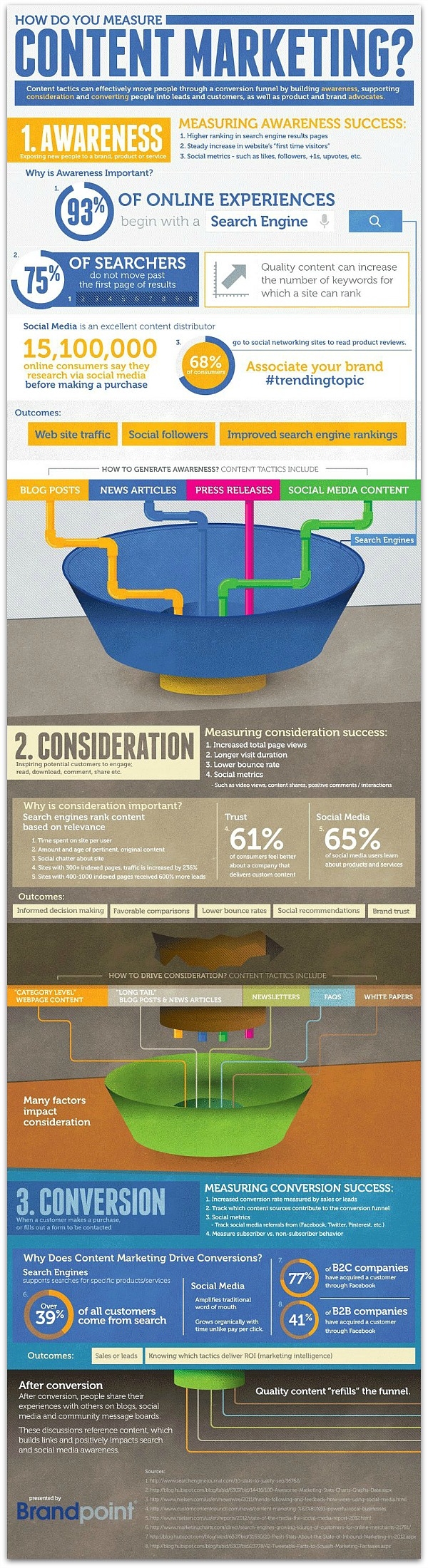
In our daily lives, we often worry about our reputation. Be well-liked and reap the benefits. Get a bad rep and never live it down.
In the professional world, a company’s reputation isn’t just a valuable asset—it’s everything it has. Unlike in the personal world, companies can’t afford (literally) to just “not care what other people think.” Appealing to consumers and maintaining positive customer relationships are at the heart of a company’s success. Blows to a company’s reputation often won’t just blow over as in daily life, but can negatively affect sales, morale and profits—or even ruin its image for good.
As PR professionals, we work hard to make sure that doesn’t happen to our clients. We know that reputation is often manageable; we correspond favorably with media, build excitement around clients’ announcements and get their name out there in a creative, appealing way. And, when crises do arise, we help clients’ face them strategically, with sensitivity and poise.
However, one often-overlooked—yet highly influential—aspect of a company’s larger reputation is its online reputation. With the advent of review sites like Yelp and the capability of Internet users to create and write whatever they please, search-engine content and online comments now contribute hugely to a company’s image. Negative reviews and unfavorable news at the top of search engines can hurt a company’s brand much more than many realize, making it valuable to monitor online content for successful reputation management.
As proof, a recent infographic from Digital Firefly, re-posted in a PR Daily article, released some startling new facts that address exactly why online reputation management is so crucial. We highly recommend you visit the whole article, but here are a couple important takeaways to consider:
- 83 percent of companies will face crises that will negatively impact their share price in the next five years.
- 70 percent of consumers consult review or ratings before purchasing products.
- 97 percent of users who made a purchase based on an online review found the review to be accurate.
- 51 percent of consumers use the Internet even before making a purchase in stores.
- Traffic to the top 10 review sites grew on average by 158 percent last year.
In the face of such statistics, the answer isn’t to panic, but rather to focus efforts on managing online reputation. Given appropriate attention, online image is as controllable as it is impactful. Our blog post, “Best Practices for Managing an Online Reputation,” offers some helpful strategies for putting your best foot forward online. And, if you need a little help along the way, feel free to reach out—we’d be happy to discuss reputation management strategy with you.
There’s no argument about it—content is currency in social media and in media in general. Companies have a wide variety of platforms through which they’re able to disperse content and create a “voice”—various social media platforms, bylined articles, contributed content and corporate blogs are a few examples. In order to be effective with this content, it’s important to be strategic from the start. This is why we often design editorial calendars (similar to those that publications create) for client content. PR Daily recently shared a piece on “13 tips for creating a killer editorial calendar” that is chock-full of helpful advice. Below are my favorite tips from PR Daily, with a few additions from my experience at Communiqué PR.
Tips from PR Daily:
Assign deadlines to key players. Even if you’re building out an editorial calendar a year in advance, develop a schedule with deadlines for each person involved. Figure out who is responsible for action items like writing, revising, posting and communicating with editors, and assign due dates for action items for each month. This will help hold the team accountable, and can be adjusted later on. It will also allow authors to integrate and prioritize creating content into their work schedule.
Determine targets. Think through what your target audiences are, and make sure that your content is being dispersed across different verticals you might be targeting. It can be easy to get caught up in one category or genre when building an editorial calendar, but ideally, you’ll have content that will resonate with each of your target audiences.
Share with stakeholders. Allow anyone that needs to agree on or contribute to an editorial calendar visibility into it. This creates shared expectations on timing, content and authorship, which is important to clarify at the beginning. To do this, consider an online collaboration tool like Smartsheet, which we use to manage all of our client work and highly recommend. A cloud-based tool allows you to update and access information in real time, which is especially helpful for an editorial calendar.
A few tips from Communiqué PR:
Consider timing. One of the main purposes of an editorial calendar is to be strategic about content. To do this, you’ll need to think about the timing of each post. Consider the events you have coming up, or events that happen year after year. For example, plan posts related to certain holidays, industry events, or trends that you know will happen on a yearly basis.
Switch between evergreen subject matter and newsier items. With a blog or column, you’ll want to leave some room for posts that tap into trend or news items—this content is often unpredictable. However, you’ll also want to schedule evergreen content that is relevant at any time of year. This will maintain equilibrium—it’s time consuming to constantly monitor the news for content ideas, but also important to maintaining quality content. You can strike a balance from the start by planning this into your editorial calendar.
If you haven’t considered an editorial calendar for your business’ blog, guest columns or other content creation, we highly recommend it. Planning not only takes some of the stress out of creating content, but also makes sure that you get the best results from the material you produce. And, if you need assistance with this planning, get in touch—we’d be happy to be a resource.