
Insights for Leaders Navigating
Visibility, Credibility, and Growth.
From media strategy to reputation management, we explore the trends shaping public perception and share the approaches that drive measurable results for growing brands.
Yesterday, in the midst of cramming for a midterm, my computer decided to freeze. Panicked, I ran through all the usual restart motions, but nothing seemed to work. I bolted down to the Apple store, stressing that my hours of work were gone due to this unexpected computer crash. As I walked into the busy store with no appointment, I braced myself for the long night of studying that was bound to follow due to this “crisis” and the large amount of people in the store. I was pleasantly surprised though when I was ushered to the Genius Bar after explaining my situation. The Apple employee ran a diagnostics test on my computer, located the problem, fixed it for the time being, and gave me the step-by-step instructions for how to fix my computer to avoid this problem in the future. What was even better was that this employee did all of this in a matter of 15 minutes. In this desperate time, I was reminded why I continue to buy Apple products.

After this experience, I got to thinking about customer service. We live in a customer-based world. It seems that no matter what business class I’m taking at school, whether it is advertising, finance, sales, etc., we are always being told that customer service is essential in the business world today. Customers are constantly looking at your product or service compared to your competitor’s, so why not save them the time of researching this and give them the added value they’re searching for. This competitive edge is easily attained by stepping up your customer service game.
PR Daily has some great tips for how to implement customer service within your own company.
First, additional training may be needed in customer service. It is important though that all employees set this as a priority. Customers will be confused (or you may even lose the customer) if all your employees are not providing the same level of service. The article points out a very important fact, “customer retention costs less than customer acquisition,” so put in that extra effort to keep your clients.
It is also important to encourage employees to resolve customer problems. Customers are more satisfied if they do not have to hunt down people higher up in the company to get their problems solved. Work with your employees to think of creative solutions to your customer’s problem. Clients will be much happier if solving their problem only takes one interaction with your company than many along the way.
Customers also value your company actually listening to them. Ask them questions about their experience and what you can do to improve upon it. Having an open dialogue is important, but actually acting on this feedback is what counts.
The final tip is looking at what other companies are doing. Even though a company may not be in your particular industry, you can still learn from their customer service programs. Some standout companies known for providing continual excellent customer service are Nordstrom, Amazon, Apple, Starbucks and Trader Joe’s. In summary, without your clients you don’t have a business. Keep them happy and you’ll keep their business and also attract more customers. Great customer service is always good PR for your company.
For other reads on customer service, refer to these posts on the Communiqué PR Blog:
After a Tesla Model S caught fire in early October, the company’s stock prices momentarily fell as the public became wary of the Tesla brand. Numerous blog posts and websites depicted the all-electric Model S engulfed in flames on a busy highway. The incident occurred after a piece of metal punctured the high-tech armor plating of the battery compartment. The event provided Tesla with a PR dilemma, but the company wisely addressed the incident head on, and eventually used the event to prove how safe the Model S truly is.
After independent testing by the National Highway Traffic Safety Administration, (NHTSA) the Model S was announced to be the safest car in history. But, the car fire led the public to believe otherwise. With the stock prices plummeting, Tesla needed to implement a PR strategy to drive the critics away. The information came from Tesla’s CEO Elon Musk. From Musk’s Twitter, he linked a blog post that he wrote on the company website. In the blog, Musk mentioned facts that revealed the true safety of the car. The company, still in its infancy (selling more than 2,250 Roadsters since 2008 and an initial order for 6,500 of the Model S in October of 2011) has logged millions of miles with limited incidents.
Musk posted in his blog about the fire ratio of his electric vehicle compared to the other standard gasoline-powered cars. Musk pointed out that, “One for every 100 million miles driven in a Tesla” has resulted in a fire, “while one gas-powered vehicle catches fire for every 20 million miles traveled.”
Due to the popularity of the Model S, and the growing popularity of the electric vehicle, the event was not about to go unnoticed. This car fire threatened to be a press nightmare. Although the news came with minor consequences to shareholders and the view of the company, the CEO used this press spotlight opportunity to prove how safe his cars truly are. Tesla even went one step further to underscore their great customer relations by providing the affected owner with a loaner Tesla.
Tesla turned a situation that had the potential to end very badly into an opportunity to sell their product even harder. The lesson here is to not be overwhelmed during such an event. It is vital to address the situation and the concerns the consumers might have head on. By staying true to their product, Tesla’s PR strategy avoided a potential company crisis.
If you’re anything like me, the last thing you want to do is to spend 15 minutes or more on the phone or engaged in correspondence with a customer service representative via instant message or email. Let’s face it, by the time we’re reaching out to them for assistance—especially when we rely on their service for something critical (like access to streaming video so we can unwind after a stressful day), we’re already frustrated that we couldn’t easily resolve the issue ourselves and need immediate satisfaction.
This is often when the tedious questions begin. You know the ones I’m talking about: when some unsuspecting customer service representative robotically asks exactly the same questions that you already answered via the automated system that directed your service call to the representative in the first place. It’s times like these that I often practice my deep breathing skills and try to harness a Zen-like state, so that I won’t accidentally say something (or many things) unkind that might ruin that person’s day. It’s not really their fault, right? They’re just the unfortunate soul who stands between me and the final episode of “The Walking Dead” season three, and they don’t understand that if I don’t watch it now, I won’t be ready to watch the first episode of season four with my friends this weekend! OK, just breathe deep for 10 seconds….
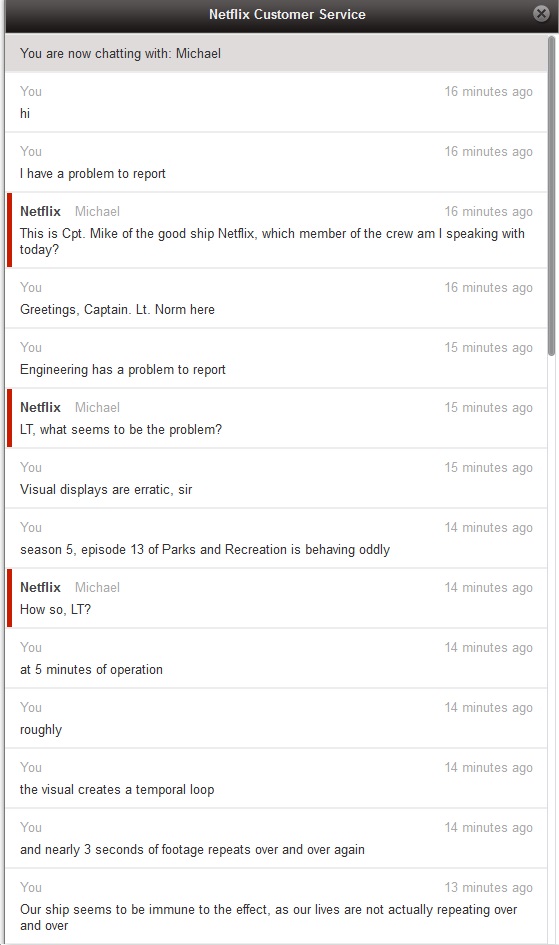
This week I was thrilled to read about a customer service representative who just may have gone where no man has gone before—and to his company’s benefit. It started very innocently, when Netflix customer “Norm” requested assistance via instant chat for an issue he was having when streaming an episode of “Parks and Recreation.” Rather than receiving a generic “How can I help you?” response, Norm received the following: “This is Capt. Mike of the good ship Netflix. Which member of the crew am I speaking with today?”
What? Did that customer service representative just respond as a character that was possibly inspired by “Star Trek?” He did indeed, and immediately, Norm was on board the good ship and happily participating in a 16-minute exchange as Lt. Norm, who has an engineering problem to report. By the end of the interaction, Lt. Norm was not only satisfied, but entertained, and so happy with the interchange that he told Capt. Mike that the chat “happens to be the best customer service experience I think I ever had.”
The good news for the good ship Netflix didn’t end there, however, as the entire conversation was featured in a Reddit post titled, “Best. Customer. Service. Exchange. Ever.” After that, the conversation went viral, it has been picked up by numerous media outlets and, according to Reddit comments, someone claiming to be a Netflix CSR stated that customers are now starting chats looking for help from Capt. Mike.
Other Reddit reader comments expressed the unfortunate truth that in today’s era of highly controlled and scripted customer service programs, many companies would fire or at least reprimand a CSR for bringing such levity to the situation. In this case, we are all fortunate that Netflix is not one of those companies and that they trust their CSRs to use their people skills to create a positive experience, rather than relying on a stale script.
Ensuring that excellent service is provided to customers is critical to a company’s customer retention and brand reputation. It’s rare that any of us take time to compliment a company for a job well done, but if we’re unhappy with a service we receive, you better believe we want to talk about it. According to Sprout Social, 74 percent of consumers rely on social networks to guide their purchases. So, in today’s socially-networked world, bad word-of-mouth can cripple a company’s reputation.
The good news is, a bad experience or customer complaint can be turned into a positive customer experience and, in some cases, can turn a formerly unhappy customer into an advocate for your brand. According to Social Media Today, 95 percent of unhappy customers will return to your business if an issue is resolved quickly and efficiently. Or, in Lt. Norm’s case, when the issue is resolved with humor.
Even if you don’t have a Capt. Mike in your customer service department, providing excellent customer service can be achieved in simple ways. Here are a few best practices to consider:
1. Acknowledge the problem promptly and whenever possible, in real-time. Today’s consumers are more connected than ever and expect swift responses. According to social media expert Jay Baer, 42 percent of consumers who complain about a company through social media channels expect a response within 60 minutes.
2. Demonstrate that you care about the consumer’s complaint—and mean it. Start by actually listening to customers and letting them know you are concerned about their issue. By doing so, you demonstrate interest in what they’re saying and if they feel you care about them, they’re more likely to care about you.
3. Do your best to resolve the issue and make it better, even if it’s not your fault. Maybe the customer is actually wrong. The product works, but they aren’t using it correctly. That’s not the point. Going above and beyond for a customer is an investment opportunity with potential to reach far more customers and improve your brand’s perception.
4. Follow up. It’s often the smallest gestures that have the biggest impact. Following up after a problem has been resolved is a great way to ensure the customer is satisfied and it gives you an opportunity to let them know that you hope to keep their business in the future.
For further customer service inspiration, and a reason to smile, I recommend reading the entire exchange between Capt. Mike and Lt. Norm, which can be found here.
Over the summer, while I worked at Communiqué full time, I would receive upwards of 40 emails a day, and I’m just an intern. Emails are one of the most commonly used forms of communication because we now live in a world where large amounts of information need to be shared in very little time. Everything from scheduling to pitching to advertising can be done through email. With a strong emphasis on technology and efficiency in today’s world, emails appear to be everyone’s favorite mode of communication. What does this mean for old-fashioned mediums of communication such as the telephone? Is it a device of the past that will soon be forgotten?
The Wall Street Journal recently published an article discussing phone use in the world of business. Millennials, typically defined as people born between 1981 and the early 2000s, are constantly texting, messaging or emailing. Offices seem to be quieter with the constant ring of the telephone replaced by the gentle tapping of a keyboard. Some would argue that speaking on the phone is disruptive and email is not only the preferred way to communicate but also the only way they choose to converse. Kevin Castle, a 32-year-old chief technology officer at Technossus, finds his phone so bothersome that he unplugs it and places it in the closet. Is the phone that inferior to email?
Personally, I do not share the same hatred for the phone that Kevin does. Though I regularly use email and find that it is beneficial in its own way, I do think the phone offers things that emails fail to. I have always enjoyed speaking to people on the phone because it is more personal, easier to convey your message, and is more efficient when you are on a deadline.
This summer I did my first set of call downs. We had pitched a story to a large number of journalists and I was asked to follow up with them a few days later. Though I was intimidated before I began, I found that most people were direct and honest about their interest or lack thereof in the pitch, allowing me to quickly decipher what the next step would be. During this process, I reached one journalist who expressed interest, but had never received the initial email. It turns out his email address had not been updated on the website. Had I not called, we would have missed an excellent opportunity for our client.
After this experience, I realized the importance of the phone. It is easy to get wrapped up in technology and forget that the phone, a dated mode of communication, is still an effective one. After staring at a computer screen for the majority of their day, most people appreciate the personal interaction that the phone provides. It allows you to build relationships and catch errors that technology will not. Obviously, there are situations in which email is the appropriate method to use, however, phone skills should continue to be developed and practiced because the phone is a valuable tool that should be relied on and not forgotten.
A little over a week ago, I wrote a blog post about the Boulder flash floods and the confusing nature of deciphering what is true and false on social media during this time of crisis. Gathering correct information was just one of the many issues citizens were faced with though. As the storm has subsided, residents are working to rebuild what the floods damaged and destroyed. Businesses around the area have now been presented with an interesting PR opportunity to lend a helping hand as the city works to rehabilitate itself.

During this hard time, companies are showing their empathy and dedication to their customers. According to The Denver Post, the American Red Cross and Save the Children are working together to assist the children who have been affected by the floods. The two have paired up to create child-friendly areas in the evacuation shelters. Ocean Prime, a local restaurant, is adding an appetizer to their menu that will donate sales to flood relief. Office Evolution, which provides virtual-office and executive suites, is helping with post-flood efforts by opening its business to entrepreneurs who are in a bind due to the flooding of highways and work buildings.
The list goes on. U.S. Bank will donate $50,000 to the American Red Cross and is also presenting customers using local ATMs the opportunity to donate to these efforts. Bellco Credit Union is even going so far as to help with loans or credit-card payments that are unable to be paid in full due to the recent events. Another impressive act of good faith is the generosity Gold’s Gym in Loveland is offering. They are allowing residents whose homes were damaged to use their showers, towels, toiletries and locker room facilities. Gold’s Gym is also helping to collect clothes to be donated to the Red Cross. If the list from The Denver Post isn’t convincing enough, the Boulder County Business Report details still more companies acting in good faith during this time. The affected citizens will remember these philanthropic acts, and even those not affected by the storm will remember the companies who came to the aid.
As seen with the varying examples, anything helps. Donating money may be the simplest path to choose, however, what I found most impressive during this time were those companies willing to offer a service. Among the many selfless efforts taking place, the ones I found to be the most touching include Gold’s Gym offering up their amenities and American Red Cross and Save the Children working to create child-friendly areas in evacuation shelters. While efforts to assist citizens during the floods were extremely important, companies’ efforts post-flood are just as crucial as the citizens’ work to rebuild their lives. I am interested to see how these socially responsible actions will pan out for these companies. I believe great PR will be a pleasant result and hope that these companies who came to the aid will get great coverage for their efforts.
Interested in aiding those who have been affected by the floods? Click here to see how you can help.
For another read on socially responsible companies see this Communique PR Blog post:
The rapid innovation of mobile and cloud technologies has forever changed the way PR pros work. With all of the productivity apps and capabilities available on my smartphone, sometimes I feel like my iPhone is permanently glued to my hand.
I’ve been contemplating upgrading to the new iPhone 5s, which started me thinking about some of the technologies I used to rely on to get my job done that have been displaced by newer, more powerful tools. Here are three that immediately came to mind:
Then: USB drive. Now: Dropbox.
I know people still use USB drives, but I can’t recall the last time I used one to save or transfer files from one device to another, or to share files with a client or colleague. Back in the day, I would never leave for a business trip without one or two USB drives in my laptop bag. The problem: document version control, maxed out capacity or worse yet, a lost or damaged drive. Now, I rely on Dropbox to store and access files when I’m on the road, or to share files (especially large graphics files) with a vendor or a client.
Then: Computer. Now: Smartphone or tablet.
OK, a smartphone or tablet may not dethrone a computer as my primary computing device anytime soon, but eMarketer estimates that in 2013 time spent on non-voice mobile activities will surpass time spent online on desktop and laptop computers. I know more and more people, especially those who travel a lot, who are abandoning their laptops for a Microsoft Surface Pro or an iPad with an external keyboard. Personally, when I’m away from the office, nine times out of 10, I find myself turning to my iPhone or iPad to check email, surf the Web, or access files rather than firing up my laptop.
Then: Spreadsheets. Now: Smartsheet.
When you need to corral and organize lots of data, such as a press list, most PR pros turn to the familiar interface of a spreadsheet. Since joining Communiqué PR, I’ve discovered Smartsheet, which is essentially a spreadsheet on steroids. Almost everything I used to do in Excel, I now do in Smartsheet. But, where Smartsheet leaves traditional spreadsheets behind are its collaboration features. Smartsheet makes it easy for me to share launch timelines with clients, track the progress of my team’s projects, and email specific line items to colleagues for further follow up. I can even attach files relevant to a project (documents, .JPGs, audio files, etc.) from my computer or from Dropbox. Plus, since Smartsheet is cloud-based, I can access my sheets from any device with an Internet connection. (Full disclosure: our firm represents Smartsheet, but prior to them coming on board as a client, we had long been a Smartsheet customer.)
Another technology that has the potential to shake up a PR pro’s usual routine is Quip, a word processing app built primarily for the mobile platform, but accessible from any device. Unlike a traditional word processing program, Quip allows you to collaborate on documents in real-time with others – no more emailing back and forth or issues with version control. I haven’t used Quip for work yet, but I can see how it has the potential to change the way PR pros create press releases, blog posts and other written documents, and collaborate with stakeholders. Imagine how much more streamlined the review and approval process on your next press release could be.
What are some of the tools and technologies that have gone by the wayside for you?