
Insights for Leaders Navigating
Visibility, Credibility, and Growth.
From media strategy to reputation management, we explore the trends shaping public perception and share the approaches that drive measurable results for growing brands.
The Communiqué PR team publishes new content on our blog several times a week. We strive to provide our readers with valuable information, analysis and tips relevant to today’s communicators and executives.
Given the amount of information we all receive daily, we recognize you may not read each and every blog post. So we thought it might be valuable to highlight the blog posts that were most popular among our readers based on the number of unique visits.
Below is a list of the most popular blog posts we published in Q1 2011.
How to Choose the Best Twitter Hashtag
Promotions on Facebook: What You Should Know
Public Relations, April Fools’ Day, and Fake News
In Social Media, It Pays to Know Your Audience
Our Business is Growing. We’re Hiring!
We welcome your feedback. Do you have a favorite blog post from Communiqué PR? Comment and tell us your favorite(s).
Launching a blog can seem like an overwhelming task. Getting started is half the battle. At Communiqué, we have helped several businesses and nonprofit organizations create, launch and manage their blogs.

For clients looking to launch a blog for the first time, we have developed a blogging toolkit that we customize for their particular needs. This toolkit assembles all the information that an organization will need to blog successfully.
Using our toolkit, we do the following:
- Identify your main objectives. In order to launch a successful blog, it is helpful to identify what you are trying to accomplish. You need to answer the question, “Why am I doing this?” Are you trying to change behavior, inform a key audience or entertain?
- Identify your key audiences. Ultimately, you want your blog to be read. Before creating the content, it is critical to identify who your readers will be and understand what motivates and/or resonates with them. Then, filter all content through the eyes of your audience by asking how it will be helpful to them.
- Name your blog. This step seems obvious, but selecting a memorable and meaningful blog name can help give your blog recognition. The name should be relevant and not misleading.
- Identify success measurements. You can determine the success of your blog in a variety of ways. Identify how you or your company will determine the success by measuring variables such as the duration of page stay, unique visits or increased site traffic. It is helpful to set achievable benchmarks on a quarterly or semi-annual basis to measure growth.
- Determine roles and responsibilities. Empower members of your team or company to help with the development of the blog content. This will help everyone feel included and ensure the blog can function consistently. This will alleviate pressure on one individual as team members take ownership in content development.
- Develop a publishing schedule. Your readers need to know what they can expect from your blog. The best way to achieve this is by committing to a schedule and delivering. If you can blog once a week, we’ll help you set up a process that will best accommodate this goal.
- Build a strong pipeline of content. We recommend you develop an editorial calendar and have a handful of blog posts ready for publication before you launch your blog. This will also help to ensure content is posted consistently and on time.
- Establish clear deadlines. Let contributors know when their blog posts are due for review. To ensure there is clarity about deadlines, we recommend scheduling calendar updates to provide reminders when draft posts are due to reviewers.
- Identify a process for managing comments. It will be important that you read comments and respond to them in a timely manner. We can help you think through the process for this.
As part of the blogging toolkit, Communiqué PR will also provide your team with ideas for search engine optimization, guidelines for developing content, a checklist for reviewers to use, and ideas for standard features that should be included when developing your sites.
If you’d like more information on the benefits of blogging, please check out the links below or give us a call. As you can tell from our site, we are passionate about blogging!
Launching a product or service is no easy feat, especially when you are entering a market that has been shaped by strong, established leaders and become saturated with other emerging players. How do you cut through the noise and differentiate your organization? How do you avoid becoming a “me too” scenario?
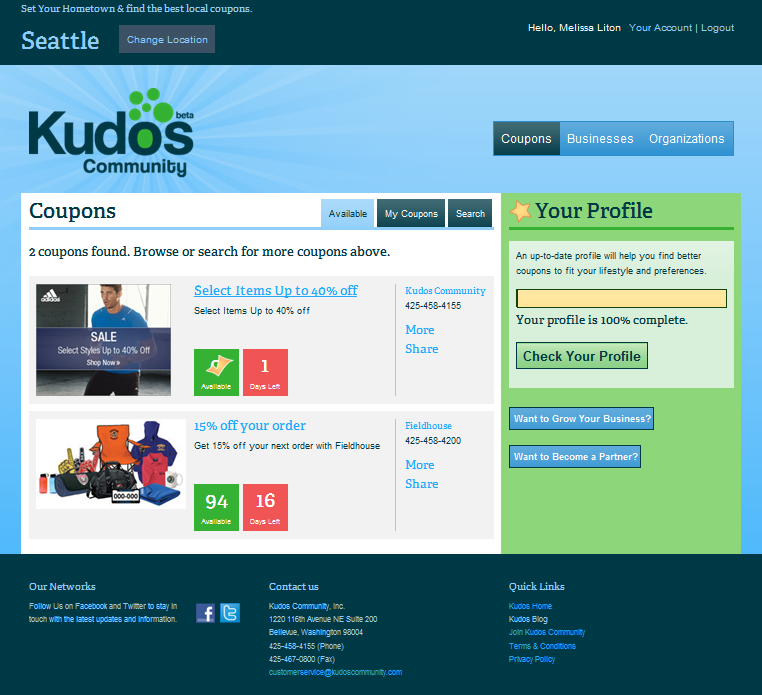
We were recently reminded of this challenge as we worked with new client Kudos Community to help promote the launch of its new online coupon platform that delivers risk-free, targeted coupons and offers to consumers to turn online engagement into real-world transactions for businesses. On March 29, 2011, Kudos Community debuted its website in the greater Seattle metro area and was well received by media and key industry analysts.
Nonetheless, we weren’t without stiff competition. Kudos is one of more than 400 daily deal sites currently available to consumers, a growth statistic reported by Entrepreneur magazine in a story entitled, “Which Daily Deal Site is Right for You?” In March 2011, Local Offer Network issued a report stating that the industry will “expand by 138 percent to $2.66B in 2011.” The report also stated that “deal sites are now in 80 markets across the country compared to just 48 in Q1 2010.” And when evaluating the competition at the local level, we learned of a number of competitors who are based in Seattle including Tippr, Daily Ticket and Ideal Network.
In order to cut through this noise, we took a strategic approach and developed an integrated PR campaign to capture the attention of industry analysts and media, with the following in mind:
- Key Messaging: Many of today’s group-buying platforms are simply not business or consumer friendly, nor do they provide a way for consumers or businesses to give back to their local charities or organizations. It was crucial that we developed messaging that clearly articulated the key differentiators of Kudos Community’s platform to businesses, consumers and nonprofits compared to other platforms available in the market. The messages we developed helped us to present a unified and consistent story to analysts and media in the weeks prior to launch as well as crafting the press release to formally introduce Kudos Community.
- Analyst Relations: Analysts are a critical audience to engage when building credibility for a new company or product. They influence customers, provide validation and endorsement to the media, and create visibility around the category in general. Kudos Community conducted several pre-briefings with prominent industry analysts at Aberdeen Group, Forrester and Gartner to begin fostering relationships and provide an early look at the platform and how the model differs from competitors. As a result, the company was able to secure two references from key analysts to provide commentary to media in support of our outreach efforts at launch.
- Embargoed Media Briefings: To secure editorial coverage that would appear the week of launch, Communiqué PR targeted journalists and bloggers at top news outlets who closely follow the emerging trend and ongoing news surrounding group-buying sites. Again, the key messaging we developed proved invaluable once again in our discussions with media, who often asked, “What makes Kudos Community different from other sites today?” or who felt as though media was saturated with news on similar group-buying sites.
- Official Press Release and Buddy Emails: On the day of launch, we sent a buddy email along with the official press release to all of the media we had originally contacted under embargo to draw attention to Kudos Community. We also extended our outreach to include media that covered niche vertical markets such as nonprofit and philanthropy, restaurant and retail outlets. This tactic helped to garner additional media interest in developing a news brief to accompany the press announcement.
Overall, the response our client received from media and analysts was positive. Because of our strategic planning, they were easily able to recognize the greater savings, flexibility and revenue potential Kudos Community offers businesses, consumers and nonprofits.
Thus far, Kudos Community has been featured in the following:
- MediaPost
- Daily Deal Media
- TechFlash
- Heybellevue.com
- Point of Sale
- FundRaising Success
- Asian Restaurant News
If you’re interested in learning more about Kudos Community or how PR can help effectively launch a new product, even in a noisy environment, send us an e-mail at [email protected].
Recently, a colleague of mine sent me an article from the New York Times that is an excellent read for anyone managing or leading people. The article entitled, “Google’s Quest to Build a Better Boss” highlights how Google analyzed and identified best practices for producing highly effective managers.
We thought we’d highlight the article here on our blog for those of you managing PR, social media or marketing teams. The article only takes a few moments to read, but contains some excellent reminders. I also highly encourage people to read the sidebar which includes “directives” Google produced for managers to employ as “good behaviors.”
Some of the reminders that were helpful to me included providing specific, constructive feedback, holding regular one-on-one meetings with teammates and coming up with a clear strategy and vision for the team.
We often use analogies to help our clients tell their stories. We find the more complicated the subject matter or the more novel the concept, the more helpful it can be to use an analogy to help people grasp your ideas.
An analogy is a similarity between like features of two things, on which a comparison may be based: For instance, one can see a similarity between the heart and a pump.
Here are a few other examples of analogies used to explain complicated subject matter:
- Example No. 1 “We are kind of like eHarmony, but for jobs,” Rob McGovern, founder, Jobfox. This statement was made during an interview with NPR and we found it to be helpful in immediately explaining what Jobfox does – matching folks to the right jobs. In addition to highlighting Jobfox’s value proposition, we found it to be memorable.
- Example No. 2 comes to us from an article on Ragan.com containing 10 tips for writing numbers and numerals. To explain the difference between the two, Michael Moser writes: “A number is an abstract concept, whereas a numeral is a symbol used to express that number. “Three,” “3″ and “III” are all symbols used to express the same number (or the concept of “threeness”). One could say that the difference between a number and its numeral is like the difference between a person and her name.”
- Example No. 3 comes from a quote in a Serials Solutions press release and compares the Summon™ service to Google: “What Google does for the Worldwide Web, the Summon service will do for libraries,” said Jane Burke, vice president, Serials Solutions. “It’s a transformation in library service that addresses our community’s most pressing need: a simple entry point to the vastness of library collections. One search box, one results screen, one path to the best, most credible content.”
So how does one come up with a good analogy? Here are a few tips that we often use to come up with the right comparisons:
- Get clear on the key attributes and the correlating benefits of your product or service.
- Brainstorm “like” scenarios with a small group of people, ideally no more than four or five. Ask everyone to fill in the blanks to this statement:
- Our service XYZ does ___________ and ________________ just like a ____________________ (person/company) does ________________ and __________________.
- Don’t criticize the ideas as people share them, as it will inhibit creativity. Instead, record them all so you can critically review them later. Once you have your top two or three analogies, you may want to socialize them with a couple of people who are not familiar with the subject matter to see if your analogies resonate with them.
- Remember you’re striving for a description that helps folks grasp your concept. It likely will not be an exact correlation to your product or service. This point is important if you’re brainstorming with folks who tend to take information literally, or who look for information to be presented in a tangible or concrete manner versus information that is more abstract.
- Finally, we recommend that you start paying attention in your reading for good examples of analogies.
Analogies can be a powerful way to bring your story to life, but they need to be relevant, clear and compelling.
Analysts are a critical audience. They influence customers, provide endorsement to the media, and help create visibility around the category. Developing an effective analyst relations program is often one of the cornerstones of our clients’ overall PR programs. However recently, there’s been a significant amount of consolidation in the analyst arena with large firms such as Forrester and Gartner acquiring second- and third-tier firms to expand research agendas and win new customers. This consolidation has left many PR and marketing professionals rushing to get their arms around this new landscape.

As I was working to get a sense of the current state of analyst relations for a presentation, I came across a couple of great resources which I thought would be helpful to share including:
- SageCircle – SageCircle “is an advisory resource that delivers AR strategic planning and tactical tools for vendors of high tech products and services.” In addition to its paid services, the company has a fantastic blog, which I read regularly to get a pulse on the analyst community. The blog covers a variety of topics surrounding both top- and second-tier firms including trend reports, social media, new hires, job openings, earnings announcements and more. This blog was incredibly helpful for a recent presentation I developed for a client surrounding analyst trends for 2011.
- Institute of Industry Analyst Relations – another excellent resource, Institute of Industry Analyst Relations (IIAR) blog covers topics useful for PR and marketing professionals including analyst trends, criteria for selecting a paid analyst relationship, consolidation, and event recaps. The IIAR is a “not-for-profit organization established to raise awareness of analyst relations and the value of industry analysts, promote best practice amongst analyst relations professionals, enhance communication between analyst firms and vendors, and offer opportunities for AR practitioners to network with their industry peers.”
In addition to these high-level industry blogs, most analyst firms have a corporate blog as well as a series of analyst blogs that cover trends and observations in a variety of industries. These can be valuable resources when looking to get a sense of a specific analyst’s perspective on a particular trend or topic.
Do you have a favorite analyst resource? We’d love to hear about it, drop us a line or leave a comment.