
Insights for Leaders Navigating
Visibility, Credibility, and Growth.
From media strategy to reputation management, we explore the trends shaping public perception and share the approaches that drive measurable results for growing brands.
According to a recent article by Games Beat’s Dean Takahashi, the PC gaming business is estimated to hit $20 billion by 2015. Consumers looking for a quick escape or several hours of entertainment are increasingly going online to find games in place of the traditional brick and mortar retail outlet. This trend has been key in feeding the growth of the downloadable games space.
Many of the games are created by indie game developers – think two guys (or gals) in a garage. Once the game is developed, they then work to secure the attention and interest of a game publisher that can distribute the game to consumers. However, there are a limited number of publishers positioned to distribute these indie titles to the masses, and getting on their radar can be challenging.
Melissa Heidrich, studio director for PassionFruit Games, garnered the attention of a publisher through distribution of a press release. Big Fish Games contacted the company after reading coverage of the announcement on Gamezebo and subsequently published the studio’s game.
As Francisco Santos Belmonte, founder of Tip Tap Games shared, “One of the biggest challenges we face as an indie game developer is finding ways to get our games in front of publishers. Indie developers simply don’t have the resources to invest in marketing to gain visibility with users and publishers. The ability to publish and share games via the Web without installs has the potential to completely transform the indie game development community.”
Lawrence Mascia, lead designer of Bewildebeest Games, explains how his team works to grab the attention of a publisher: “What we are doing now is creating a packet of information about the game and a CD of the demo and sending it around to different offices. The biggest challenge we’ve faced is getting people to actually look at what we have, let alone play what we’ve sent.”
Given the difficulty of getting eyes on their titles, game developers are eager to eliminate every possible barrier in the courting process. And now there is a solution that will make life much easier for game developers.
Spoon, a Communiqué client, recently launched the Indie Game Garage, a free service for indie game developers that provides a radically new and simple way to distribute games to publishers and consumers.
The Indie Game Garage lets users play full desktop games directly from the Web, with no installs or downloads. Once on Spoon, games can be shared directly on websites, blogs, and social networking services such as Facebook and Twitter. Potential publishers, bloggers, trade press, and users themselves can test indie titles instantly – without worrying about setup, uninstalls, or dependencies such as DirectX and .NET. And Spoon works with existing, unmodified games.
The Indie Game Garage is available now at http://spoon.net/indiegames.
Attention all tech fans and gadget geeks! We’ve been playing around with a semi-new (launched a year ago) technology site developed by former Engadget editors Peter Rojas and Ryan Block called gdgt (or gadget). gdgt is a social platform that enables users to connect with the community through gadgets, and connect with your gadgets through the community. According to its website, “gdgt is all about providing you with useful, contextual information – both from here and around the Web – to help you get more out of the products you already own, as well as help you discover that next great device to add to your collection.”

Here’s how it works. Users sign up for a free account and begin building their list of favorite gadgets. Once registered, you can connect with friends and other users, write reviews and start discussions about devices. Think of it as Facebook for gadget fans.
Gdgt is hosting a party and meet up on Tuesday, July 27 at the Showbox SoDo in Seattle and some of our team members will be in attendance. The event will feature gadgets and demos from vendors including Belkin, D-Link, Dragon Mobile Apps, HTC, Logitech, T-Mobile, Microsoft Zune and more.
In a recent interview with TechFlash, Rojas said, “The whole concept of the site was really about connecting people to gadgets and connecting people through gadgets, and we really wanted to create an event that brought that to life. The whole point of these events is to really give people who don’t get to go to CES and don’t get to go to press events a chance to actually play with this stuff. This is really for us a chance to democratize that whole experience.”
The event is free and open to the public. We hope to see you there!
To RSVP on Facebook, visit http://www.facebook.com/event.php?eid=135148676504452
Mistakes. We all make them. It is part of human nature. Sometimes it’s unavoidable and other times we just overlook something. Regardless of the mistake, it is how we respond afterwards that sets us apart from one another.
One of the most recently publicized mistakes comes from a company not known to make many mistakes. Apple Inc. released the highly anticipated iPhone 4 on June 24. As quick as the phones were flying off the shelves, reports started flooding blogs and news outlets about usability issues. The most glaring problem was the antenna being wrapped around the phone’s casing. When held in the left hand, the skin can bridge the gap between the two antennas causing signal loss and dropped calls. It has become a major problem for Apple with everyone buzzing about it including media, bloggers and the Twittersphere. Consumer Reports recently offered a fix for the problem by suggesting consumers cover the gap with a piece of duct tape. However, Apple has yet to acknowledge or address these reports.
The problem itself isn’t the issue I find interesting. It is how Apple has handled the response thus far. The company’s official response details that all phones can have antenna problems and it’s just the nature of cell phones. Apple then goes on to suggest that users either hold the phone differently or buy a case. They have yet to admit the iPhone 4 has an antenna problem. Instead they dance around the issue and offer remedies that force the consumer to spend more money to solve a problem that they didn’t cause. This type of response can often cause consumers to lose confidence and loyalty to a company, damaging the brand.
From a PR perspective, one of the most important things a company can do in the midst of a crisis is strategically evaluate the need to respond. We’ve written several posts about how to respond during a crisis and in the case of Apple, they’ve chosen not to directly address the situation. However, we recently learned that the company finally came forward this week and announced a press conference to be held at 10 a.m. PDT today to reportedly discuss the antenna issue.
We want to share a few tips on how to effectively address a problem or crisis.
- Acknowledgement. An organization first needs to decide how (if at all) they want to acknowledge that there is a problem. This can be determined by the scale of the problem or the amount of backlash from consumers. In your acknowledgement, it can often be helpful to apologize for any negative affects. This will notify the public that you identified there is a problem and are working on a fix.
- Don’t blame others. Take full responsibility for your actions and don’t point fingers. If there are others involved, encourage them to follow your lead. For example, when Google launched Google Buzz, people were upset that it made their e-mail contacts public. Instead of blaming the user, Google took full responsibility to fix their mistake.
- Fix-it. If you choose to publicly acknowledge the mistake, you must work on a way to resolve it and communicate that to your key audiences. You want to explain to the public the steps you are taking to fix the problem and when to expect a solution. This will help in reassuring the public and instilling confidence that a company is proactively working to solve the problem. In the Google Buzz case, Google issued multiple updates to make sure users knew of the privacy settings and how to use them.
- Move on. Don’t dwell on what is in the past. Instead look ahead to the future and learn from the mistake.
It will be interesting to see how Apple approaches the press conference. Either way, hopefully consumers will get some sort of fix for the antenna problem. While it’s unlikely that Apple will suffer any major damage to their brand given their stellar track record and goodwill they have established, it’s a good reminder for any organization to take the necessary steps of acknowledging a problem or mistake. This one act can go a long way to building consumer confidence and loyalty.
Next week, Communiqué PR’s Jennifer Gehrt (@JenGehrt) will be in New York presenting to Insight Venture Partners’ portfolio companies. Jennifer will be facilitating two sessions on using social media effectively and strategically.
Jennifer will share real-world examples and case studies to illustrate the impact social media can have for organizations. Additionally, Jennifer will outline best practices for building a presence on a variety of social media platforms.
Insight Venture Partners is one of the most active and fastest growing venture capital and private equity firms focused on the software and Internet verticals. Its portfolio companies include Twitter, Threadless, 6waves, HauteLook as well as a number of others.
The VC firm is hosting a one-day conference for the executives of its portfolio companies to share best practices and learn from industry experts. Jennifer is looking forward to sharing her experience on how both B2B and consumer facing companies can leverage social media to accomplish their business objectives.
I have to say I am a big fan of Charlene Li, co-author of “Groundswell” and founder of the Altimeter Group. Recently, she was named by Fortune Magazine as one of the smartest analysts in technology. However, it was an interview in The Strategist, which prompted me to order her latest book, “Open Leadership.”
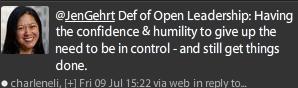
The premise of the book is about how leaders must let go of control to succeed. In theory, the concept of open leadership sounds good, but the thought of letting go of control can be frightening. In the article, Li points out that in the business world, many of us are taught that if we give up control work product will suffer, people will slack and business will suffer.
However, Li goes on to argue, “There’s a new reality: You’re actually not in control.” For me this is a very freeing perspective. It releases me from the responsibility of control and gives me more permission to be open, which frankly over the course of my career has not always been encouraged.
Clearly, leaders and managers still have to get things done; but Li asserts that this can happen by being “in command” and effectively working with people “who already have responsibility and power.”
It is a refreshing perspective and I look forward to learning more about how openness can impact the success of a business. In her book, Li also outlines the 10 ways people can be more open and how to measure success. I am certain there will be significant insight not only for me as a leader with Communiqué PR but also as I provide counsel to our clients.
For more information on the book, I would encourage you to read the full Strategist article. Li shares examples of open leadership, factors for success, and insight into whether open leadership is right for every organization.
Finally, if you have already read the book, I hope you’ll consider commenting below to share your thoughts on it.
Broadcast interviews can be an exciting and valuable opportunity for any business. These interviews provide a vehicle for an organization to establish themselves as thought leaders in an industry or on particular topic, provide a platform to deliver key messages to a broad audience, and put a face to an organization.
Broadcast interviews are very different from print interviews in that voice, engagement and looks can play as big of a role as content in how the public perceives the spokesperson and your company. We recently prepared two clients for on-camera interviews with national outlets Fox Business News and ABC World News. Earth Class Mail ‘s CEO Sarah Carr was sought after for perspective on the recent postage increase from USPS for ABC World News. Digonex’s CEO Jan Eglen spoke with Fox Business News about dynamic pricing’s role in the future of tickets.
Like any other interview it’s important to prepare accordingly, however given the nature of on-camera interviews, we want to share our approach for how we prepare clients for these opportunities.
The Content
- Try to secure the interview questions prior to the interview. It’s important to have a clear understanding of what the segment is about and the questions that will be asked so the spokesperson is armed with the appropriate information.
- If possible, take the time to watch some past interviews with the host/interviewer. This will provide insight into their interview style and can help play a role in how you develop your key messages and answers.
- Have a clear understanding of the top three messages you want to convey during the interview. Again, having the questions ahead of time will be helpful so that you can weave these key messages into the answers.
- Be prepared for unexpected or controversial questions. While you might not get these during an interview, it’s always good to be prepared to answer these. If you find the conversation going down a path that might be outside your areas of expertise, controversial or is a topic you don’t want to address, bridge back to those topics you are equipped to speak to and reinforce your organization’s messages.
- Conduct a mock interview. We can’t stress enough how important it is to practice. If you have time before the interview, it is beneficial to conduct a mock interview with your spokesperson. At the very least, encourage your spokesperson to practice answering the questions in front of a mirror or out loud as they’re driving to the interview.
Appearance and Engagement
- Be sure to wear neat and comfortable clothes. Bright and solid colors look best on camera, so avoid distracting patterns, stripes as well as white shirts as they don’t balance well on camera.
- Make sure that any facial hair is clean shaven or trimmed to avoid any shadows.
- Determine where the camera will be positioned and how the interview will be conducted. Will the reporter be on camera or off camera? Will there be one camera or multiple cameras? Is this a live satellite interview? This information will help determine where you should direct your attention during the interview.
- Engage with the host or interviewer. Thank them for having you on the show and/or use their name when answering questions. You want the interview to feel like a conversation between two people, not a static conversation.
- Limit the use of “talking with your hands.” Many people use body language and their hands to make points throughout a presentation or conversation. However, these can be distracting during an on-camera interview. Try to limit these to keep the focus on what is being said during the interview.
- Be sure to always smile, it evokes a warm and welcoming feel.
The more you can prepare your spokesperson for an on-camera interview the more likely the interview will be a success. For more information on how to prepare for broadcast interviews send us an e-mail at [email protected].