
Insights for Leaders Navigating
Visibility, Credibility, and Growth.
From media strategy to reputation management, we explore the trends shaping public perception and share the approaches that drive measurable results for growing brands.
At Communiqué PR we do a lot of writing. We write press releases, case studies, company messaging and contributed articles. In fact, during the past several months we have written articles for clients that have been published in more than 20 industry or business magazines or daily newspapers. (Please e-mail me if you’re interested in a summary of articles and publications written by Communiqué PR.)
Nonetheless, we are consistently striving to improve our skills and style. We also understand with social media, attention spans are getting shorter so it is imperative that we grab the reader’s attention early on so they continue reading and are interested to know where our story is headed.
Given this commitment to continuous improvement, we were excited when Jeanne Miller with Tecplot Inc., shared an article about the Blundell Technique. For those of you who aren’t familiar, William E. Blundell came up with a technique for feature writing while he was with the Wall Street Journal and detailed it in a book entitled, “The Art and Craft of Feature Writing.”
Among other things, this book explains how and where to get story ideas; what readers like and don’t like; how to infuse articles with energy and color; and how to organize one’s material. We encourage anyone striving to perfect his or her non-fiction writing to pick up a copy of this book.
Jeanne, who is an amazing writer, also provided us with an overview the Blundell Technique which suggests writers organize feature articles as follows:
- The story lead or introduction. The opening of a feature article should tease the reader and spark his or her interest in the topic. The introduction may or may not be an anecdote. If it is an anecdote it needs to be easy to grasp and relevant. Typically, the story lead is no more than three paragraphs long.
- A Nut Graph or angle for your story. This is the paragraph that explains the story focus, theme or point of view. Clearly this is a critical element to writing and organizing a well-written and compelling piece.
- The main body or supporting points. This section of your article backs up the Nut graph. These are the paragraphs that demonstrate the validity of your angle, premise or argument. Oftentimes, quotes are used here to bring the material to life and illustrate key points.
- The conclusion. This should summarize the material and make an impact on the reader. There are many ways to do this, but the main goal of the conclusion should be to reinforce the central message or theme of your article.
We hope as you embark on the development of your next article that intends to inform, educate or entertain your reader, you take a few minutes to think about Blundell’s Technique. We believe it is more relevant than ever and want to thank Jeanne for reminding us about Blundell’s impact on journalists and writers around the world.
Last month, I read a blog post that really resonated with me about the difference between being liked and being valued. As the author of the post states, clearly the two are not mutually exclusive, but must be prioritized.
The author explains in his post, “When you focus on being valued first and liked second, you’re far more likely to take on the behaviors to create demand.” He goes on to state, “Being valued means risking, even for a few moments, not being liked.”
I have worked with individuals who focus too much on being liked and forget to provide value or are hesitant to disagree even if their counsel is well founded.
While it is important to be liked, and good chemistry and rapport can impact a client’s hiring decision, as a PR professional I focus on providing value for our clients, but strive to do so in a manner that enhances our relationship. Ultimately, this means I help clients accomplish their business objectives through integrated strategic communication in a manner that is fun, affirming and win-win.
Since being valued is so important, it is critical that we have a good understanding of what our clients want to achieve. This means getting a sense for the client’s long-term business and communication objectives as well as his or her willingness to take a strategic approach to PR.
Recently, we received a phone call from a person who wants to work with a boutique firm that can create an ongoing narrative for his company. He is not just looking for the one-off media placements, but is interested in taking a strategic, integrated approach to utilizing PR to help achieve his company’s business objectives. We are very excited about working with him because we know he’ll value the services we provide. We also know we can make a meaningful and positive impact on his business.
He, like many of our clients, is looking to build brand awareness, shift perceptions and establish thought leadership – and he understands this will not be achieved through one piece of coverage. He therefore appreciates the value we can add around helping him achieve success.
Consider Tegic Communications and its PR activities from 1997 through its sale to AOL in 1999. The company took a strategic approach to building awareness, securing mentions in buying guides and as part of handset reviews, stories discussing trends and growth of text messaging, in-person meetings, and did not focus solely on big one-off stories.
Through its ongoing PR activities, Tegic got the attention of AOL, who bought Tegic for $350 million. An AOL executive later shared that his team calculated they paid an extra $50 million for Tegic due to the buzz about the company. An additional $50 million in two years – that demonstrates value. (Excerpted from “Strategic Public Relations.”)
People hire us because we are likeable and easy to work with, but also because of the value we bring and the results we deliver as they work to achieve tough business and communication objectives. What is your point of view? Do you think it is more important to be valued or liked?
Many people believe 2010 is the year of the mobile app. A recent report from analyst firm, Gartner states consumers will spend $6.2 billion in 2010 in mobile application stores. The increasing penetration of smartphones, coupled with the recent release of the Apple iPad is fueling additional buzz around mobile apps.
It is interesting to note that, according to Gartner, free downloads will account for 82 percent of all downloads in 2010. Clearly, for most companies, they are not necessarily deploying mobile apps to generate revenue, some are instead using free apps to engage with mobile consumers and drive sales of other products or services.
eMarketer recently reported 64.8 percent of marketers and publishers said they’re planning to invest in mobile apps this year, according to a December 2009 survey conducted by DM2PRO and Quattro Wireless. Given consumers’ increased dependence and interaction via their smartphones, companies are finding the handset is an important part of their marketing and engagement strategy.
For a large company with excellent brand recognition such as Starbucks, developing a mobile application may be a profitable way to secure a presence on consumers’ handset while offering them timely and valued information such as promotions and coupons. But what about the small to mid-size business, does it make sense to develop a mobile app in an effort to secure prize placement on your customer’s handset?
As Wall Street Journal’s Riva Richmond highlighted in her December 2009 article, it really depends on the business and its objectives. For instance, a company needs to be clear on whether the goal is to attract new customers or engage with existing ones. “In general, businesses that rely on repeat customers, like restaurants and retailers, or have intense interaction with clients for some period of time, like real-estate brokers and car dealers, are the most likely to benefit from an app, said Greg Sterling, a senior analyst at Opus Research Inc.”
If you believe a mobile app is right for increasing loyalty and driving engagement for your business, here are some things to consider:
Understand Your Objective – Develop a plan outlining the business goals you are looking to accomplish and how a mobile application helps achieve those objectives. How will you measure or track success? How does the mobile app add value to your customers? How does your mobile app strategy integrate with other activities and initiatives you are executing?
Identify Available Resources – Understand what resources are available to create the mobile application. For most small businesses this involves securing budget to either hire a mobile app development firm or use one of the new DIY mobile app creation services, such as BuildAnApp (Disclosure: This is a solution developed by MobileOn, a Communiqué PR client).
Consider Going Cross-Platform – Know what platforms your customers are using and be sure to provide the application on those devices (e.g. Android, iPhone, BlackBerry, Windows Mobile). You do not want to isolate customers or create a second class of customers by providing an app for only one smartphone platform.
Keep Content Fresh – Give your customers a reason to use the mobile app on a regular basis. This may mean new coupons, compelling promotions or updated tips and tricks. Similar to a Facebook fan page, keeping content fresh will drive engagement and encourage your customers to spread the word about your app and your business.
As small and medium businesses weigh the pros and cons of deploying a mobile app to meaningfully engage with customers, keeping the above criteria in mind will help ensure any mobile app you build is a successful tool to help increase customer loyalty.
With the ascent of online news sources and the advent of social media, news is becoming portable, personalized and participatory. Now more than ever, people are accessing multiple media platforms to get their news.
Recent findings from the Pew Research Center prove that “The overwhelming majority of Americans (92%) use multiple platforms to get news on a typical day, including national TV, local TV, the Internet, local newspapers, radio and national newspapers.”
The Internet is now the second most popular medium to get the news, behind local and national TV. In addition to turning to the Internet, studies show that “One quarter (26%) of all Americans say they get some form of news via cell phone,” and this news is coming in a variety of forms consisting of social networking sites such as Twitter and Facebook, blogs and e-mails.
For some, staying current on the news has provided a way to be socially active. The Pew study found that “Some 72 percent of American news consumers say they follow the news because they enjoy talking with others about what is happening in the world and 69 percent say keeping up with the news is a social or civic obligation.”
Lastly, the Internet allows people to access the news in a much more personal format than other news platforms. Readers can customize their homepage to contain articles from favorite sites or about favorite topics. According to the Pew Research findings 40 percent of Internet users said “an important feature of a news Web site to them is the ability to customize the news they get from the site.”
Furthermore, the ability to communicate to large social networks from smartphones and laptops is creating a citizen journalist culture where anyone can capture, share and report on events and news in real time. Just think back to when US Airways flight 1549 made an emergency landing on the Hudson River. The first reports of this accident came in from Twitter.
For more information and status around the consumption of news, I would encourage you to read the full study. As PR professionals, we found the findings to be quite interesting and informative as we continue to think about the most effective ways to reach consumers and business decision makers alike.
Finally, we’d love to hear from you on the number of ways you access news today. Do you get your news from four to six different platforms? If so, which ones?
The other morning I had the opportunity to catch up with my former manager and mentor Brad Stevens. At the end of 2009, Brad left Starbucks after seven years with the company where he served as vice president of U.S. Marketing and their first head of Customer Relationship Management, to join Mud Bay, a provider of healthy food, supplements, and supplies for dogs and cats.
I was excited to talk with Brad about his role as Executive Vice President of Stores and Sales for Mud Bay and to learn more about Mud Bay’s marketing activities. As EVP of Stores and Sales, Brad oversees four areas: store operations, marketing, category education and research.
Brad explained one of the reasons he is excited about joining Mud Bay, which operates 17 stores in the greater Puget Sound area, surrounds the powerful emotional connections people have with their pets and the specialty store’s commitment to helping dogs and cats lead long healthy lives.
“There is a growing awareness and appreciation for the importance of a healthy and nutritious diet for dogs and cats,” says Brad. “Oftentimes, common issues like hair balls in cats or itchy skin patches on dogs can be linked back to what they are eating. We have many examples of a customer consulting with our in-store specialists and altering a pet’s diet, and within a week or two, the animal is feeling better.”
According to Brad, experts’ understanding of the dietary needs of animals has really progressed over the years. “As a result, there is now an amazing array of nutritional formulas available for specific breeds. This is good because the nutritional needs of a tiny Chihuahua versus a Great Dane are significantly different.”
In terms of marketing, Mud Bay relies heavily on word of mouth. The retailer has a loyal group of customers who often refer friends and family to the store. One such customer is Jackie Barry, who has a 9-year-old Lynx Point cat, named Sushe, and has been shopping at Mud Bay for about 15 years.

Barry started out buying just cat toys and luxury pet items, but now purchases all of Sushe’s food and cat litter at Mud Bay. “Sushe was a very picky eater,” explains Barry. “I went to Mud Bay because the store provides descriptions of the different brands of cat food along with information about why some breeds of cats respond better to different ingredients.”
The people at Mud Bay gave Barry five or six little samples of food to try on Sushe. Barry continues, “I was able to find one that he loves. I trust the products I buy at Mud Bay. Finally, I have to say the people who work at Mud Bay also seem more engaged in serving their customers than people who work in the big box stores.”

In addition to relying on word-of-mouth marketing to drive business, the retailer also has a fan page on Facebook (www.facebook.com/mudbay/) and has strong relationships with veterinarians and other experts to generate awareness and drive demand for its products.
Brad’s new position sounds like a lot of fun. Clearly, the company is poised for continued success because it offers high-quality products, it employs informed and passionate people in their stores (and on the management team), and the category is growing as consumers become more aware of the link between healthy food and their pet’s health. It will be fun to watch the evolution of this business.
If you have a perspective on Mud Bay, I would love to hear from you!
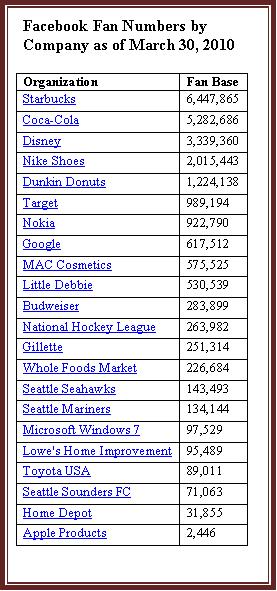
We recently did some research to identify companies with more than 250,000 Facebook fans. The results were interesting. Some brand name companies (or organizations) fell significantly short of our expectations – while others have significantly more than 250,000 fans.
While we know fans will come and go, we thought it would be fun to compile a list of some of the top brand name companies, including some Seattle-based organizations, to create a snapshot of their Facebook fan numbers.
In addition to gathering data on current fan base numbers, we also reached out to a couple of these organizations to learn more about how they grew their Facebook fan bases.
Mariesa Stokes, account executive at Mckee Foods, the parent company for Little Debbie, explains the Little Debbie Facebook page went from 5,414 fans to 269,994 fans between October 3 and 10, 2009. “To drive this growth, the company took an integrated approach to marketing. It worked to drive Little Debbie lovers to the Facebook fan page though national advertising, PR, couponing, social media and consumer giveaways all at the same time – and it was overwhelmingly successful.”
Erica Berkovich, a communications coordinator with the National Hockey League, adds “Within the last six months we grew from zero to more than 260,000 fans after launching our Facebook page in Sept. 2009. To fuel this growth, we cross-promoted our page with all of our NHL Media Platforms, including NHL.com, NHL Radio, NHL Team Websites, NHL mobile as well as other social platforms.” She adds they are now considering what resources can be brought to increase the audience farther and faster.
We at Communiqué PR recently completed a campaign for a company where we helped it grow its Fan base by 219.2 percent in just 14 days.
As you consider the growth and management of your Facebook fan page, we hope you find this information to be helpful. Clearly, there is no silver bullet for growth; but it appears as if the key to success is pursuing an integrated approach and leveraging a variety of mediums to raise awareness of your page.