
Insights for Leaders Navigating
Visibility, Credibility, and Growth.
From media strategy to reputation management, we explore the trends shaping public perception and share the approaches that drive measurable results for growing brands.
Have you ever wondered how your company or nonprofit organization is perceived by the broader community? Or maybe you simply want to measure awareness of a particular feature on your new widget before you promote it in your next PR campaign?
These are questions many of our clients ask as they work to make informed decisions about their business and communication strategies. For instance, imagine you have a software solution like PDFill that allows people to more easily and conveniently edit PDFs.
As the vice president of marketing, you are chartered with driving downloads of this software. As you work to create the right awareness, you’re interested in knowing how many people are aware of your product and what they think about its usability.
You decide you want to conduct a perception audit. The trouble is you have limited dollars for this research and cannot afford to hire a prestigious firm to do the work for you…. Well we have some good news to share with you.
A business associate of ours has taken a very innovative approach to market research. He uses Zoomerang to create his surveys and then finds people to take them using Amazon Mechanical Turk (mTurk). For those of you who don’t know, mTurk is a marketplace where workers (people) are waiting to do small, simple tasks on the Web. And, for a small fee, these workers are eager to complete surveys.
Here’s how it works. Each time our associate has a survey he needs completed by a group of people, he submits what is called a hit. Each hit has a tagline, a description of the work that needs to be done, the number of workers needed and the fee to be paid to each worker. Typically, for a survey containing 15 questions, our colleague pays each person $.11 to $.25 for his/her work.
Once the hit is published, workers accept the hit and begin work on their assignment. When the work is complete, they submit for approval. For surveys, our colleague uses a complete code that appears at the end of the survey to verify that the worker has completed the hit.
With this process, our business associate has been able to glean all types of information from all over the country. For a survey completed by 700 people at $.25 per response, he paid just $175.
Clearly, this type of data gathering is not right for everyone (especially if you need a very select demographic to participate), but we thought this was a fabulous idea and look forward to trying it out in the future.
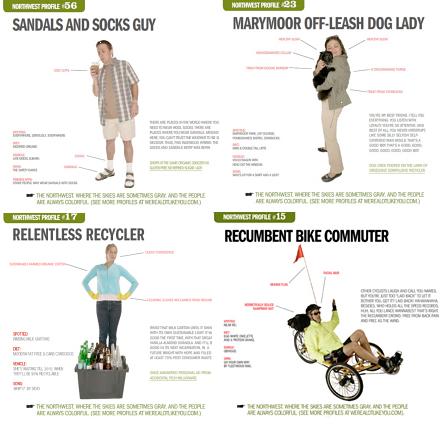
If you live in the Northwest, you probably have seen PEMCO Insurance’s innovative marketing “We’re a Lot Like You” campaign. Maybe you even have a favorite profile, such as socks and sandals guy, the recumbent bike computer, relentless recycler or the Marymoor off-leash dog lady. Have you ever wondered about the history of this campaign?

This week I had the opportunity to hear Rod Brooks, CMO with PEMCO, speak at the Puget Sound American Marketing Association Luncheon. His presentation was terrific because it clearly demonstrated the importance of knowing your customer and positioning. It was also fun to hear Rod talk about how the campaign has been extended from traditional ads to outdoor advertising, social media, PR and more. It is another fabulous example of the power of integrated marketing communications.
Anyway, I selfishly wanted to make sure I captured some of the salient points of Rod’s presentation so I decided to blog about it. Here are some of the highlights:
Before creating its campaign, the insurance company did significant market research. They made their first use of “ethnographic research” and sent folks (trained researchers) out to the homes of customers and potential customers to glean information, study their environments and generally find out what was on their minds. Here is what was learned:
- People in the NW are fiercely independent;
- We are leaders in innovation – Rod joked that in the eyes of our NW neighbors, anything invented that is GOOD probably came from the NW;
- We’re proud – This is evidenced from the above bullet;
- We’re incredibly green – And act as if we invented composting and the whole idea of recycling; and
- We love Main Street. Local trumps large; personal trumps price. Rod explained people in the northwest like to go to our local pet store, even if it costs a bit more than a big chain pet store down the road.
The goal was to connect core Northwest values to PEMCO. PEMCO wanted to own the local market. After all, from a brand positioning perspective, this was a message that the large, national insurance companies would not be able to own. This was important to the overall brand strategy as PEMCO is a challenger brand, which means PEMCO competes with the big boys (and girls) who are all national players and have far greater resources.
As a challenger, Rod explains that PEMCO lacks economies of scale. The company must have well-defined strategies; be highly creative, innovative, resourceful and nimble; and be willing to challenge the establishment – starting with the internal sacred cows that graze inside the organization. Finally, relevant to all of us, PEMCO must capitalize on word of mouth from loyal customers and advocates.
Rod also explained that PEMCO’s overarching business objective is to “sustain profitable growth” and consistently deliver a “world class customer experience” at every touch point. He said that “a perfect storm or convergence of internal forces” has come together at the right time and place to make this goal a reality. They include: 1) The marketing BHAG: to never have to pay for a lead again (they want to grow through referrals); 2) The PEMCO culture: to foster a culture where the company leads with its relationships; and finally, 3) Commitment to hearing and responding to the voice of the customer: to stand in the customers’ shoes each and every time a strategic decision is made. These certainly are lofty goals, but it was important that the campaign helped PEMCO move toward these goals.
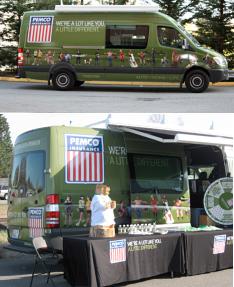
In closing, Rod shared how the campaign has been extended from traditional ads to banners on buses, social media and even the WALLY van (a clever acronym for We Are A Lot Like You). The WALLY van provides PEMCO with the opportunity to stay connected with the community by travelling to events around our state. To view Rod’s presentation titled, “Word of Mouth Marketing: Blending Online and Offline Approaches,” click here.
All in all, it was a fabulous presentation. Rod is an inspiration and it was valuable to learn more about the strategies and tactics of this successful brand strategy.

We are happy to announce the release of “Discover Cooking with Lavender,” a cookbook written by Seattle-based author Kathy Gehrt. This book takes readers on a culinary adventure into the world of lavender and features 75 unique recipes spanning seasonings, drinks, savory dishes and sweets.

“Discover Cooking with Lavender” is ideal for seasoned chefs, foodies, and novice cooks, as well as lavender and gardening enthusiasts. It offers readers tips on how to incorporate this exotic herb into simple, fresh and flavorful recipes.
Promoting a book is a huge undertaking. We developed a three-pronged strategy to help Kathy Gehrt and Florentia Press create buzz and drive sales of “Discover Cooking Lavender.” The first is to drive reviews of the book with influential foodie bloggers. Bloggers can often be the “early adopters” for book reviews and other information because they are so passionate about the subject and want to share information with their audience. To date, we’ve secured commitments to review the book from six influential food bloggers.
Second, we developed a press release and sent it to traditional media (both local and national) covering food and gardening to seed feature stories about how to incorporate lavender into everyday cooking. We are currently working with local media to place feature stories on cooking with lavender for publication this spring and summer.
The third strategy is to secure speaking engagements for Kathy to share her passion and tips in- person through in-store author events, book signings and speaking opportunities.
While the book just launched yesterday, below are some early reviews of “Discover Cooking with Lavender;”
To learn more about “Discover Cooking with Lavender” or to purchase a copy of the cookbook, visit Amazon.com or DiscoverLavender.com. You also will be able to find this book in select Made in Washington stores.
As we wrap up a project for Aveso Displays, we want to summarize the results we secured for the company.
Aveso Displays is a developer of printed electronic displays for the credit and security card industry. The company’s solution can be used for one time password (OTP) technology among other things. As you may know, OTP technology is often utilized by large enterprise companies or financial institutions to prevent fraud. To embed OTP on a credit card, manufacturers need flexible display modules which can withstand the hot lamination process used to produce bank cards.
To raise awareness for Aveso, we focused on securing briefings with influential industry analysts and placing contributed articles to position the company as a thought leader in the electronic display market
Specifically, over the course of a three-month project for the company, we secured nine conference calls with top-tier industry analysts at Gartner, Forrester, Frost & Sullivan, IDC, and other leading firms.
These briefings enabled Aveso to establish relationships with key industry analysts following the banking and security industries and gauge their perspective on Aveso’s technology and how it impacts relevant industry trends.
We also placed and wrote three contributed articles in the following publications:
- Electronic Design, “Flexible Display Modules Offer New OTP Options” – October 1, 2009
- ECN Magazine, “Printed Displays Offer New World of Design Opportunities” – February 10, 2010
- Bank Systems & Technology, “Fraud and ID Theft: Are One-Time Password Bank Cards the Answer?” – Feb. 17, 2010
In these articles, Aveso provides insight on how flexible display technology can help increase security and provide new design opportunities for a range of companies.
It was a sincere pleasure working with Aveso Displays as well as the analysts and journalists who expressed interest in understanding how flexible display solutions can be used in products – such as OTP credit cards – to protect banks and consumers from fraud.
We hope to have the opportunity to build on this experience by taking on another PR project for Aveso Displays or other companies working on technology to prevent the illegal access of personal information.
I serve on the Board of Trustees for Villa Academy, a private independent school in Seattle educating children in kindergarten through the eighth grade. In the past several months, I have been thinking about how Facebook could be used by Villa and other elementary and middle schools to help them achieve their top objectives.
I began brainstorming by reviewing a New York Times article that highlighted how small businesses are using Facebook. After all, if small businesses are benefiting from social media, why can’t schools?
As I pondered this, I came up with a list of reasons schools should have a presence on Facebook. I also conducted some research to see how other schools are using Facebook and Twitter. Here are my conclusions.
Facebook provides schools with a powerful opportunity to achieve the following:
1) Communicate about school activities. Facebook can be used to publicize information about school events / performances or highlight the progress of particular classes.
2) Build community and school spirit. Social media is an excellent vehicle for community building as it allows people to engage with other parents, administrators and alumni.
3) Motivate people to donate time and money to the school. School’s can leverage Facebook to make appeals for support.
4) Support school admission goals and publicize open houses. As schools look to expand awareness of the breadth and depth of academic programs, Facebook can be another resource for them to showcase information.
5) Stay connected with alumni. Many alumni are interested in the happenings of their schools. By creating a Facebook page, there is an opportunity to stay engaged with former students and employees of the school.
6) Stay current on how technology is changing the way we communicate and collaborate. After all, teaching the Facebook generation is going to require some firsthand experience of the 21st century tools they use.
7) Monitor what is being said about the school. Social media is an excellent way to gain feedback from key constituents and get a sense of the general sentiment of an educational institution.
Consider Denver Academy, which is a private school focused on educating children in first through 12th grades with learning differences. Administrators of the school are using both Facebook and Twitter – in addition to its Web site updates and e-newsletters – to inform its community of the latest news and events.
According to Bridget O’Toole, PR and communications coordinator at the school, the use of social media has been well received by parents and students alike. “We have received a lot of positive feedback about our use of Twitter and Facebook. Parents, alumni and prospective families all enjoy visiting our Facebook Fan Page as it provides them with a way to learn more about our community and school activities. It is an easy and hassle free way for us to share information about school activities and build awareness of our unique academic programs.”
While Facebook provides many organizations with tremendous opportunity, it is not without its risks and challenges. For instance, Facebook has a policy that children under the age of 13 are prohibited from having accounts, but it does little to enforce the policy. So what is a school administrator to do when a child under 13 wants to become a friend?
To provide more control over comments and content posted, as well as to avoid dealing with the underage “friending” issue, Denver Academy uses a Facebook Fan Page. A Fan Page is not the same as an individual profile page. It is simply a page where an organization (company or nonprofit) can post information, applications, photos or videos.
Also, contrary to an individual profile which limits you to 5,000 friends, a Fan Page allows for an unlimited amount of fans.
The bigger the fan base, the more the page will be viewed. When people become a fan of a page, it shows up on their personal wall and is visible to their friends. Friends can then click on the alert and immediately be taken to the Fan Page.
Fan Pages also allow you to place a varied amount of security settings. This gives you the freedom to make your posts as public or private as you want.
With regard to people posting comments on the Fan Page, O’Toole acknowledges, “We actively monitor our Facebook page and delete any comments we deem inappropriate. Thus far, the benefits of the page have far outweighed the risks.”
Twitter also has served as a highly beneficial means of communication for the Denver Academy. O’Toole commented on the ease of setting up the site. “The beauty of twitter is its simplicity and straight-to-the-point format,” she said. ”Our followers can go to the page and see everything the school has tweeted about.”
Finally, O’Toole explains, once the school created its Fan Page and Twitter handle, it posted links on its Web site and e-newsletter and began noticing an increase in both parent and alumni involvement with its social media pages.
So whether you are looking to increase enrollment at your school, or simply stay engaged with parents and alumni, using social media is an easy, free way to communicate.
On Feb. 10, we announced Communiqué PR would host a Twitter contest in conjunction with the firm’s sixth anniversary.
The idea for the contest came after Jennifer Gehrt participated at the Enterprise Social 2.0: Rip or ROI? event in Amsterdam. There, she heard executives with Kodak, Dominos and others share details about contests held via social media to drive buzz and awareness. These well-known brands saw social media contests increase brand awareness and facilitate deeper engagement with key audiences.
We decided to experiment with our own contest to see if we could achieve similar results on a smaller scale, while also gaining valuable experience we could leverage on behalf of our clients. Our objectives were to drive awareness and sales of “Strategic Public Relations: 10 Principles to Harness the Power of PR,” and increase visibility of Communiqué PR.
The contest took place on Fri., Feb. 12. Throughout the day, we asked eight trivia questions. The answers to each question could be found on the Communiqué PR Web site or our blog. The first two correct responders received a copy of “Strategic Public Relations.” Dan Greenfield, organizer of PRMKTG Camp, also graciously offered a free ticket to the upcoming Seattle event as a prize for the first correct response to the final question of the day.
Given our objectives, we knew it would be important to reach individuals that are interested in public relations, marketing and communication, so we intentionally selected prizes that would appeal to that audience versus a broad consumer audience. Offering something such as a new iPod might have increased the overall number of followers, but those individuals may not be interested in PR.
To measure the impact of the contest we monitored,
- Sales of “Strategic Public Relations;”
- The number of new followers of @CommuniquePR; and,
- Web traffic to the Communiqué PR Web site.
In addition to these immediate results, we are continually tracking reviews and blog mentions of “Strategic Public Relations” from contest winners who receive and read our book.
The initial results from our contest were as follows:
- Sales of “Strategic Public Relations” increased during and following the contest. On Feb. 12, the day of the contest, we saw “Strategic Public Relations” climb Amazon’s list of bestselling PR books to number 27 up from 100+ on the hour-by-hour sales rankings list. Since our contest, sales have continued to increase. On Feb. 17, “Strategic Public Relations” was listed number 10 on Amazon’s best selling PR books.
- Followers of @CommuniquePR have increased by approximately 7 percent. The decision to offer prizes that appeal more narrowly to our target audience seemed to be a good decision as a large majority of our new followers appear to be interested in PR, marketing and communication.
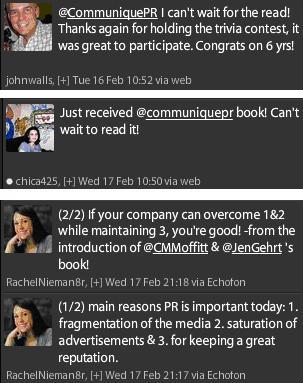
- In addition to new followers, we have seen more conversations about “Strategic Public Relations” and an increased level of engagement with individuals via the @CommuniquePR handle.
- We did not see a marked change in the Web traffic on our site, although site traffic has been unusually high since being mentioned on HARO.
Besides the 16 books and the cost of shipping the books to the contest winners, the only other costs associated with executing the contest was the time of our team. Although, I will add that the time to develop, promote and monitor the contest were not insignificant.
Overall, we felt the contest was a success; however, it is too early to say if we will host a similar contest on our seventh anniversary. In the meantime, we will capture additional feedback and monitor for additional results, such as book reviews from the contest winners who won copies of “Strategic Public Relations.”
We gathered valuable information from our experience hosting a contest on Twitter. If you are interested in learning more about our experience or need counsel on conducting your own Twitter contest please contact us.