
Insights for Leaders Navigating
Visibility, Credibility, and Growth.
From media strategy to reputation management, we explore the trends shaping public perception and share the approaches that drive measurable results for growing brands.
We recently reached out to science reporter Dan Vergano of USA Today to pitch a story surrounding the phenomenon of fuel slosh on behalf of our client Tecplot. As a result, we sparked his interest in writing and gained a mention of Tecplot in the article which appeared on Sept. 25 in the “Science Snapshot” section.
We connected Dan Vergano with Tecplot’s customer Dr. Sathya Gangadharan of Embry-Riddle Aeronautical University (ERAU) to discuss the phenomenon of fuel slosh, its affect on spacecraft and the aeronautical industry, and the university’s research around eliminating fuel slosh in spacecraft.
Fuel slosh is a term used to describe the movement of liquid within another object, such as a tank, which is typically experiencing the same rate of motion. Recently, ERAU determined how to simulate fuel slosh using computers versus physical lab tests and also validated that computational fluid dynamic (CFD) models can be used to research this phenomenon.
The article positions Tecplot’s customer, ERAU, in a very positive light and also includes simulation images from Tecplot. Dr. Gangadharan of ERAU commented, “It was a nice article and we are very thankful for the support.”
Click here to read the full article entitled, “Mercury Ready for a Rare Close-Up.”
As a University of Oregon alum it is not easy for me to acknowledge how impressed I am with USC’s head football coach Pete Carroll’s use of social media. The guy is doing a phenomenal job of galvanizing support for his players and team.
Consider this, today Carroll has more than 53,000 followers, and when USC running back Stafon Johnson (number 13) was badly injured in a weight room accident, Carroll provided updates on the situation via Twitter and called on people to show support for him. Specifically, he published the following tweets.
Oct. 2 – “how many follow Friday mentions can we get for @stafon13? Let’s leave no stone unturned!
Oct. 1 – “RT @stafon13 – Hay Twitt world its SJ feeling better & better by the hour with the love and support I appreciate this… Fight on”
Sept. 29 – “I’m visiting with stafon…he wants to say…he’s coming back and through his yrs as a Trojan he’s learned to be strong and fight on.
Another example of how Carroll is using social media includes his YouTube video blogs, which he posts regularly. See below for links to a couple of these blogs:
Video blog #4, UW Game Week and Ohio State recap, https://www.youtube.com/watch?v=5Ht_YKAAXnA
Video blog #5 – Overcoming Challenges, https://www.youtube.com/watch?v=Sp1if8jRkss
Finally, I want to point out that Carroll appears to be deliberate about the information he shares. You don’t see him posting willy-nilly comments about politics, food, or what he is doing. He shares information about his team, other athletes, and trivia like the song of the day (#SOTD) that will resonate with this key audience – USC college students, faculty and staff as well as alum.
Although I am not a Trojan, I am impressed with how he is keeping the Trojans top of mind and securing support for the team. You can find Pete Carroll on Twitter at www.twitter.com/Petecarroll, on Facebook or check out his Web site http://petecarroll.com/
I believe more CEOs and leaders could learn from Carroll’s use of social media.
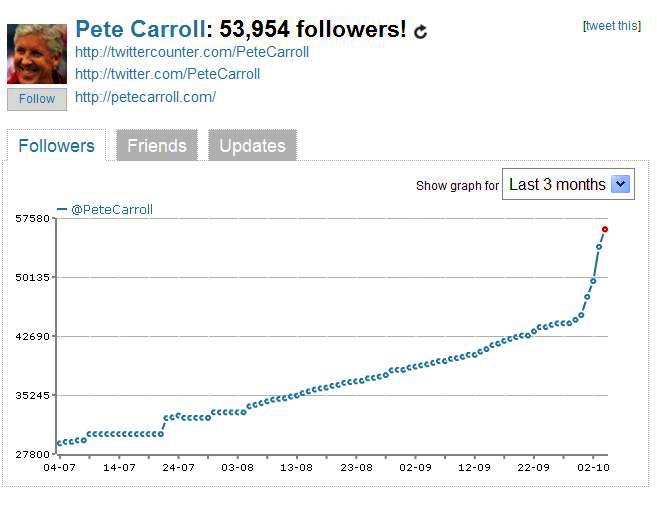
This graph (courtesy of www.twittercounter.com) shows how Carroll’s followers have grown from the week of July 4 through October 2.
In August, we wrote about a new Communiqué PR client, Aveso, Inc., in a post entitled, “The future of One-Time Password (OTP) Technology.” Since then, we have made good progress helping Aveso educate people about the merits of its technology, building the category and raising the company’s profile as a thought leader.

Specifically, in the past six weeks, we have been focused on writing and placing byline articles as well as securing conference calls with industry analysts following the security or credit card market.
Building and maintaining strong relationships with industry analysts is a great way to raise awareness of a company’s product and services, as well as secure third-party references for media and press materials.
I am excited to say we have secured 10 briefings with influential analysts following security and/or the banking industry with Gartner, Forrester, Frost & Sullivan and IDC among others. These individuals have been interested in the market opportunity and how Aveso’s flexible displays are being embedded onto bank cards so consumers can take advantage of OTP technology to prevent online identity theft and fraud.
In addition to our work with these analyst firms, we also have a number of byline articles in the works. To learn more about Aveso, please click here to read the contributed article we developed on behalf of Dennis Brestovansky, president and CEO, which was published by Electronic Design.
Reuters is a well-respected, influential news outlet. With 196 editorial bureaus in 130 countries and 2,400 editorial staff members, the newswire covers international news, regional news, politics, social issues, health, business, sports and media. A story placement with Reuters can provide a fantastic opportunity to raise the visibility of a company, establish thought leadership on a particular trend and gain credibility within a particular market.

Reuters’ stories are picked up by a variety of newspapers and online publications across the country and world, making them a compelling vehicle for reaching a very broad audience. However, the current economic climate and shifting media landscape are forcing reporters at the outlet to juggle multiple beats or cover very niche beats such as pediatric health or mobile and wireless.
In order to secure coverage with Reuters it’s critical to craft a compelling story idea that appeals to a broad audience or target market. We have found from our past experiences working Reuters that they’re typically interested in story ideas around trends that impact a broad audience or events and announcements that are disruptive to a particular market.
When approaching Reuters consider the following elements:
Establish a clear objective for the story – What is the purpose of the story you envision a Reuters reporter writing? Is it to establish thought leadership on a particular trend or market? Is it to displace a competitor? Raise awareness for acquisition? Establishing a clear objective will go a long way in helping craft a compelling story and help you determine which messages you want to communicate throughout the story.
Craft a compelling story with broad appeal – While big name companies like Microsoft and Starbucks may routinely land Reuters stories, smaller organizations and startups have an equal opportunity to garner coverage with Reuters. The key is to develop a story idea that demonstrates how a particular product or service will change the behavior of a broad audience or significantly impact a market. You might consider looking at trends in your particular industry, recent newsworthy events or upcoming events to determine if you can leverage these to help tell the story you envision.
Bring the story to life – Incorporate other elements to help bring the story to life. These elements could include industry data points or offering the perspectives of either a customer or market analyst to help validate the key points of your story.
Check out two recent stories we’ve secured with Reuters on behalf of our clients Dashwire and Digonex.
Telling the story of your company draws your audiences into your business in the same way a novel captivates a reader, creating a powerful way to shift perceptions. “I think that we human beings have always enjoyed great stories,” says Lee Weinstein, principal of Lee Weinstein & Associates and the former director of global corporate communications for Nike. “It’s part of who we are. It’s built into our evolution. How you tell a story and where you tell a story are really important, and I think PR really allows us to do that in a powerful way.”
So how do you go about crafting your company story? First, you need to have a clear idea of the value proposition of your company. “It all starts with the company’s vision and mission,” says Weinstein. “At Nike, our mission is to provide the innovation and inspiration to every athlete in the world. If you think about innovation and inspiration first, then everything that you do in PR should be innovative and inspirational, from the writing to the images to the selection of the campaign you’re going to really get behind.”
In addition, your overarching story should have all the elements of a great narrative: a protagonist, an antagonist, a lively cast of characters, a setting, a plot, a conflict, and a resolution.
Excerpt from Strategic Public Relations, written by Jennifer Gehrt & Colleen Moffitt with Andrea Carlos
Colleen Moffitt, co-founder of Communiqué PR, will be speaking at the Northwest Environmental Business Council‘s Seattle Luncheon on Wed., Oct. 7. The event, which will be held at McCormick & Schmick’s Harborside restaurant, will focus on social media and business.

Colleen will discuss the following during the presentation:
An overview of the various social media platforms including Facebook, LinkedIn and Twitter.
Illustrate how Twitter and other social media platforms can help you achieve business and communication objectives.
Provide practical tips to help organizations get started with social media today.
To learn more about the event or to register, please visit http://www.nebc.org/Events.aspx. We look forward to seeing you there.