
Insights for Leaders Navigating
Visibility, Credibility, and Growth.
From media strategy to reputation management, we explore the trends shaping public perception and share the approaches that drive measurable results for growing brands.
Broadcast media have rules and preferences for pitches that, when followed, can make the difference between placing a story and having your pitch sent to the recycle bin.

Before pitching broadcast media, it’s important to do your homework and know the answers to these questions:
-
Who is the appropriate producer to pitch given the subject manner?
-
Does the producer have preferences for how she or he is approached?
-
Assuming the producer takes phone calls, when is the best time of day to call?
-
What audience does the show target?
-
What is the style format of the show?
-
When does the show air?
-
How much lead time will producers need for a story?
This may seem like a lot of information to gather before pitching, however there are great resources available online to help you find answers and effectively prepare.
For example, Cision Media Source, a world-class provider of media intelligence, published a report in January 2009 titled, “Pitching Profiles for Television Broadcast Contacts.” The report provides business professionals with important information about pitching major broadcast outlets including, The Today Show, CBS Evening News, Today in New York, Good Day Chicago and NBC Nightly News.
The Cision report provides important background information such as pitching preferences, lead times and show style. It also offers contact information for the appropriate producers.
Mediabistro.com is another valuable source when looking for background information on broadcast media. The organization is dedicated to providing opportunities to meet and share resources and knowledge among professionals. Its Web site contains helpful information and feedback from broadcast producers and print journalists.
For instance, on March 13 Mediabistro.com posted information about Zev Shalev, the new senior broadcast producer for The Early Show. Mediabistro.com provided detailed information about Zev’s background and provided a copy of the press release announcing his new role at The Early Show.
Based on our experience pitching broadcast media, we have found that watching the show, examining the show’s Web site and looking at what has been written about it on blogs is another great way to gather information. Some shows, such as The Ellen Degeneres Show, provide information about the show focus and style directly on the Web site.
Whatever resource you use, it’s important to do your homework before pitching broadcast media to help your pitch get noticed and demonstrate to producers that you are familiar with their program.
If you are interested in receiving a copy of the Cision report, please e-mail Cision at [email protected].
The overarching goal of a public relations team is to provide strategic support for a company and its products and ensure the highest quality of communications to foster a positive public perception of the company. When organizing a PR team, there are many factors to consider.
There is no right or wrong organizational structure for a PR team. PR teams vary depending on the company’s size, business objectives and level of support needed. Some companies employ in-house PR teams, hire external PR agencies or use a combination of the two.
Many times, when a company decides to hire both an internal and an external PR team, one of the areas of confusion revolves around the roles and responsibilities of the teams. In order to strategically leverage public relations and foster a positive relationship between the two teams, the roles and responsibilities should be clearly outlined. It is also ideal if the external team and internal PR specialists and managers have shared expectations about processes and procedures.
Based on our collective experience and observations on both the client and agency side, these are the roles and responsibilities that you should consider for your external team vis-a-vis any in-house PR staff:
Roles & Responsibilities of an Internal PR Team
- Secure internal buy-in from the executive management team. Build support for PR as a strategic tool, determine how much the company is willing to spend on PR initiatives and clearly outline the activities the team plans to implement.
- Manage the PR budget to ensure it is being used efficiently. The internal PR manager should act as a liaison between the external agency and the company, and help both teams meet expectations.
- Drive the PR strategy and make sure the company develops long-term strategic plans that mesh with its overarching business goals. The internal PR manager may want to involve the PR firm in developing a strategic plan. Oftentimes, this is a smart idea especially if the firm is going to be charted with executing the plan.
- Coordinate with other internal teams to make sure the public relations program reflects consistent messaging and supports the company’s business and communications goals.
- Define measurement criteria and evaluate results against those criteria. The internal team should establish, along with other internal stakeholders (e.g. product marketing, program managers, etc.), the criteria for determining whether the public relations programs are meeting internal expectations and requirements. Again, you may want to ask your agency to participate in this discussion so they can share their perspective and you can come to shared expectations about what is realistic.
- Prioritize PR requests in order to ensure the agency is focused on the right value-added programs and supporting activities that are most strategic.
Roles of an External PR Team
- Work in tandem with the internal PR team to develop a strategic PR strategy and provide counsel on campaigns or projects.
- Proactively respond to editorial inquiries and requests as appropriate and manage the process accordingly. Field interview requests, coordinate and facilitate interviews, and develop briefing materials to prepare key spokespeople. Manage the angle of the story and work with the journalist to provide additional information. It is also important to monitor for the article and develop and deliver a recap to the clients in order to merchandise the results.
- Assist the internal team in developing press materials including press releases, key message and Q&A documents. Conduct reactive outreach to key media targets to inform them of upcoming announcements, key customer wins, product releases, etc.
- Work with the internal team to flesh out messaging or to develop a messaging architecture.
- Champion program planning activities with strategic input from the internal team. The agency is responsible for identifying key audiences, major messages, objectives, strategies and tactics for carrying out these programs.
- Execute on plans as needed. Write press materials, such as press releases, corporate backgrounders and media alerts. Draft speeches or presentations. Develop briefing materials for executives so they are prepared for key interviews. Secure speaking opportunities.
- Provide weekly and monthly status reports to the internal PR manager so he or she has a sense of what work is being completed and what results are in the works. Communication is key. Erica Iacono with PRWeek recently wrote an article about showing agency value to clients and said, “Constant communications between an agency and client is essential . . . It’s also important to keep clients apprised of new developments within an agency, including its staff and capabilities.”
As companies grow, change and reorganize, it is important to re-evaluate the roles and responsibilities of both the internal and external teams. Although selecting the right PR team can be time-consuming, a winning PR team can help cultivate a positive company image and successful business.
AARP CEO William Novelli commented to PRWeek, “Most organizations recognize team building is key to success. Communications pros must be strong and true partners in management team building. This means aligning with the organization’s goals.”
If you have any other thoughts about the roles of internal vs. external PR teams, we’d love to hear them. E-mail us at [email protected] or post a comment.
A few years ago one of our clients approached us about developing and distributing an April Fools’ Day “joke” press release. Clearly there are pros and cons to these types of announcements. A successful joke press release can garner significant attention and build dramatic awareness for a company. However, a joke release in poor taste can cause long-term damage to a brand or company image.
As we prepare for this year’s April Fools’ Day, we thought it might be worthwhile to share thoughts and perspectives we gathered from a few reporters on the appropriateness of the hoax announcement. Here is what we learned:
1. Reporters do have a sense of humor so they’re not totally opposed to the idea. However, they cautioned us that this type of release needs to be written in such away that there is no doubt that it is a joke. Clearly, if a reporter believes an announcement is legitimate news, and writes about it as such, his or her credibility could be damaged and this would be detrimental.
2. To ensure the announcement is not taken seriously, you might want the press release (or advisory) to include a statement (at the end) stating that it is a joke.
3. Timing is everything. Nothing illustrates this more clearly than this post on Engadget when a press release intended as an April Fools Day joke was distributed on April 3.
Finally, as with any announcement, a company should carefully consider the objectives of the “joke” announcement and the perceptions it will create. For instance, is it going to make light of an issue that deserves serious consideration? How will it make key partners feel? Will other target audiences find it funny or annoying?
Here are some April Fools’ Day announcements from years past.
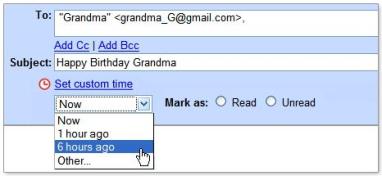
Google’s “Gmail Custom Time” lets users send e-mails in the past. E-mail can be sent to appear as though it was sent 1 hour ago, 6 hours ago or another time in the past. E-mail show up in proper chronological order in the recipient’s inbox. Never miss important deadlines again.
WestJet Introduces Sleeper Cabins, Airline is first to provide new service without need for cabin upgrades – The photos illustrates a WestJet guest snuggled in “new” sleeper cabin. Be careful when you open the overhead compartment, items my have shifted!

Nestlé Announces Official Name Change for ButterfingerÆ Candy bar – We think the packaging says it all.

Njection Hits Final Hurdle to Provide Real Time Tracking of Police Officers -Track police officers from your computer and by mobile phone. The press release clearly captures both the need and benefits of this compelling solution:

“I feel a lot better with this announcement.” Jeffery Jarvis, 2nd time felon looking at his 3rd strike. “This information will be very helpful for me in my line of work. I am just upset that is has taken this long to get something like this started.”
Feel free to share your favorite hoax announcements with us by posting a comment.
Many industry experts predict that the merger and acquisition market (M&A) is going to turn around later this year. This theory was outlined in several recent articles including one by TechFlash’s John Cook, “When will the high-tech M&A bottom feeders emerge?” and another from IDG News’s Marc Ferranti “Wall Street Beat: M&A, Oracle Stress the Positive.”

In the TechFlash article Bill McAleer, a managing partner at Voyager Capital, shared with John Cook that there are a number of large companies (such as Oracle, Microsoft, etc.) with strong cash positions who are preparing to leverage the recent economic downturn to get some good deals in the acquisition arena. We are starting to see some evidence of this happening with recent acquisition news from Cisco, merger discussions between IBM and Sun and statements from Steve Ballmer indicating that Microsoft is ready to do several (10 – 20) small deals of less than $500 million.
While increased M&A activity is good news, there is still significant competition among companies looking for acquisition as an exit strategy. Additionally, companies are now faced with reduced valuations. Much like a home owner coming to terms with the decreased value of their home, company executives and investors will need to be prepared for lower terms.
For companies looking to be acquired, cost-effective, strategic public relations is a critical tool for raising awareness, increasing valuations and ultimately accomplishing the desired exit.
According to Ferranti’s article, a recent report by 451 Group revealed that corporate buyers “are looking for ‘bolt-on” deals that help vendors in specific market niches.” These niche companies need to raise awareness with potential acquirers to demonstrate how their product, solution or technology will be a strategic asset as well as how they can integrate effectively within the organization. Public relations can be extremely effective to boost a company’s visibility and ensure its valuation is maximized.
In our book, “Strategic Public Relations: 10 Principles to Harness the Power of PR”, we include a sidebar “A Focused Approach to PR: How PR Helped Tegic Raise Its Sales Value” in which Don Davidge, Tegic’s former vice president of marketing and sales reveals how PR helped Tegic secure its acquisition by AOL and how later, an AOL executive told him “his team had internally calculated they paid an extra $50 million for Tegic just because of how much buzz there was about the company.”
Today’s business climate may be more conservative; however, PR can be a powerful tool to ensure your company is on the radar with potential acquirers. In addition, PR can increase the perceived valuation of the company and possibly create a sense of urgency for the completion of an acquisition.
Tecplot, Inc., one of Communiqué PR’s newest clients, recently helped scientists from MIT shed light on a century-old mystery surrounding flow separation. After reading this study, I was intrigued to learn more about flow separation and how Tecplot’s solution helped scientists better understand this complex phenomenon.

Flow separation occurs when the air traveling over a surface “detaches” from that surface, causing increased drag. Take for instance an airplane that is accelerating to gain elevation and then slows to go into a turn. The airflow around it cannot keep up and detaches turbulently from the wings. This aerodynamic separation creates drag, which causes further slowing and forces the engine to work harder.
Tecplot’s visualization solution allows scientists and engineers to quickly analyze data with easy-to-use quantitative and qualitative charts. Users can view data as wire-mesh plots, contour lines and flooding, vector fields, light-source shaded plots, and a variety of XY plots. As described by Mike Peery, CEO and founder of Tecplot, the company’s solutions are like “Microsoft Excel on steroids.”

With the help of Tecplot 360, “a CFD visualization tool that helps analyze, explore and understand complex simulation data,” scientists were able to explain the mathematics behind the unsteady separation of fluids in both two and three dimensions.
Understanding flow separation is important to designing fuel-efficient cars, planes and combustors – controlling flow separation helps manage both fuel consumption and pollution emission. From a news perspective, this study is timely because of the awareness around fuel efficiency. Industries such as automobile and aerospace are focusing on creating more eco-friendly vehicles and planes. Just recently, Honda announced the release of Honda Insight, a hybrid car which according to a New York Times article, “promises to let drivers respond to both of the leading crises of our day: the environment and the recession.”
Fuel efficiency also continues to be a major issue under the Obama administration. As awareness for fuel efficiency increases, technologies that can help reduce pollution and increase energy efficiency will be top-of-mind with politicians and the general public.
We are excited to leverage current trends such as these to garner coverage of Tecplot.
To learn more about Tecplot’s solutions and the flow separation study, visit www.tecplot.com.
Given the current economic conditions and the demise of many print publications, conversations are increasingly taking place online through networks and platforms such as Twitter and Facebook. We recently wrote a blog post about the power of Twitter and the impact of Facebook on companies like Coca-Cola. There’s no doubt social media is a hot topic right now.
As professionals are getting acquainted with the changing digital space they want to know how to leverage these mediums to achieve business and communications objectives. PRWeek recently gathered a roundtable of professionals to discuss the impact of digital media and how companies can leverage it to secure key business objectives. The roundtable discussion outlined best practices for leveraging the various digital media platforms. Here are a few key takeaways from the discussion:
Digital in a down economy
Social media is growing exponentially. However, in a down economy there is added pressure to deliver measurable results. When implementing social media campaigns, it is important to outline anticipated results, how the results will be measured and communicate the strategic value of the campaign – to show how these results align with business and communications objectives.
Impact on traditional journalism
Traditional reporters are also blogging – many of them are gathering information from a variety of sources such as Twitter, Facebook and corporate blogs. During the PRWeek roundtable, Paul Berg with Southwest Airlines commented, “It really changes how PR should be thinking about things as basic as their talking points. It’s not a quote in a story anywhere. You have to go a lot deeper than that.” The way we communicate with journalists and conduct media briefings is changing. Everything is instantaneous now. Before the rise of social media it would take a journalist a couple of days to publish a story, now they can do it in real-time through blog posts and Twitter updates.
Corporate blogging
From company Facebook pages to corporate blogs and Twitter accounts, some executives are finding it hard to differentiate their personal accounts from their corporate accounts. Marc Monseau with Johnson & Johnson commented, “When you’re corporate blogging as well, you still need to have your personal identity in that blog, but it needs to be your professional identity.” We’ve seen examples of this going wrong with the Ketchum employee’s tweet that caused controversy with its clients. Remember, personal is now public and what you say on your personal Twitter account or Facebook page could affect your professional relationships.
Staying up-to-speed
Being versed in the social media landscape is now more important than ever. When Marcy Cohen, a participant of the roundtable discussion and senior PR manager for Sony Electronics was looking to hire another member for his team, he looked at 50 resumes and couldn’t find the word social media or social networking on any of them. We can’t stress this enough. In order to get familiar with the social media landscape, you have to participate, and as the saying goes, “get your hands dirty.”

To learn more about the impact of social media and best practices for leveraging these emerging technologies, read the PRWeek roundtable discussion here.