
Punctuation has a definite and important place in writing. When used improperly it can change the meaning of a sentence and drive your readers crazy. As communication professionals, we need to pay particular attention to punctuation as we strive to deliver clear and concise messages.
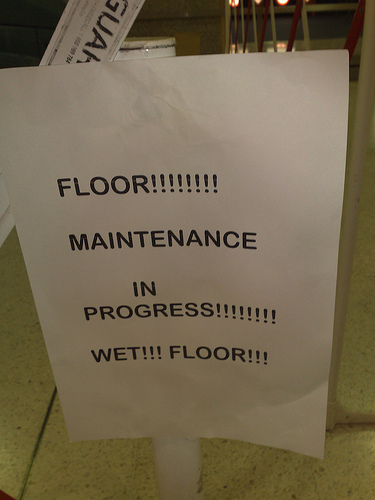
See the image on the left. It seems this person finds floor maintenance exhilarating! However, it’s easy to see that this is an obvious misuse — and overuse — of the exclamation point. Punctuation problems aren’t always this over the top, but happen frequently. So what are some quick ways to ensure you’re using punctuation properly?
Ragan.com offers some good direction in an article, “5 frequently misused punctuation marks.” The author, Rob Reinalda, discusses when and when not to use the question mark, the ellipsis, the apostrophe, the comma and the exclamation point. You need a subscription to access the article so I have summarized Reinalda’s guidance and provided complementary examples.
Consider this:
- The exclamation point. Reserve exclamation points for writing dialogue or conveying extreme excitement. It’s best to leave it out of business writing, Reinalda advises, “Or people might think you run a bit, well, hyperbolic.”
- The question mark. The question mark should be used to ask a question, but people often misuse the question mark when a period is the appropriate choice. For example, “Guess what I had for dinner?” Reinalda explains that “guess” is used as an imperative, not an interrogative. You are instructing someone to guess therefore the correct use is, “Guess what I had for dinner.” Another common mistake is, “I wonder what Mom is making for dinner?” This is a declarative statement and again should be replaced with a period.
- The ellipsis. This is another punctuation mark that is misused … frequently. The ellipsis is used to indicate a pause, gap or missing words in quoted text. However, it should replace extra information without changing the meaning. For example:
“I would like, once I finish shopping and cleaning the kitchen, of course, to cook dinner for family and friends tonight.”
This could be shortened to the following using the ellipsis:
“I would like … to cook dinner for family and friends tonight.”
However, it is not appropriate to shorten the sentence using an ellipsis that alters the meaning. An ellipsis can also indicate a pause, but a common mistake is…….too many dots.
- The apostrophe. The most common mistake using an apostrophe is to create plurals. Use an apostrophe to form possessives, such as “grandma’s famous muffins.” You also use an apostrophe in a contraction.
- The comma. Commas have a lot of uses, and because of that are commonly misused. Here is an example that shows a blend of misplacement and omission:
“My mother has recipes for delicious meals, and perhaps more important, healthy recipes, that are quick.”
Only one of these commas is used correctly. This is how it should be rewritten:
“My mother has recipes for delicious meals and, perhaps more important, healthy recipes that are quick.”
Often times commas, apostrophes and exclamation points are used randomly in writing. These are just a few tips to help you avoid the punctuation crap shoot and the mishaps that can lead to a confused or frustrated reader. There are other sites out there that offer helpful guidance and illustrate the power of punctuation like Daily Writing Tips, which shows readers “How to Punctuate References to Dates and Times,” “7 Types of Hyphenation That May Seem Wrong But Aren’t,” and even how “Punctuation Saves Lives!”
The bottom line, you want to convey a clear message to your audience, punctuation should help, not hinder.
What other common mistakes do you see? And trust us, they’re everywhere.