
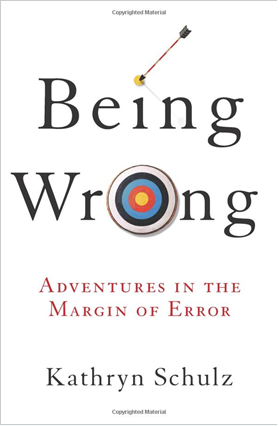
On my way to lunch in early December, I happened to catch Kathryn Schulz on KUOW’s The Conversation talking about her new book, Being Wrong: Adventures in the Margin and Error, and the value of being wrong and making mistakes. It caught my ear because in public relations, we strive to be mistake-free. In addition to being compelling, our PR materials need to be grammatically correct, free of typos and factually accurate. Deadlines cannot be missed. Information needs to be shared in an appropriate and timely manner. Our counsel to clients must be spot on and our execution in any situation or campaign flawless. Frankly, it is a lot of pressure. It’s no wonder that many folks see public relations work as intensely stressful. Just check out David Schepp’s article “10 Most Stressful Jobs of 2011,” where PR Officer is listed at number two.
So with great interest I tuned into senior host Ross Reynolds’ interview with Schulz on The Conversation. It did not disappoint. It was helpful for me as a leader as I constantly obsess about delivering quality work, crisis management and even storytelling. Here are some of the points she made which resonated with me:
- We are attached to being right and our sense of accuracy. However, oftentimes we learn the most from making mistakes. Mistakes force us to grow, they drive innovation and many times they inspire us.
- The structure of the human mind is designed so we can make swift and probabilistic judgments about the world. Probabilistic thinking means you’re probably right or possibly wrong. This brings new insight into St. Augustine’s words, “To err is human.”
- If you don’t want your people making mistakes, you need to design systems that prevent them from making them, or at least reduce the probability of them happening, because human error is inevitable. You need to consider why mistakes are made. Just getting rid of the person who made the mistake will rarely eliminate the cause or issue. (Consider the processes developed by the medical profession and airline industries.)
- Being wrong can be a powerful narrative and story-telling device. Schulz interviewed Ira Glass from This American Life for her blog on Slate.com and learned that almost all of the segments have the following structure: “I thought something was going to happen. And then it did not happen. I had a revelatory moment. My whole sense of my reality collapsed and I had to shift my thinking.” These situations of being wrong are transformative moments and make for terrific stories.
- Science and its related domains (such as technology industries) understand that mistakes help us with breakthroughs. Experiments that go wrong often help scientists develop a deeper understanding of a subject.
The primary goal of Schulz’s book is to help people become better at being wrong and learn to behave with more grace, humility, empathy and curiosity in the face of wrongness, errors and mistakes.
I am truly looking forward to reading her book. If you have a story to share about a mistake you made, or thoughts about this book, I’d appreciate hearing from you.
Jennifer