
Insights for Leaders Navigating
Visibility, Credibility, and Growth.
From media strategy to reputation management, we explore the trends shaping public perception and share the approaches that drive measurable results for growing brands.
Recently, a writer at Newsweek published a story recounting his week-long experiment to read and to reply within 36 hours to every PR pitch he received. Given the volume of pitches that landed in his inbox, it was a noble effort. Some of the experiences he relayed made me chuckle, but a lot of his story also made me cringe as he enumerated the pitches that were completely irrelevant.

We’ve written extensively about the topic of pitching on the Communiqué PR blog and every PR pro worth their salt knows that one of the basic tenets of PR is to appropriately target and personalize your pitch. Nothing will land your pitch in a journalist’s deleted mail folder faster than a pitch that is off base and irrelevant to their beat.
So why do PR pros continue to break this cardinal rule?
Most PR practitioners are exceptional professionals who strive to deliver outstanding results for the organizations they represent as efficiently and expediently as possible. However, it would not be too far-fetched to say that more than once in his/her career, a PR pro has sent a pitch that was off target. Reflecting back on my own experience, there are a number of reasons why this might occur. One of the most notable reasons is having press lists that are so large that having the bandwidth to do the home work required to develop a personalized pitch and to send the individual email is nearly impossible.
Here’s a tip: Rather than going after say, 100 publications, hone your list to the top 10-15 outlets that are the most relevant to your company/client and that will move the needle for their business. Once you’ve identified those outlets, drill down and identify the appropriate writers, read their articles and follow them on social media. Get to know their beats and the topics they cover. It may take a pitch or two to pique their interest, but being laser focused on the outlets that matter and reaching out to journalists with news and story ideas that are relevant to them, will reap greater benefits.
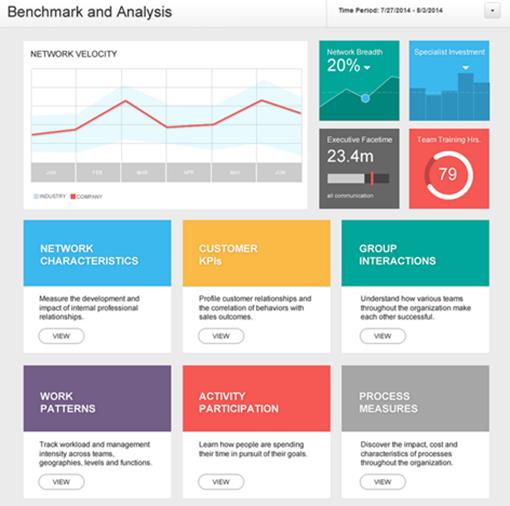
- Organizational Load Index (OLI): OLI is calculated as the total amount of time any given employee consumes from the rest of the organization based on meetings they schedule and emails they send out. For example, if Ed schedules a one-hour meeting with four people, he has consumed four hours of time from the organization. OLI helps employees and executives alike understand to what extent they are consuming an organization’s time through scheduled meetings and emails sent. This metric has made me re-think hitting “reply all” and inviting people whose presence is not critical to a meeting.
- Number of people in cross-collaboration: This metric can be dynamically calculated for any set of two groups within the company. It is based on the number of unique individuals who participated in email communication or attended a meeting involving anyone from the two groups in question. This metric provides unparalleled insight into which teams are collaborating and the frequency and duration of the collaboration. Ineffective or infrequent collaboration across company teams can stifle innovation, growth, and employee engagement.
- Time Fragmentation: Time Fragmentation measures the extent to which meetings fragment the working time of employees. It is calculated as the number of two-hour blocks with no calendared meetings available during normal employee working hours (e.g., if your standard working hours are 8 a.m.-5 p.m. and you have a one-hour meeting at 10 a.m. and a two-hour meeting at 2 p.m., then you would have two two-hour blocks of time available). Research suggests that it takes people at least 15 minutes to regain focus after an interruption, and employees find it difficult to refocus when there is less than an hour until their next meeting. By understanding time fragmentation data, managers can schedule meetings strategically, so employees have significant blocks of uninterrupted time each day to focus on their actual work.
In addition to these metrics, which provide actionable insights into a company’s organizational health and productivity, VoloMetrix’s technology can predict sales-quota attainment, attrition, performance, and more. VoloMetrix unearthed that internal networking is strongly correlated with sales-quota attainment. By gathering data on employees’ internal networking, VoloMetrix can predict employees’ quota attainment with a high degree of accuracy, as early as one month into the quarter. VoloMetrix’s technology truly is at the forefront of people analytics, an emerging big-data category.
For the full release, please visit MarketWired. VoloMetrix’s announcement also spurred some compelling coverage in key outlets.
- CIO – Is Big Data watching you at the water cooler?—August 22, 2014
- PC Advisor – Is Big Data watching you at the water cooler?—August 22, 2014
- ARN – Is Big Data watching you at the water cooler?—August 22, 2014
- BankITAsia—Is Big Data watching you at the watercooler?—August 25, 2014
- Forbes—Volometrix Attempts To Measure Employee Productivity–But Is It A Flawed Model?—August 27, 2014
- ITBusiness.ca—How productive are your employees? VoloMetrix can give you the numbers—August 27, 2014
- Datanami—Are Meetings a Waste of Time? Data Analytics Weights In—August 26, 2014
- Contact Center Analytics Review—VoloMetrix Files Patent, Featured in Harvard Business Review—August 27, 2014
- News.Now.Co–NEWS: VOLOMETRIX FILES PATENT FOR GROUND-BREAKING PREDICTIVE PEOPLE ANALYTICS SOFTWARE—August 27, 2014
- Software Industry Today—VoloMetrix Files Patent for Ground-Breaking Predictive People Analytics Software—August 27, 2014
As Chantrelle Nielsen, head of customer solutions at VoloMetrix, shared with Datanami, “In a lot of companies, you have to submit a receipt and an expense code for a cup of coffee you bought for somebody. But you don’t have to submit anything and there’s no approval process and no real judgment on whether you’re spending $5,000 worth of people’s time in a meeting that lasts all afternoon.” We are excited to help VoloMetrix change that.
Last week, Facebook quietly announced in a blog post that it has updated its policies around “click-bait” links. According to the post, click-baiting refers to links “with a headline that encourages people to click to see more, without telling them much information about what they will see.” We’ve all seen these—you’re scrolling down your news feed and come across a link with a giant photo and ambiguous caption: “You’ll never GUESS what this celeb did… Click through to see!” These types of in-your-face links often receive a lot of clicks but are not always the most valuable, suppressing content that viewers actually want to read and share.

Facebook has therefore decided (reasonably so) to improve the quality of stories appearing on the news feed and reduce the number of spammy, irrelevant posts. The network has set new criteria for deciding which posts will be featured on the feed, now judging stories based on how valuable they are to readers. This comes down to two main factors, including 1) how much time readers spend away from Facebook viewing a particular post (i.e., longer time spent reading = more enjoyable post); and 2) how often users share and discuss a particular story with friends compared to how many clicks it receives (i.e., high number of clicks but few “likes” or comments = not valuable).
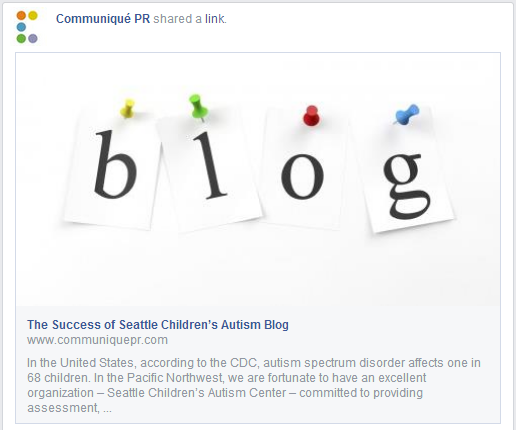
In addition, the network announced it will show more links that are posted in the “link format,” which happens when you paste in a link as you’re drafting a post, rather than just including the URL in the caption that appears above the photo. The link format shows additional details that help readers decide if they want to view a post—such as the story headline and first sentence in addition to the caption.
Here’s an example in link format from our own Communiqué PR page, which includes a photo, the actual headline and first few lines of text:
For PR pros and companies publishing stories and news to their feeds, these updates have the potential to affect content click-through and distribution rates. With the demise of click-baiting, here are a few ways to ensure your posts will still be featured on Facebook:
- Post valuable, share-worthy content. This should be a no-brainer anyway for PR pros, and is also the easiest way to ensure your stories will be picked up on the news feed. By nature, stories that are compelling and valuable will pass the new criteria and have the best chance of being featured. Now is the time to refine your content-creation strategy and put extra-careful thought into what you post.
- Be straightforward. Honesty is always the best policy and that especially applies here. Don’t deceive viewers with misleading, teaser captions to links. Instead, be honest about the content and include the actual headline or context, then leave it up to the reader to decide whether it’s worth viewing. Think your post won’t receive enough clicks on its own without a click-bait headline? Re-read no. 1 above and re-think your methods.
- Use the link format. This is easy enough—when sharing posts, simply paste in the link while drafting the post, rather than including the URL as part of the photo caption. This is a smart move even if Facebook didn’t force you to do it—the company has found that these types of posts receive twice as many clicks compared to links embedded in photo captions.
At day’s end, not much has changed—readers still want valuable content and it’s your job to give it to them. The new Facebook rules just add that bit of extra pressure to deliver awesome, engaging posts—which you’re doing anyway, right?
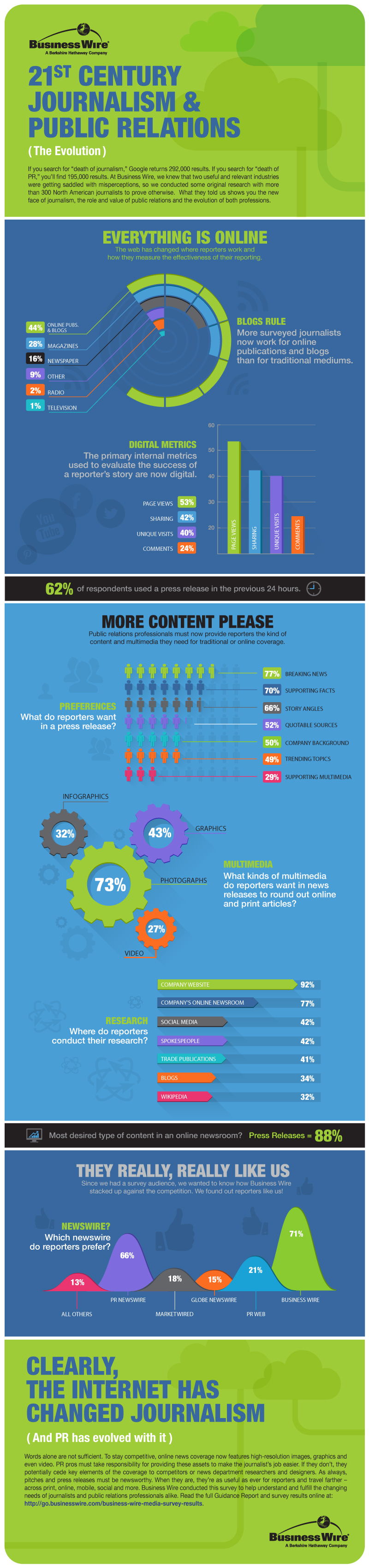
As PR professionals, we are constantly trying to get into journalists’ heads to determine what they’re looking for from us. What kinds of multimedia elements are most helpful? How in-depth should our pitches be? Should we engage reporters on Twitter? Luckily Business Wire might have some of the answers. It recently conducted a media survey in which it asked a wide range of journalists 30 questions to determine the latest trends in media relations and provide a better understanding of journalists’ preferences around working with PR professionals.
The survey starts off with some unsurprising information around the shift toward digital media – results show that the majority of journalists now work for an online publication, which aligns with the trend toward moving everything online.
It then dives into some interesting insights into reporters’ preferences around press releases. Press releases are still widely used by journalists, with almost 90 percent of the responding journalists using a press release within the past week. Since journalists still commonly use the tried-and-true PR tool, it’s important for PR pros to continue polishing their press-release writing skills. But what kind of information do journalists look for in a press release?
According to the survey, the most sought after type of story information in a press release is breaking news, followed by supporting facts, interesting story angles, quotable sources, company background and trending industry topics. Interestingly, the least important type of information for responding journalists was supporting multimedia. This contradicts a number of other sources that tout the importance of including multimedia in press releases, including a study from PR Newswire stating that multimedia content drives nearly 10 times more visibility than text.
The survey resulted in a number of other compelling findings around media trends. To learn more, download the full report or take a look at the following infographic from Business Wire summarizing the results of the survey.
Quentin Hardy of The New York Times recently wrote a story that positions Seattle as the next tech capital, highlighting a trend that is changing the way people think about the Emerald City. For a city mostly known as the birthplace of Starbucks, the Seahawks and rain, a recent influx of Silicon Valley venture capital investments and big wigs like Facebook, Google, eBay and Twitter have finally placed Seattle as the emerging epicenter of cloud-computing, datacenters and innovation.

The topic of Seattle as a major technology center fueled a recent panel discussion at a luncheon hosted by Rotary Club of Seattle, moderated by Todd Bishop, co-founder of Geekwire. Panelists included Michael Schutzler, CEO of the Washington Technology Industry Association (WTIA); Sarah Bird, CEO of Moz; Julie Sandler, principal at Madrona Venture Group; and technology veteran Jeremy Jaech, co-founder of SNUPI Technologies.
Geekwire’s Todd Bishop began the tech-focused session by asking panelists to weigh in about what makes Seattle so different from Silicon Valley and how the tech scene has changed over the last several years.
“Seattle is rapidly embracing new technologies beyond innovations taking place at Microsoft and Amazon as the industry matures with more thoughtful ‘bets’ and increased competition,” said SNUPI Technologies’ Jeremy Jaech.
“Competition has also increased, as it is easier than ever to reach people from all over the world with accessible cloud computing applications,” added Moz’s Sarah Bird.
“Keep in mind that compared to Silicon Valley, Seattle is 10-20 years behind the power curve where the entire local industry was just Microsoft 20 years ago,” added Michael Schutzler from the WTIA. “Now we are home to a viable and growing VC marketplace. It’s not that we haven’t been swinging for the fences, we just haven’t had as many times at bat as a city.”
Bird added that she believes it’s now much easier for companies to get started in Seattle with the rise of local accelerator programs and tech conferences like TechStars and Geekwire. However, finding top talent continues to be a challenge, given increased competition in the region. The growing number of cloud-based and mobile app startups has made the fight for engineers even more difficult in recent months.
Julie Sandler offered another perspective from her work at the Seattle-based venture capital firm Madrona. “Having worked in Silicon Valley, when other people talk about Seattle, they often say the tech community just seems so nice. This bugs me because Seattle is very aggressive and yet collaborative,” she said. “It’s not uncommon to see two founders of different companies meeting regularly. It’s not uncommon to see an established CEO meet with a start-up founder. This tension between collaboration and aggression makes Seattle so successful and is putting our city on the map.”
Bishop then asked the panelists to name the most promising Seattle-based startups that no one has heard of yet. The responses included online course developer Skilljar; emerging biotech company Acucela that treats macular degeneration; Glympse, a mobile app that lets you share your location with others for a specific timeframe; and Canary, the maker of personal air quality sensors.
Over the last five years, the proliferation of venture capital firms in the Seattle region including Madrona, Vulcan, Cascadia Capital, Ignition Partners, Voyager Capital and Benaroya Capital has helped stimulate tech-sector growth while providing more job opportunities. As The New York Times reports, Madrona alone has participated in 15 cloud deals since March 2012, raising $68 million of $304 million total venture capital for cloud companies in the Seattle area, while the rest came from 20 other investors, mostly in the valley. Those companies are still private and are valued at around $2.3 billion.
For decades, Microsoft and Amazon were the lone tech giants in the region, but now the Pacific Northwest is home to myriad newcomers like EMC, Tableau, Apptio and Smartsheet.
As John Cook of Geekwire reported, the City of Seattle and real estate company Kidder Matthews have recently unveiled plans to begin marketing a 4.41-acre parcel just southeast of downtown Seattle to potentially lure Bay Area companies to set up shop.
But the question remains – is Seattle ready to take on the Valley?
You bet.
As Twitter’s popularity and user base have rapidly grown in the last eight years, companies have used this as an opportunity to engage customers on the social networking and micro-blogging site. Twitter has become a medium for entertainment, news, product releases and reviews, as well as brand building. However, the instantaneous, small word-count tweet can sometimes go out a little too fast and easily. Whether it’s a tweet gone wrong or a bigger company issue at hand, follow these tips from PR Daily to master your apology on Twitter.
1. Be sincere and concise.
A simple and direct message is the most effective in this situation. Luckily, Twitter’s 140- character maximum helps the message to be concise and to the point. The apology needs to have an authentic voice, but also a voice that matches that of the brand elsewhere. An apology that is inconsistent with the company’s overall tone is not likely to be accepted by customers, so avoid this by simply matching the voice of the message with the brand’s voice.
2. Don’t make excuses.
Not only do you not want to take up any of your valuable space in your short tweet limit, but you also do not want to point fingers. Take responsibility – your followers will appreciate the honesty.
3. If you say there will be a follow up, actually follow up.
A simple apology is not quite enough anymore. If appropriate, assure followers that a more detailed follow up on the issue will be forthcoming, and then deliver. This is especially true for customer service or product issue apologies, for these issues directly affect your customer base. Customers will want the appropriate information to tackle the issue at hand.
4. Provide contact information.
If there is room in the tweet word count, include an email address so that followers may reach out. In today’s world, it is all about customer service, so giving customers contact information is essential.
Great customer service includes a sincere apology when one is needed. Whether the apology is remedying a larger company issue or a smaller tweet mistake, Twitter can be an easy and effective way to reach customers. If the right steps are taken and the apology is sincere and takes responsibility for the mistake, customers will be appreciative of the honesty.
For more on perfecting an apology, see our blogs on How to Apologize Effectively and Three Studies in Public Apologies & Crisis Communications.