
Insights for Leaders Navigating
Visibility, Credibility, and Growth.
From media strategy to reputation management, we explore the trends shaping public perception and share the approaches that drive measurable results for growing brands.
Recently, I wrote about publishing capabilities on LinkedIn and the social media giant’s plans to invite all its members to contribute articles via long-form posts. Since that time, I began thinking about the implications of this new capability as it pertains to copyright, other forms of intellectual property, corporate guidelines and staff education.

For instance, every person with Communiqué PR regularly contributes to our blog. Communiqué PR owns the copyright for those blog posts because the articles are prepared by staff as part of the scope of their employment with Communiqué. Nonetheless, my colleagues and I also want to distribute our posts via our LinkedIn pages leveraging LinkedIn’s long-form publishing capabilities. And Communiqué sees value in having our work republished in other forums, such as LinkedIn long-form publishing. After some consideration, we decided to create a policy letting employees re-publish their blog posts as long as the individual includes the statement: “This blog post was originally published on Communiqué PR’s blog,” with a hyperlink back to the original content.
However not all employers have the same objectives and they may need to carefully consider if they want their employees publishing employer-owned articles. For many organizations there are other, more serious implications beyond copyright to consider. Miller Nash partner Kathleen T. Petrich, who practices law in the area of intellectual property and patent and trademark prosecution, has an interesting perspective on the challenge that long-form publishing via LinkedIn may open up for companies.
Consider a situation in which a medical institution hires a physician to assist in expensive research to discover a new drug treatment or procedure. If the physician blogs about the drug treatment or procedure and explains how it works, it may become problematic for the medical institution to file a patent, as some extremely strict rules exist around timing and disclosure in U.S. and foreign patent laws. This could pose some thorny problems for the company and physician.
Another issue is liability. If an employee publishes information on LinkedIn that is harmful or wrong and causes damage, liability issues could face that person and his or her employer. Also, the LinkedIn long-form publishing agreement is between LinkedIn and the owner of the personal LinkedIn profile and not with the employer that may own the copyright in the specific article.
Given there can be copyright, other intellectual property and even liability considerations when sharing information on LinkedIn, Petrich strongly suggests that companies create or update their social media guidelines and policies to include a process for vetting work and granting permission to employees so they know what they can safely, and legally, share on social media platforms such as LinkedIn.
“The bottom line is that many employers agree that employees’ LinkedIn profile are theirs,” explained Petrich, “but they also want to be sure that, if you are posting content that is owned by them, they have some control over that in the form of permission or with other terms governing its publication.”
Finally, for those executives who are submitting essays or articles for publications on news sites like the Huffington Post or Re/Code, it is important to remember that just because you authored the work, you do not necessarily own the copyright. If you signed a contract, make sure you look at it to see if you can legally share your article via LinkedIn long-form publishing.

Have you ever experienced the sinking feeling of seeing a typo in something you wrote—whether it’s a published article, a press release or an important email—and realizing there’s nothing you can do about it? Once the email has been sent or the article has been published that typo will live on forever. And if the mistake is big enough to warrant fixing it, you endure the embarrassment—and ire from your editor—that comes with running a correction.
Everyone makes mistakes, which is why proofreading is so important. Following are a few proofreading tricks that have effectively helped me avoid making cringe-worthy errors.
Give it a rest. If time allows, set aside your finalized piece for a few hours or even days before proofreading it again. Seeing it with fresh eyes will make inadvertent mistakes stand out more clearly.
Print it out. You’ll catch more errors if you print out your text and proofread it on paper. The human eye reads onscreen material much more quickly and, consequentially, less carefully.
Use big font. If you have to proofread onscreen, increase the font size to make errors easier to identify. It also helps to double-space the document. In addition, turn on the show/hide feature on the Microsoft Word toolbar to highlight extra spaces between words or paragraphs.
Use Microsoft Word’s proofreading capabilities. Consider turning on proofreading capabilities in Word. These features can act as a safety net that catches obvious errors. Make sure you select preferences from the advanced options menu such as checking spelling as you type, using contextual spelling, marking grammar errors and identifying when you are using passive or active voice.
Cross-check every fact. Even if you’re almost positive something is correct, double-check it just in case. This applies to names, titles, places, publication names, statistics, addresses and dates. Pay close attention to dates and times when sending meeting invitations, particularly if the participants are in different time zones.
Refer to your AP Stylebook often. All documents related to journalism and PR should adhere to AP Stylebook guidelines. If you’re unsure, look it up. Keep in mind that the most common AP style mistakes are related to abbreviating state names, capitalizing titles or deciding when to write out numbers.
Create your own proofreading checklist. Develop a list of mistakes you commonly make and check each piece of writing for those errors in particular.
Use a ruler. As you proofread, put a ruler under each line in your hardcopy to keep your eye from jumping ahead to the next line.
Ask for help. Always have someone else review your work before submitting it. A new set of eyes can catch errors that you overlooked.
Although there is no foolproof formula for catching every error, tips like these can help improve your accuracy. Are there any other proofreading tips that you find useful?
Google recently began implementing a new update to its search algorithm known as Panda 4.0. Google created this update in order to help remove “thin content,” or low-quality search results, from its search rankings. Low-quality to Google means duplicating content, key word stuffing, content that’s not useful, or poor engagement metrics, such as low time on site or high bounce rates. Panda 4.0 will sit on top of the previous Google algorithms, but this one will filter through results to uncover these low-quality pieces. With this new algorithm in place, there will be some PR implications that will be important for PR pros to note as they seek traffic and visibility for their clients.

Barry Schwartz, founder of SERoundtable.com and news editor at SearchEngineLand.com, found that major wire services have experienced a large decrease in visibility and traffic to their sites. On Search Engine Roundtable he reported PRWeb, PR Newswire, BusinessWire and PRLog are all losing between 60 and 85 percent of their SEO visibility, the results of which appear to have come right after the Panda 4.0 update.
These numbers prove the importance of Google’s update and the need for PR pros to take action. Carrie Morgan of B2C has some tips for PR pros to help mitigate the effects that may be felt by the launch of Panda 4.0.
First, watch carefully for duplicate content. Panda will penalize content that is too similar to past content, so it is important, now more than ever, to create fresh and creative pieces.
Morgan also emphasizes the importance of never publishing blog posts that you find on other sites. Duplicating content, once again, will be penalized. Instead, summarize the article and include quotes, putting an original spin on the piece.
Another suggestion is to create long content opposed to short content. Longer pieces allow for better understanding of the content and will help Google have more to work with when it comes to their search engine quality ratings, which determines where your piece will be placed in the search results.
Finally, writings should be focused on quality and not quantity. Instead of trying to push as much as possible onto the Internet in the hopes of more hits, focus on creating quality pieces. Quality pieces will be rewarded with Panda 4.0.
Google’s desire is for websites to produce high-quality and relevant information that is worthwhile reading for users. Panda 4.0, they feel, will help create the best user experience by preventing low-quality information from ranking well in search results. It essentially creates a quality scoring of the content. Therefore, PR pros should focus on assisting their clients in creating fresh, high-quality and helpful content. Higher search result rankings should follow.
Who are your most trusted media sources? A recent survey by Cision and PR News overwhelmingly found that print media and their online equivalents are still the go-to outlets for PR pros.
That’s probably not very surprising, but it is telling that despite shrinking newsrooms, changes in journalism and our increasingly social media-driven world, tried-and-true news outlets are still held in high regard. Noticeably missing from the list of trusted media sources was broadcast media.
The survey, which gauged PR and marketing pros on their view of the social media landscape, also found that less than half of those polled had successfully pitched media via social media. This seems to correlate with the results of another survey which found that email and phone are the top methods preferred by journalists to receive pitches.
For more findings from the survey, check out the infographic below.
Credit: Cision and PR News.
There have been many articles written about Zappos branding strategy and brand promise. The company has a reputation of repeat business and customer loyalty due to word of mouth about its fantastic customer service. Just take a look at this 2010 article, “Branding Through Customer Service, From Delivering Happiness: A Path to Passion, Profits and Purpose,” by Tony Hsieh.
In this piece, Hsieh, Zappos CEO, explains Zappos’ philosophy as well as how that philosophy has shaped its policies around shipping costs, marketing and buzz building, and measuring the lifetime value of customers. For instance, Zappos’ policy of offering free shipping both ways to customers in the U.S. is rooted in the belief that customers’ experience should be easy and risk-free. In fact, they want it to be as easy and risk-free as possible.
It is one thing to read an article about claims a company makes about customer service and it is another to experience the service firsthand. I have recently had one of those exceptional Zappos experiences. Since this experience truly demonstrates how Zappos employees live its brand and are empowered to do what is right for the brand, I feel compelled to share it.
A couple of weeks ago my sister and I were going through my mother’s belongings. It has been an emotional process because she passed away from complications from a brain tumor in April. During our last day of going through her closet, we came across a pair of beautiful Born Beryl boots that we had ordered from Zappos. I had purchased the boots for my Mom in December on her credit card, but she had never even taken them out of their box.
Unaware of Zappos generous 365-day return policy, I called to see if I could send back the boots and have her money refunded. I also was uncertain how the refund would work as we had closed her credit card. The people with Zappos were fantastic. They explained the process and encouraged me to make the return, but they did not just stop there.
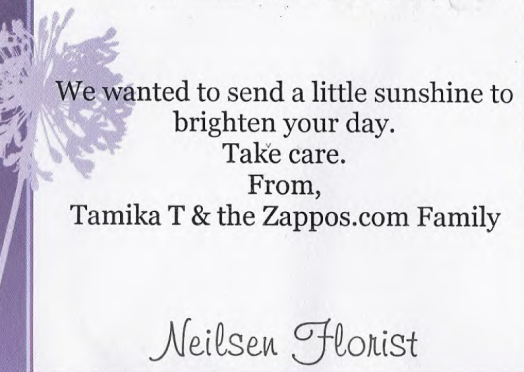
Zappos customer service reps took the situation one-step further. A couple of days later, I received an email from my father. He had arrived home to a beautiful bouquet of flowers with a note from Tamika T & The Zappos.com Family.
I can tell you that we (my father, sister and I) very much appreciated this gesture. It absolutely created a positive emotional association with the brand, and our likelihood of ordering from the company will go up. Not only that, but we have told many people about this experience as well as tweeted and blogged about it.
More companies would be smart to follow Zappos lead when it comes to branding – and I would add buzz building – via customer service.
In today’s highly competitive tech industry, it’s just not enough to have a great idea or a winning design concept – one needs to have the resources to turn that spark of creativity into a thriving company. Established entrepreneurs understand the need to weigh the costs and benefits associated with adopting different financial strategies like bootstrapping to keep overhead costs down versus taking on investment funding from angels or venture capital (VC) firms. While there are advantages and trade-offs to both models, generally speaking, companies with a larger working capital may have more options and resources at their disposal to invest in product development, attracting top talent, and making a larger PR splash.

We at Communiqué have extensive experience working with clients of all shapes and sizes, from Facebook Engineering in Seattle, Alaska Airlines, Seattle Children’s Hospital and Smartsheet to companies carving out entirely new markets like Spaceflight and AnswerDash. For our portfolio of clients who work with VC firms, building strong relationships with the communications contact within these firms is of paramount importance to help align PR strategies, compare media notes and collaborate on what has worked traditionally to help get the word out.
Throughout my years as a communications professional, journalist and marketing executive, I’ve had the pleasure of working with prominent VC’s from Manhattan to Sand Hill Road including Warburg Pincus, Mayfield, Madrona, Cascadia Capital, Ignition, Emergence Capital, Canaan Partners, Storm Ventures and many more. My experiences have never been short of spectacular since these firms typically go the extra mile to help mentor emerging companies and navigate them toward maturation and successful exit.
Recently Communiqué had a representative from one of Seattle’s most prominent VC firms Madrona Venture Group into our office for a brown bag lunch and general discussion about how the investment process works and the best ways for us as an agency to partner with them on behalf of their portfolio companies. PR agencies and VC firms have common goals – both desire to promote their clients through driving just the right media attention that highlights value proposition, customers and differentiation that can, in turn, positively influence perception and company valuation.
VC should also be thought of as trusted advisors and in some cases, as clients themselves since they often have a vested interest in the ongoing success of their portfolio companies as shareholders of the companies they represent. The communications contacts within VC firms often have a great collection of stories, advice and personal relationships with journalists that they can help leverage across their companies. In short, they want companies to succeed so there’s a clear incentive for PR professionals, VCs, agencies and internal communications teams to collaborate and help build a company’s brand.
As an entrepreneur, be sure to help foster and encourage these relationships since it allows your company to tap into the years of collective experiences. After all, this approach furthers our philosophy as a leading tech PR agency in Seattle – that together we can achieve great things on behalf of our clients through demonstrating industry knowledge, having the right connections and implementing PR strategies that truly make an impact.