
Insights for Leaders Navigating
Visibility, Credibility, and Growth.
From media strategy to reputation management, we explore the trends shaping public perception and share the approaches that drive measurable results for growing brands.
It’s that time of the year again—last week, the Associated Press (AP) released the 2014 edition of its AP Stylebook, better known to many as the journalist’s bible. If you work at all with media, you’re undoubtedly well aware of the book’s unique style and grammar rules. As PR pros, we likewise abide by the book to maintain consistency and make things easier for the journalists with whom we work.

Now, I’ve personally always been a fan of following proper grammar, style and spelling (or at least trying). They’re a reflection of our use of language and the roadmap for how we express ourselves. Abiding by a style guide in particular makes sure we’re consistent and not misunderstood—critically important in a field like PR, where successful communications makes up the very core.
However, this year, the AP seems to be easing up on some of its most notorious rules. All hell broke loose in March, for example, when the AP announced it would now accept the use of “over” in place of “more than.” Many journalists took to Twitter to express their frustrations. Others applauded the AP’s loosening up on what some see as overly strict or archaic rules. In any case, the change sparked an interesting debate around the fluidity of language—how much should we sacrifice “proper” grammar and style for the sake of modernity and ease of use?
Whatever side of the fence you’re on, this year’s stylebook updates are a reflection of our evolving culture and the trends that are sweeping society. In addition to the aforementioned rule change, the latest guide features a slew of new and updated sections, entries and terms in areas like culture, religion, food and social media, revealing the themes that matter most and are on people’s minds today. PR pros, take note—some of the most significant updates to the 2014 stylebook include:
- A comprehensive religion section with 208 new or updated entries from a variety of religions, including terms like megachurch, Zionism and Advent, as well as a detailed description of Easter
- New and updated diet, drink and food entries such as mixologist (i.e., “cocktail crafter”), Buffalo wings, aioli, Chobani (for the American Greek yogurt) and vegan vs. vegetarian
- Social media terms like Emoji, Snapchat, selfie and bitcoin
- Pop culture and politics entries including the addition of actress Lupita Nyong’o, comedian Louis C.K., songstress Sara Bareilles, “Frozen” star Idina Menzel and various notable politicians
- New science and medical terms such as HPV, MERS, in vitro fertilization and polar vortex
- Sports updates and figures including NFL draft picks Johnny Manziel and Jadeveon Clowney, as well as the recognition of football as the preferred international term for soccer
Other notable updates include terms like LGBT and (sic) as well as the AP’s controversial revision to the use of state names in stories. For a complete list of updated entries, be sure to pick up a copy of the updated AP Stylebook.
For more on why AP Style matters, check out our blog post, “Understanding AP Style and Its Importance.”
Looking back on my first six months in the PR industry, one of the most important skills I’ve learned is how to manage everything on my plate. Working at a PR agency requires exceptional time management and precise organization to stay on top of every client’s needs, and it only took dropping the ball on a project once for me to realize I needed a better strategy.
I turned to the master of organizational productivity, David Allen, to help get myself organized. His book “Getting Things Done: The Art of Stress-Free Productivity,” offers applicable advice about how to manage everything on your to-do list and is definitely worth a read if you’re a young professional or simply seeking a more organized life.
Following are the tips from David that I found most helpful and how I applied them to PR.
Categorize your work into phases
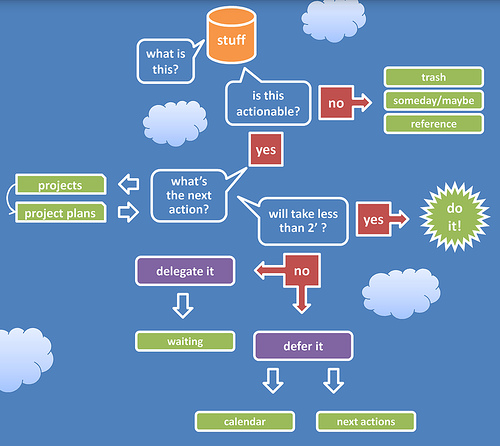
At the heart of David’s productivity system is a flow chart for categorizing mental work. When a new task arises he recommends asking yourself a series of questions to determine the appropriate next step. I’ve found it very helpful for managing my mental workload.
Get everything out of your head
Our brains are designed for fast decision-making, not storage. Trying to mentally track too many things at once is a major source of stress and you’ll inevitably forget something. Find a system that works for you to track every little task you need to get done. The key is creating a system that is always at your fingertips so you’ll check it constantly throughout the day.
For some, putting pen to paper every morning is the best way to track their to-do list. Personally, I think PR has too many moving parts, deadlines and follow-ups to simply use a hand-written to-do list. For example, if I need to follow up with a reporter a week from now, I don’t want to continue writing “Follow up with Tom on June 2” on my list every day, but if I let it fall off the list I might forget.
Instead I use an app called Wunderlist. It allows me to quickly add action items to my list and then sort them by due date. That way the things I need to do first are always at the top. If my list becomes too long I can narrow the view so I only see my daily tasks. I can also set reminders for certain tasks and make a task repeat on a regular basis. To top it all off, it’s accessible on my smartphone and desktop so my list is always on hand.
If Wunderlist isn’t your style there are plenty of other productivity apps out there. Forbes published a list of the best to-do list apps for 2014 that provides some fantastic alternatives.
Break down projects into tasks
Many projects are too big to accomplish in one sitting and including giant, looming projects on your to-do list will become incredibly overwhelming. For example, if your client has a big announcement coming up, writing “plan funding announcement” on your to-do list won’t be helpful, it will be overwhelming. It’s more effective to treat it as a project and break it into smaller tasks like “develop a timeline,” “identify media targets,” “draft a press release.”
Employ the two-minute rule
If a task will take less than two minutes, do it now! It’s much more efficient to simply get it done so you don’t have to think about it. Adding a multitude of small tasks to your to-do list will increase your stress and make it appear as though you have more work than you actually have. If you need to send a quick email to a client, just do it.
Developing a system to manage your workload takes time and experimentation. What other tricks have you found to be helpful for managing productivity in PR?
As a marketing major, I am constantly learning about the new ways that companies are attracting consumer attention and proving their brand’s value over the competitors. The ads and promotions that people commonly associate with marketing are those for consumer products. However, marketing is equally important for those companies seeking to create value for their business customers.
I recently read an article online at Ad Age titled, Do Your Business Customers Love Your Brand? This article broke down the steps of creating a brand platform with which your clients can align. This can be done by creating “brand movement,” which is “seeing where the brand is today and planning where it needs to be moved relative to the competition, to a position that takes the target rationally and emotionally closer to the brand, and of course moves the needle on business.” The following breaks down the steps to successfully implementing brand movement for your business.
Step one is the discovery phase. Here, a company needs to evaluate their product or service to more thoroughly understand how their customers interact with their product. Positioning yourself correctly in your product or service market is vital for customer retention and brand loyalty. Creating the correct positioning can seem like a daunting task, but can be divided into a few easy questions.
The article suggests asking five questions. First, what are the company goals? This includes an analysis of your current position in the market, what value and purpose your product or service serves, strengths and weaknesses of your company, and internal and external views of your brand.
The second question is how do your customers perceive your brand? This requires your company to define your customers and take a deeper look into the purchase decision process. What qualities do your customers expect from your product or service? Figuring out what customers expect and what they value will help you to create a better product and create brand loyalty.
The third question is how do consumers perceive your brand? At first glance this question looks to be the same as the previous, but this question requires analyzing how consumers in general view your product. In today’s internet-focused world, every message has the potential to be seen and or shared by everyone.
The fourth question requires analyzing your position in comparison to your competitors. It is important to understand your competitor’s offerings and why it might be tempting for customers to chose the competition over your product. Understand your weaknesses so you are never caught off guard by an attack from your competitors.
The final question is centered on the culture in which your brand operates. What dominant characteristics are present? Different age perspectives or varying regional cultures will change how your product will be marketed.
After asking the previous questions, your company can now move your brand with a new and improved platform. This second step involves creating a vision, mission, and position. The vision should articulate what the brand believes, whereas the mission should outline what the brand actually does through its products and or services to its customers. Your brand’s position is “the territory that [your] brand will unequivocally own – the immovable stake in the ground.” It is of the upmost importance that your product or service has some benefit over the competition, firmly planting your “stake in the ground.”
The final step in this marketing makeover is brand consistency. Now that your brand has laid out its vision, mission, and position, make sure it is consistent across all mediums. This includes events, promotions and advertisements, and all communications. The brand platform should be used as a tool in future decisions to ensure that it is in line with the company strategy and best interest of the customer.
Utilize your resources. Your employees are some of your best assets and can be a tool for promoting your brand as well. Create consistency by giving employees the tools they need, such as brand books and style guides.
Remembering the importance of creating value for customers, even when your brand is not in the consumer products market, is vital for survival in today’s customer-focused world. Using marketing to create the perfect brand platform will allow your company to position itself in way to not only retain current clients, but win new customers as well.
One of our clients recently asked us to come up with ideas to create visibility for C-level executives who are interested in building their personal brands in conjunction with building the corporate brand. It was a fun assignment and we outlined several strategies for helping them. One of these focused on regularly contributing content on LinkedIn. Below we have summarized some of the ways to do this on the popular social networking site for professionals.
Be a LinkedIn Influencer
According to its website, “LinkedIn Influencer is a designation given to approximately 500 professionals who have been invited to publish on LinkedIn. As leaders in their industries, geographies and seniorities, they talk about broad topics of interest such as leadership, management, hiring and firing, disruption, how to succeed, and more.”
Today LinkedIn Influencers include high-profile figures such as Richard Branson, Bill Gates, Arianna Huffington, and Guy Kawasaki.
Becoming an influencer is not an easy task, because you cannot apply for this status. LinkedIn staff invite people to be influencers. To increase your chances that LinkedIn will select you, we recommend appealing to the editorial staff with LinkedIn, being high profile, and having a breadth of content that will be relevant and interesting to LinkedIn’s members.
It is also important to know that LinkedIn may package Influencer content and market that content, as it deems appropriate.
LinkedIn also states, “The roster of Influencers changes throughout the year. We regularly evaluate existing Influencers to include only the most engaged, prolific and thoughtful contributors and to ensure that their expertise matches up with our members’ interests.”
Contribute Long-Form Content
If you don’t think you are likely to be invited to be an influencer, the good news is that there are other opportunities to contribute. LinkedIn will soon invite all its members to share information via a long-form post. Look for this invite via your LinkedIn homepage. If you do not want to wait for the invite, you can also apply for access here. (I have done this and am waiting to hear back from LinkedIn.)
According to an article in Bloomberg, “The company also added 30 new content channels – such as one focused on residential real estate – in the last week, drawing from more than 1 million publishers.” Personally, I have found it difficult to discover these channels on LinkedIn and am hoping they make it easier to find and subscribe to them.
Before you get started with publishing long-form content, please keep in mind:
- Your original content will become part of your professional profile.
- Long-form content will appear on the “Posts” section of your LinkedIn profile. LinkedIn will share this information with your connections and followers.
- Members not in your network will be able to follow you from your long-form post to receive updates when you publish next.
- Your long-form post is searchable both on and off LinkedIn.
For more information about long-form posts, please check out these guidelines.
Share an Update
If publishing long-form content does not appeal to you, you still can post thoughts, articles or other information from your LinkedIn homepage and several other places on the LinkedIn platform. For those who are too busy to create the long-form content, this can be a very effective way to stay top of mind and connect with other professionals. Specifically, you can create this information via updates from your homepage, via group discussions, from partner news sites such as the Wall Street Journal or the New York Times, and from LinkedIn Pulse.
So what is Pulse?
LinkedIn Pulse is a special “news” section on LinkedIn with a corresponding award-winning news-reader app that makes it easy to consume news on mobile phones and tablets. Content found on LinkedIn Pulse includes Influencer posts, member posts, publications, and SlideShare decks.
To get your content featured in the Pulse app, you will need to fill out a Pulse Publisher Feed Onboarding Form. To do this, visit http://www.pulse.me/publishers. I have done this, but have not yet heard back from LinkedIn. As a next step, I will likely reach out via email to [email protected] to check on the status of our application.
Finally, you should know that if you share a link on LinkedIn and choose to make it visible to “Public” or “Public + Twitter,” your picture could appear on Pulse.
Undoubtedly, the LinkedIn platform will continue to evolve, but for now, the information in this blog post hopefully will serve as a starting point for people wanting a brief tutorial on the publishing options available with LinkedIn.
I’m very fortunate to work for a company that supports its employees’ volunteer causes. From making financial donations to enabling employees to participate in volunteer activities, Communiqué PR fully embraces the spirit of giving back to the community.

One of the causes I’m passionate about is an annual volunteer trip I help organize to build houses in Mexico. Our group, “Club Baja,” isn’t an official 501(c)3, non-profit organization, but we’re simply a group of friends who rally our friends and family to do some good in the world.
We returned from our most recent trip in early May and over the course of 2-1/2 days, our intrepid group of 30 volunteers built two deserving families each a home and a latrine. It’s hard, manual labor, but completely rewarding.
As one of the trip’s organizers and its project manager of sorts, I’m tasked with managing a lot of moving parts—from coordinating with the non-profit organization on the ground in Mexico that helps us select the families, to managing the volunteer registration process. In the past I’ve used Excel to manage all of the trip details, but even this ubiquitous tool has its limitations.
There are four of us who organize the trip, and ensuring that everyone has access to the latest financial data or volunteer sign-ups can be challenging when you’re relying on emailing spreadsheets to distribute information and keep everyone updated. On more than one occasion, we’ve also run into the problem of document version control. There was definitely room for us to improve our operations.

Smartsheet is one of Communiqué PR’s clients, but long before we started working with them, we were using the spreadsheet-like tool to manage many aspects of the firm’s business operations and to collaborate with clients. Moving from Excel to Smartsheet was a natural transition for Club Baja and now we’re using it to manage most of the details required to pull off our annual trip, including:
- Tracking our expenses and income from registration fees and donations. Our organization runs on a break-even basis and knowing where we are financially at any given time is crucial.
- Storing documents such as registration forms, trip information packets and construction schematics.
- Tracking the inventory of tools that we keep in storage in Mexico so that we know exactly what we will need for our upcoming trip.
- Managing our volunteer information.
What’s great is that all of this is in one cloud-based location so that everyone involved with planning the trip can access the latest information and documents anytime, anywhere, and make changes if necessary. Plus, because Smartsheet is based on the familiar spreadsheet interface, using the tool is second nature.
Although Smartsheet is geared toward large companies or work teams, even small volunteer groups like Club Baja can use and benefit from enterprise-ready tools.
On Tuesday, May 6, the NBA named Oklahoma City Thunder player Kevin Durant as its Most Valuable Player (MVP). That day, during a press conference staged by his team, Durant showed his true colors as an inspiring and authentic leader.
During his more than 25-minute, unscripted acceptance speech, Durant spent little time talking about his own skills on the court. Rather, he chose to speak about the gratitude and love he has for his fans, his team and his single-parent mother whose sacrifices made it possible for him to become what he is today.
Nearly half of his remarkable speech was dedicated to his teammates. Although he could have given a generic “thanks for your support” message, he chose instead to speak to each of his teammates individually, calling out the things each does that make him a better player and a better leader. Everyone on the team—from veterans to rookies—heard his name and learned how important he is to Durant and to the Oklahoma City Thunder.
The attributes on which Durant focused when speaking of his teammates had little to do with basketball. He spoke of his relationship with them as people. We learned that Durant is inspired by Hasheem Thabeet’s smile and by Thabo Sefolosha’s selflessness. We learned that, after a tough stretch of games, Caron Butler slipped a piece of paper into Durant’s locker that read “KD MVP,” which touched Durant. We learned that Russell Westbrook “will run through a wall” for Durant and that he considers Serge Ibaka as a brother.
We learned many things about the Oklahoma City Thunder during Durant’s emotional speech. As he frequently fought back tears when talking of the men who made it possible for him to be named the league’s MVP (as well as scoring title holder), we learned that Durant’s humanity is a key element to his leadership style. Through watching his speech, we also learned what authenticity in leadership looks like.
According to Kevin Kruse’s “What is Authentic Leadership?” article in Forbes, most theorists agree that authentic leaders:
- Are self-aware and genuine. They show their real selves to their followers and don’t hide their mistakes or flaws out of fear of appearing weak. Durant regularly spoke of his own failures during the speech.
- Are driven and focused on results. They do the job in pursuit of results, not for their own power, money or ego. Durant’s efforts have paid off for himself, with the MVP and scoring titles, but have also brought light to his team and fellow players. This new title may also assist in additional advertising and ticket revenues for the organization.
- Lead with their heart, not just their minds. Authentic leaders aren’t afraid to show their emotions and vulnerabilities in order to connect. Durant’s speech was all heart, with many tears shed to prove it.
- Focus on the long term. Leaders realize that nurturing a company requires hard work and patience. Durant took time to address the many rookies who will likely be playing the game after he has retired.
Given that more than 2,000 articles have been published about Durant’s MVP speech, it’s clear that viewers have been moved by the authenticity with which he delivered it. Syndicated columnist Mark Shields—who doesn’t cover sports, by the way—shared his thoughts on the speech during his appearance on PBS NewsHour.
“It’s a tribute. It’s such a testimonial, and it’s so real,” Shields said. “What do we seek? We seek the authentic. We prize the real, the human, the humane, the unpretentious, the genuine. He was all of these things. And very few people knew about it. And it was just—it’s an absolutely touching exchange.”
If you haven’t had a chance to watch Kevin Durant’s MVP speech, treat yourself. You won’t regret the time spent to witness a stellar example of authenticity and leadership. Personally, I’ll be adding the speech to my media training toolbox as required viewing and an example to which my clients can aspire.