
Insights for Leaders Navigating
Visibility, Credibility, and Growth.
From media strategy to reputation management, we explore the trends shaping public perception and share the approaches that drive measurable results for growing brands.
On May 5, our very own Seattle Department of Transportation (SDOT) posted a tweet that received a large amount of backlash. In an attempt to deliver a traffic update with a touch of humor, SDOT referenced the popular meme “Scumbag Steve.”

Referring to this meme, SDOT tweeted a picture of slowed traffic near the site of an accident. The photo clearly demonstrates that people have slowed in order to view the accident, causing a long line up of vehicles. The image included “Scumbag Steve” hats imposed along the row of slow cars, while the tweet read, “You get a scumbag hat, you get a scumbag hat, everyone gets a scumbag hat! Haha I’m mean #sorry.” The tweet has since been deleted.
Given that SDOT is a state-run organization, many people took offense to the message insulting the public. An SDOT spokesperson released a statement to The Seattle Times saying, “Our traffic-management center staff typically will use a humorous meme to highlight a problematic roadway situation. Our intent is not to insult motorists, rather it’s just to call out where there’s a problem so people can make decisions about their trip.” Even the mayor weighed in on the situation. Ed Murray spoke to the Consumerist stating, “It’s never acceptable for a city employee to ridicule members of the public. I understand the Tweet in question was meant humorously, but many—myself included—took it quite differently.”
This incident raises an important question. In a world saturated with social media, where do we draw the line between being current or humorous and being offensive? Considering that traffic is typically a dry, uninteresting topic, should SDOT receive some credit for attempting to entertain its followers? Or would it be better off sticking to the facts and delivering traffic updates as simply as possible? Let us know your opinion on the controversial tweet.
We’ve had some fun recently working with one of our clients on an exciting company announcement. Seattle-based Spaceflight Inc., a spaceflight logistics company reinventing the model for launching small satellites into space, recently secured a launch service agreement for the maiden voyage of its SHERPA platform. The SHERPA, a free-flying satellite platform and in-space tug developed by Spaceflight, will deliver up to 1,200 kg of customer small satellites into low-earth orbit in 2015.

For those of you not space-savvy, this is a unique move. Launching a satellite into space is widely seen as being expensive and inaccessible for all but the largest companies and space agencies. The standard model involves a company purchasing an entire launch vehicle to deploy a single satellite. This is an inefficient use of resources and often prices out small-satellite customers working with smaller budgets— universities, startups, emerging space programs and others.
Spaceflight is changing up the norm and improving access to space for small-satellite customers by offering launch rideshare services. Instead of requiring customers to pay for an entire launch vehicle, Spaceflight piggybacks multiple small-satellites onto the extra capacity of a single launch vehicle. This translates to cheaper launch services and improved access to space for the customer as well as increased revenue for the launch service provider—a win-win.
Spaceflight’s own SHERPA platform builds on this unique approach with the capability to deploy multiple small satellites at considerably lower cost than was previously possible. To support the announcement, we targeted influential local, national and space industry outlets and reporters with the news, leveraging both Spaceflight’s unique business model and the SHERPA story. This strategy was successful, resulting in substantial industry and media interest as well as editorial coverage in many of Spaceflight’s key markets.
Here is a sampling of the articles generated by the news:
- Via Satellite
- Aviation Week & Space Technology (requires subscription)
- SpaceNews
- Puget Sound Business Journal
- Satnews
- SatellitePro
- Parabolic Arc
- NewSpace Watch
- Satellite Evolution Group
The best part about our job as PR professionals is supporting companies that are making the world a better place—in Spaceflight’s case, improving access to space for more people and organizations. Spaceflight has even more exciting plans in place for the road ahead and we look forward to continuing to support its business and communications initiatives.
For more on how Spaceflight’s shaking up the industry, check out www.spaceflightservices.com.
Creating meaningful content that perfectly displays your industry thought leadership can be an arduous process. So when you come up with something brilliant, why not utilize it to its full potential?

Repurposing can extend the life of your content and boost the number of people who see it. As Frank Strong points out in his PR Daily article on repurposing, there are a myriad of different ways to do this. Following are a few of the most effective.
Turn an article into a presentation. People are more likely to remember what they see than what they read (90 percent of information the brain processes is visual) so turning a written piece into multimedia is sure to be effective. Create a Slideshare presentation out of the most interesting elements of your article or blog post. Choose a piece that has bullet points or subheads so it can easily be broken down and be sure to add relevant, eye-catching photos.
Use statistics as social media fodder. Tweeting an interesting statistic from a blog post or white paper will likely lead readers back to the original source, effectively extending the life of your content.
Write a blog post based on a white paper. In the tech industry, a white paper is often written by a lead product designer to explain the philosophy and operation of a product in a marketplace or technology context. They provide a wealth of facts, statistics and explanations about your client’s products and industry that can serve as the backbone of a compelling blog post.
Syndicate your blog posts. There are many benefits to syndicating your blog posts – more reach, visibility, sharing and traffic to name a few. Many publications accept syndicated content, but make sure your post matches the audience of the publication you pitch. If you pitch to the wrong publication, even if they decide to publish your piece it won’t be reaching the right audience so your efforts will be wasted.
These are just some of the ways to increase the life of your content. What other suggestions do you have for making your content go the extra mile?
Social media is relatively new, but it has proven to be a vital element in the customer-engagement equation for businesses. With the constant changes taking place on social channels, it is important for companies to understand how to best use these valuable tools for gaining attention from target audiences. In particular, recent changes on Facebook and LinkedIn will certainly begin affecting how journalists, marketers and PR professionals use social channels.
Facebook has been undergoing some significant changes that will affect how companies can reach their audiences. Previously, companies could create a Page, essentially a company or brand Facebook profile, and push content to their audiences through this medium. However, the ease and low cost of this source may soon not be as effective as it once was.
According to Ad Week, Facebook has recently been reworking its news feed algorithm, making it more challenging for companies to get impressions from their content, no matter how clever they may be. An anonymous source from Valleywag claimed that Facebook is reducing the organic reach of Pages to 1 or 2 percent. This move will make it continually more challenging for companies to reach their audiences through Facebook posts, eventually forcing companies to pay for ads on Facebook instead.
A Facebook spokesperson responded to this change on CNET: “We have not given a specific reach number that Pages should expect to see because organic reach will vary by Page and by post. Like many mediums, if businesses want to make sure that people see their content, the best strategy is, and always has been, paid advertising,” the spokesperson said.
While that might make it more difficult or costly to reach audiences, Facebook recently announced a new tool that will be valuable for journalists, which PR professionals should note as well. FB Newswire is a public page of real-time news that will curate original pictures, videos and status updates on the latest news, weather, entertainment and more. According to the Wall Street Journal, Storyful, a social news-verification company, will monitor FB Newswire. Each photo, video or status update on the page will link back to the user’s personal Facebook page, giving journalists the opportunity to contact the user for the information around the post. PR professionals will need to take note of the changing ways journalists get their news leads and possibly re-strategize depending on how successful FB Newswire is.
LinkedIn recently announced another change in the social media world. In just a few years, LinkedIn has made a variety of changes to the way the site aggregates news and then pushes it to audiences. An article from the Huffington Post highlights LinkedIn’s recent timeline of change. In 2011, LinkedIn introduced LinkedIn Today, a news aggregator. The following year LinkedIn created LinkedIn Influencer, which is a blogging platform for thought leaders and experts selected by LinkedIn.
LinkedIn recently announced LinkedIn Publishing, giving each user the opportunity to create content, a privilege previously reserved for the select 150 leaders and experts. LinkedIn Publishing is an exciting new tool that enables companies to potentially increase brand awareness. Essentially, it will give users access to share their blog posts to the LinkedIn community. LinkedIn Publishing will give PR professionals another outlet to assist clients with reaching their target audiences.
Social media is still relatively new, but even so, is constantly changing. Social channels must encourage community involvement (as has real-time news) in order to keep the interest of users, journalists, marketers and PR professionals alike. FB Newswire and LinkedIn Publishing have the potential to be two useful sources, and it will be intriguing to see how these social media sites affect the PR industry.
This week was an exciting one with the work for our client Smartsheet, a leading provider of a collaborative work management tool that we and 42,000 other businesses use every day. On Monday, May 5, 2014, Smartsheet, already well on its way to changing the way that enterprises work, announced it has secured another $35-million round of financing. As part of this announcement, the company also unveiled the names of some of its largest enterprise customers—Google, U.S. General Services Administration (GSA), Netflix, Office Depot, Groupon, Intercontinental Hotels Group, Pearson, Unisource, Oceaneering, and McGraw-Hill Education, among others.
Reaction to the news was overwhelmingly positive, with coverage in more than 20 news outlets. In case you missed the news coverage, below we have included links to the articles.
- Forbes
- Xconomy
- The Seattle Times
- Hispanic Business
- Bloomberg
- CITEWorld
- GeekWire
- Gigaom
- VentureWire
- Fortune
- FinSMEs
- The Wall Street Journal
- Puget Sound Business Journal
- Silicon Valley Business Journal
- eProfits
- Pulse 2.0
- Techmeme
- TMCnet

I’d like to add how easy Smartsheet makes coordinating a significant announcement such as this. With the Smartsheet tool, we were able to review press lists simultaneously with VC partners, track editorial coverage and access and easily share assets such as images with journalists. We also used the tool to set up a master media interview schedule and share it with our client and VCs. An additional benefit of Smartsheet is that it can be accessed from multiple types of devices.
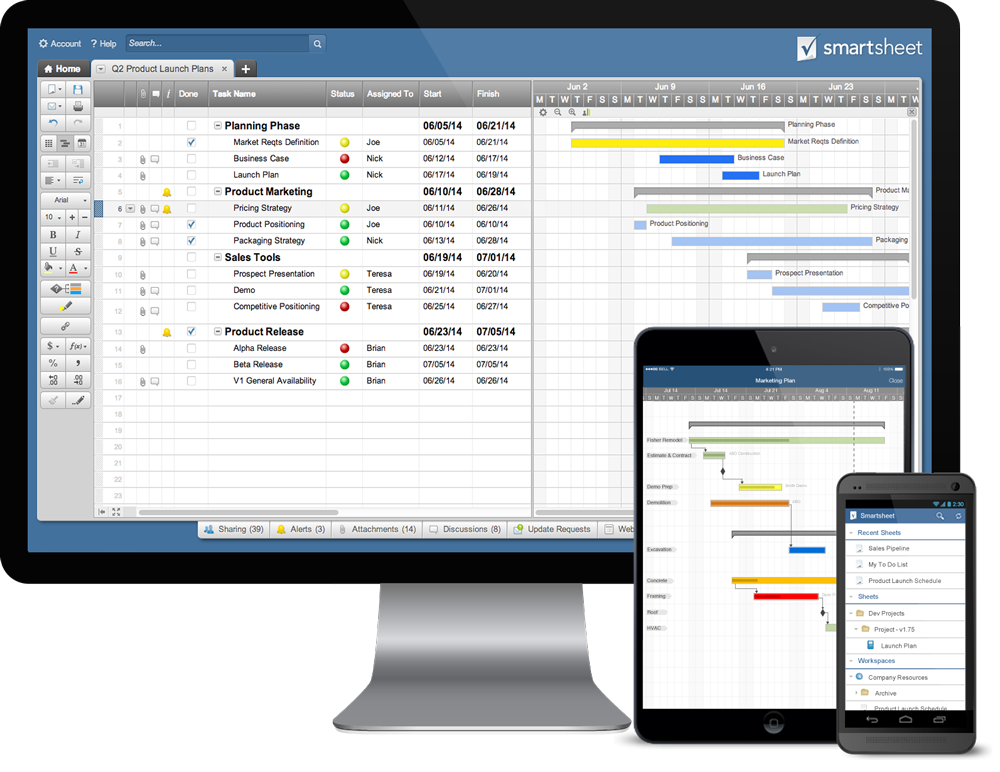
We are excited about upcoming enhancements and plans that Smartsheet has in the works. From our perspective, the tool just keeps getting better with new features including Resource Management. (We wrote about the Resource Management functionality, which Smartsheet added earlier this year, in a guest post featured on Cision’s website.)
Smartsheet’s Resource Management lets Communiqué PR’s team add allocation data to existing projects and tasks. This information is then compiled into a central sheet, where account managers can easily see all staffers’ project loads in one place. What could be more helpful!
Stay tuned for more news from Smartsheet. With funding totaling $70 million, a valuable product and happy paying customers, the company is well poised for success.
Many articles have been written about the optimal times to post on social media, most with varying opinions, but on this we can all agree: Timing is everything.
A recent infographic published by SurePayroll summarizes the best and worst times for posting, pinning and tweeting. According to the infographic:
- On Facebook, updates posted between 1 p.m. and 4 p.m. result in the highest average click-throughs. The worst times are weekends before 8 a.m. or after 8:00 p.m.
- The best time to post on Twitter is Monday through Thursday between 1 p.m. and 3 p.m.
- For LinkedIn, posting Tuesday through Thursday will increase your chances for engagement.
If you’re trying to reach a business audience, these times make sense and correlate with our own observations and experiences with the social media activities we manage for our clients.
Just as important as knowing when to post is knowing what to post. Unless you work for a large company with a dedicated social media manager, ensuring your social media channels are updated with a regular schedule of posts can be challenging. To help meet this challenge, consider developing a social media editorial calendar.
With an editorial calendar you can map out your posts for the upcoming week and beyond. Your editorial calendar can be as granular as including the actual copy/text for an upcoming post for a specific day. Or, you can use the editorial calendar to assign a theme for a particular day, such as on Mondays you’ll publish posts that revolve around industry research or data, on Wednesdays you’ll highlight one of your products, etc.
While you want to be nimble enough to react to trending topics and breaking news, laying out your publishing schedule in advance with an eye toward the best times to post on a particular social media platform, can maximize your time and effort.
For more information and facts you can use to optimize your social media activities, check out the full infographic below.