
Insights for Leaders Navigating
Visibility, Credibility, and Growth.
From media strategy to reputation management, we explore the trends shaping public perception and share the approaches that drive measurable results for growing brands.
Getty Images recently announced its decision to make some, but not all, of their images free. Nearly 13 million images without watermarks will now be available to the public by simply embedding a code for the image. These embedded images will contain a footer with credit linking to the company’s licensing page.
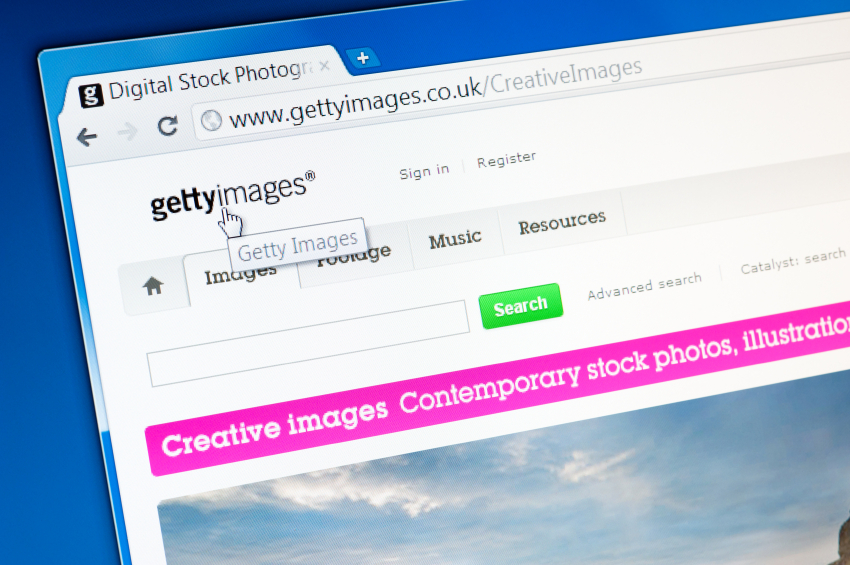
We have been paying to use Getty’s services for years, so after hearing that free images are now available, I wondered, what’s the catch?
In the past, Getty images could be Googled and then captured with a screenshot that did not include watermarks. This process of attaining images is illegal. Getty understood that this was taking place and sought to prevent illegal use of images. The company reasoned that by offering some images for free, there would no longer be a motive to use images illegally.
Mashable pointed out that through these new embeds, Getty will have the opportunity for a new source of revenue. Getty will now have the ability to “gather user information and run ads within branded, embeddable frames.” Another potential “catch,” noted by The Verge, is if Getty were to remove the image from public consumption, the embedded image would disappear from where you placed it as well.
As Ragan’s PR Daily pointed out, it is important to note Getty’s terms of use. These embedded images are not for commercial use, including advertising, promotions or merchandising. Furthermore, the terms prohibit use of these images for endorsement or sponsorship.
These free embeddable images, however, enable private users to enhance their work with images, all while doing so legally. As long as Getty does not remove your image and you are willing to bear the credit footer in your image, these high quality, free images are quite the steal. Getty has made it easy for anyone – from bloggers, social media users, and companies alike – to use the power of images to strengthen their piece.
Recently, as I browsed articles on Ragan.com, I came across “What PR courses should teach undergrads,” written by Ed Zitron. The piece caught my attention for a couple of reasons. Earlier this year, we received word that our book, “Strategic Public Relations: 10 Principles to Harness the Power of PR,” would be used as a textbook at Xavier University for a course taught to juniors. Secondly, we often have college students as interns and, whenever possible, try to hire them.

In his article, Zitron explained that he took a PR course at a major state university and it did not address how to work with the media. He then shared his perspective on the core elements he’d recommend applying to every curriculum, which included a heavy concentration on media relations, especially those related to the relatively new “social” variety.
While I agreed with many of Zitron’s points, I do wonder about his assertion that educators are not teaching the right theoretical information to their students. My experience is limited, but I have found that graduates of the University of Washington—especially those majoring in communications and journalism—are well prepared for their work in PR.
When Communiqué looks for entry-level PR people, our ideal candidates are ones who possess excellent critical thinking and communication skills, not necessarily ones honed at university-level PR courses. I believe a strong manager can provide training around the mechanics of research, the ideal elements and length of a pitch, how to use social media, or any of a number of specific PR elements, but it is much harder to help someone develop intellectual horsepower.
The world of PR needs people who can deal with concepts and complexity comfortably, who are quick at separating fact from fiction, who can find some success at building a strong network and media connections, and who are good problem solvers. While I agree with Zitron that it would be good for PR programs to teach some of these more granular tactical lessons, I think our major educational systems must continue to develop core competencies around critical thinking, persistence, negotiation and communication.
With those skills and some dedication, fine-tuning a successful career in public relations is certainly attainable.
The challenge put forth by organizers of the annual National Day of Unplugging seemed easy enough: Do you have the willpower to unplug and unwind without electronics for a full 24 hours?
I stumbled upon the National Day of Unplugging late last Friday afternoon as I was looking for inspiration for this blog post. For me to say I like a good challenge would be an understatement. Plus, I really needed a topic for a post so I accepted the challenge.
Like for many, planned vacations are really the only time I come close to unplugging from electronic distractions. But even then, while I may not be checking my phone for work email or monitoring feeds for the latest breaking news, I’m checking personal email and constantly scanning Facebook for the latest updates from friends and family.
On the weekends, I check my personal and work email accounts eight to 10 times a day. Add to that the time I spend checking Facebook, Twitter, Pinterest, Instagram and a host of other apps, and I’m on my smartphone, tablet or laptop a good portion of the day. I don’t always respond to work emails, but I like to keep an eye on things just to make sure nothing is exploding or requires immediate attention. With PR, there is an expectation, perhaps more self-imposed, that you are available 24/7. Breaking news and crises wait for no one and you have to be ready to act swiftly when necessary. Plus, seeing what awaits in my inbox makes the transition from weekend to Monday much smoother.
So what did I do for 24 hours without my mobile appendages?
- I went on a walk with a friend (hastily scheduled before my 24-hour electronics fast) and even took off my Fitbit activity tracker.
- Rather than draw culinary inspiration from the dozens of recipes I’ve saved on Pinterest or from one of the nine food/recipe apps on my tablet, I turned to my many cookbooks gathering dust in the kitchen.
- I got lost in a book and read the newspaper, savoring the feel of the paper and the smell of the ink. I even caught up on last Sunday’s New York Times, which sat atop a pile of other barely touched Sunday editions. Reading the actual newspaper gave me a greater appreciation for the journalists and staff who produce them. As newsrooms continue to shrink and circulation numbers dwindle, I felt compelled to support the industry that we as PR people rely on so heavily for success, so I renewed my home delivery subscriptions to the Seattle Times and the New York Times (after I was able to plug back in).
- I worried that I was missing something urgent for work or with friends.
All in all, I lasted 23 hours and 50 minutes. I had to make one exception to my no-electronics rule to find an email containing information for a friend’s father’s memorial service, which I did look for first in the obituaries section of the newspaper. In my book, supporting friends wins over austerity almost every time.
Now in its fifth year, the National Day of Unplugging starts at sundown on the first Friday in March. In a field like PR it is difficult to completely unplug without a little pre-planning to lessen one’s angst, but I’m planning to observe National Day of Unplugging again to remind me of the distractions that keep me from connecting with my environment and my community.
Could you live without your smartphone, tablet, laptop or any other electronic device for 24 hours?

If they’re in the tech industry, they had better learn.
Too often in the tech world you hear about a divide between engineering or product management teams and groups like PR or marketing. It’s easy to see why this could be the case. You wouldn’t ask your PR team to be fluent in Python or C++ any more than you would ask your engineering team to study AP Style.
But to successfully tell your company’s story, to represent the brand and pitch the product, your PR team does need to be fluent in said product’s function, its value to customers, and the intricacies of its operation. And yes, if your company is making hardware or software, your PR team should be using it!
This is true at companies large and small, but can be especially impactful at startups or small businesses where product development roadmaps can change suddenly and dramatically, leaving little time for a ramp-up on technical know-how and lingo.
How can your PR team get a handle on the technical details of your product?
- Get hands on. Wherever possible, your PR team (whether in-house or agency-side) should use your product daily. As we’ve written about previously, the team at Communiqué PR uses Smartsheet—our client’s product—to manage many of our day-to-day projects, track deadlines and to keep an eye on how busy each of us is. There’s no better way to understand your client’s or your company’s product than to make it a part of your daily routine.
- Let PR and product teams collaborate early and often. You already have a tremendous technical knowledge base under your roof: your product development teams. Working with cross-functional teams is a crucial component of success at any modern business. So to keep your PR team in the loop, make sure they have plenty of chances to interact professionally and casually with your developers, engineers and product managers. A two-way flow of information between these teams helps everyone learn about the product, internal processes and each other. Building bridges between these teams can help prevent a panic on your PR team next time a product launch is cancelled, specs change, or you ship a new version of your API ahead of schedule.
- Your PR team should speak your product’s language. If a reporter asks your PR team about your SDK, API or IDE, they need to be able to answer—or at least know who to ask. Tech PR teams need to be able to translate industry jargon into easily understandable language—I call this the “explain-it-to-your-mom principle.” But to do this, they need to understand the jargon themselves. This comes from spending time immersed in your product and from consistent collaboration with product teams.
- Understand the competition. It’s not enough that your PR team has a working knowledge of the product. They need to know what you’re up against, inside and out. This means sending your PR team to industry conferences and trade shows, staying on top of press and analyst coverage of competitors, and being able to answer intelligently, “Why is your company different?”
Don’t let your PR team’s eyes glaze over next time the conversation turns technical. In this industry, the product is everyone’s business, and your PR team should have a deep understanding of it as well.
When it comes to social media, some brands have it easy. If they have an interesting product that people widely enjoy, gaining followers is not as daunting a task. For instance, GoPro has 888,000 followers on Twitter because
they are constantly posting interesting photos and videos captured by their cameras. Starbucks is another brand that is openly adored by most and their following of 5.8 million is further proof that admired brands maintain a strong presence through social media.
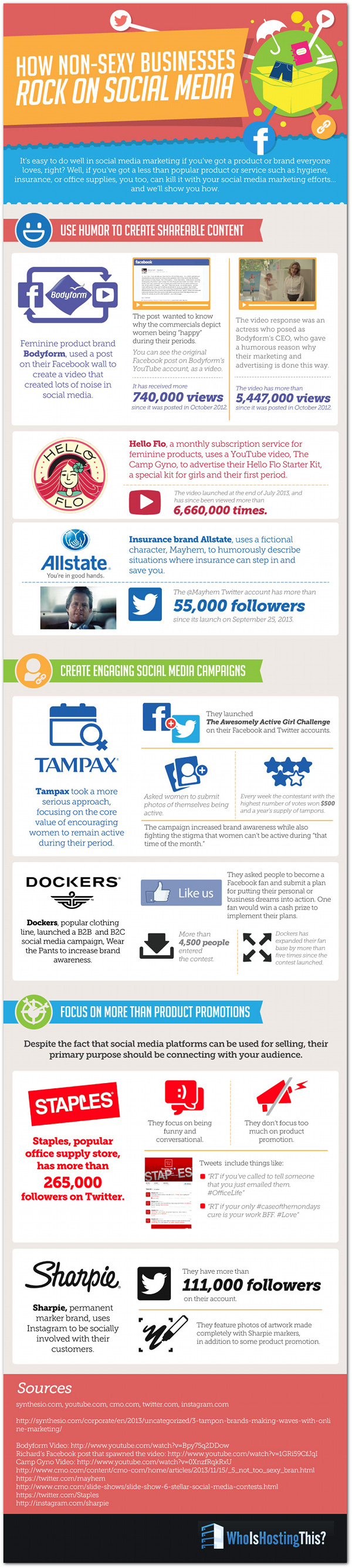
But, what if your brand sells office supplies? Or insurance? How can these simple, seemingly uninteresting brands gain traction on social media? Who Is Hosting This? recently posted an infographic offering three main pieces of advice when it comes to gaining popularity on social media.
First, use humor to create shareable content. Allstate Insurance launched a twitter handle for their character mayhem in September 2013. The handle already has 55,000 followers.
Second, create engaging social media campaigns. Tampax created a campaign that encouraged women to be active while on their periods and post about it. Every week they gave away $500 and a year supply of tampons.
Lastly, focus on more than just product promotion. Staples has developed a handle that focusses on being conversational and posting tweets that people can relate to rather than focusing on product promotion.
Ultimately, any brand, whether it sells feminine products or insurance, can create an interesting story to attract an audience. For more examples of successful social media accounts from “non-sexy” brands, view the infographic below.
As any savvy PR pro is aware, the state of the media is in constant flux. New media platforms have meant new opportunities for journalists to locate stories and ideas. Social networks have provided robust new ways to connect with influencers. Evolving technology has led to new mediums for breaking through the noise.

With an ever-changing landscape, it can be difficult for PR pros to keep up and know what works best when it comes to media relations.
I recently participated in a webinar, hosted by Vocus, about the state of the media and its implications for PR. The session featured speaker Gini Dietrich, founder and CEO of integrated marketing communication firm Arment Dietrich, who broke down Vocus’s “State of the Media 2014” report to offer useful takeaways for PR pros. The report surveyed a random sampling of 256 journalists to provide a snapshot of the current media outlook.
Here, I thought I’d share a few of the most interesting insights I learned—and what they mean for PR—from Dietrich’s breakdown of the report:
- Media relations has changed a lot. Or has it?
The rise of social media has undoubtedly changed the way we communicate. The media industry is leveraging new mobile and digital platforms that offer tremendous opportunities for connecting in new ways. The global nature of these networks means the chance to reach individuals to whom we previously would not have had access.
At the same time, the same strategies continue to apply when it comes to working with the media. “Nothing has changed from a media relations standpoint,” Dietrich said. “We just have new and interesting tools to do it.” Despite all of the new technologies, at day’s end we’re really still just dealing with human beings.
For PR pros, that means that the most successful pitches still require building solid relationships with journalists—relationships that still take time. Dietrich warns that, while you may already have a great relationship with a journalist on social media, as soon as you pitch a story you take that relationship to a new level. Don’t let the fast pace of social media prevent you from being as engaging, creative and focused on quality interaction as ever.
- Social media: Good for relationship-building, bad for pitching.
Despite journalists’ avid use of social media—only 2 percent reported they don’t use it—a whopping 97 percent still prefer to be pitched via email, according to the report.
Dietrich explained that journalists generally don’t want to be pitched via social media for two reasons. One, they don’t want their competitors knowing what they’re writing about or who their sources are. Putting that information into the public realm gives competitors the chance to scoop stories and sources. Two, it’s not nearly as easy to track information over social media as it is over email. Email offers a quick, searchable and comprehensive archive of conversations.
This doesn’t mean PR pros should avoid social media altogether when it comes to media relations. Journalists do use social media heavily for engagement—that means for locating story ideas and sources and, yes, even networking with PR pros. Dietrich’s advice? Use social media to build a solid relationship, then switch to email to actually pitch the story.
- Your new PR strategy: increasing page views.
One of the greatest reasons journalists use social media is to promote their work. Journalists are always striving to increase page views of their stories—which translates to ad dollars. That means that if you can help increase viewership of their work, they will be much more willing to work with you or include your client in stories. “They might not say it, but they’re definitely thinking it,” Dietrich said.
According to Dietrich, what journalists often want to know is whether you can help them with their reporting in relation to promotion. If they run your article, are people going to click? Do you or your client have engaged followers on social media who would circulate their work? Is your client influential or producing content that would lead readers to their stories?
To translate this into actionable terms: Show journalists exactly how you can help them in your pitches. Explain how you can promote their work through your own or your client’s large or engaged social networks. Make photos, videos, visual information and other multimedia a part of your pitches that will help draw readers to content. Tactics like these result in a win-win for both parties—and give you a much higher chance of placing a story.
For more insights, you can download a copy of the full “State of the Media 2014” report from Vocus here.