
Insights for Leaders Navigating
Visibility, Credibility, and Growth.
From media strategy to reputation management, we explore the trends shaping public perception and share the approaches that drive measurable results for growing brands.
Why do some agencies have a significant amount of client churn, while others maintain long client relationships? I posed this question to one of our clients, James Mustarde with Twisted Pair Solutions in Seattle.

James has a unique perspective on this topic because early in his career he worked for a PR firm on the Rolls-Royce Motor Cars account, where one of his job duties was to manage test drives by European motoring, lifestyle and mainstream news journalists. Today, he works “in-house,” and has managed scores of vendors (including PR firms, ad agencies and web designers) over his career.
The agency and client-side experience give James a unique perspective on building long-lasting agency relationships, and I think PR practitioners everywhere would be smart to adhere to his best practices, which I have recapped below.
1) Strive to have a deep knowledge of the industry. To wow clients you need to work hard at understanding their industry. For instance, do you know the top competitors, the competitors’ positioning and how they rank in the industry? Are you knowledgeable about the current strategies and tactics the competition is employing?
2) Go “above and beyond” to add value. Just doing the work is not enough. Sure, it is easy to focus on the day-to-day work, but you also need to add value by regularly sharing information that will help your client’s organization be successful. You can do this by flagging a competitors’ campaign, demonstrating new ideas, introducing them to a new influential contact or uncovering and sharing market stats.
3) Convey a sense of confidence and trust. Clients need to know that you will provide them with current, complete and actionable information. They need to know they can count on you during good times as well as stressful ones, and that you care about them and their business.
4) Be reliable and dependable. They also expect you to follow through as well as do what you say you will do and check back if there is a problem. These types of behaviors also build trust and are essential to long-term successful relationships.
5) Drive to produce tangible results. Your client also needs to know that he or she can count on you to exceed goals successfully. You need to demonstrate you can steadfastly push yourself, your team and your client to secure results. Results might be placement of articles, securing speaking opportunities, setting up a press tour or briefings with analysts. Find out what your client values and deliver.
We at Communiqué PR strive to demonstrate these behaviors. We also regularly work to secure input from our clients so we understand their perceptions around our work and service ethic. We also understand that, while James’ values these performance dimensions, other clients may have different needs or be looking for different contributions.
The Pew Research Center recently released its “State of the News Media 2014” report, which contains some unsurprising information about the growth of digital news consumption and publishing.

Consumption of news on mobile devices and via social networks is still trending upward: About half of Facebook’s users read their news on Facebook for instance, whether they intend to or not. And while many of us still turn to newspapers—print or online—for our news, the industry’s face is changing. The Pew Center analyzed employment numbers at newspapers and at digital news outlets, and it found that these digital outlets employ about 5,000 full-time editorial professionals. Many of these positions were created in the last year. The print world still accounts for a bulk of editorial jobs (38,000, according to the American Society of Newspaper Editors and Pew), but that number is trending downward.
Given these trends, it’s not surprising that news outlets like The Washington Post, newly bought by Amazon’s Jeff Bezos, are expected to focus more and more on digital, or that there are a few newcomers on the block making waves in the digital space. For public relations teams, it’s clear that there is tremendous opportunity to start building relationships and working with new, native digital outlets.
With that in mind, here are a few outlets that we are keeping our eyes on in 2014 (from our smartphones, of course):
- Quartz: Quartz launched in 2012 with a focus on delivering news to tablets and mobile phones. Its layout, content and even its short URL (www.qz.com) are optimized for mobile viewing. Its coverage focuses on business and economic topics—what it calls “the new global economy.” Quartz beefed up its editorial staff with heavy hitters in journalism, pulling talent from the likes of The Wall Street Journal, Business Insider, The Economist’s CFO magazine, The Financial Times and others household names. I have been impressed with Quartz’s reporting on economic trends, its coverage of technology and business news and its emphasis on reporting on and visualizing data. It has become a fixture of my Twitter timeline and my morning news reading, and I expect it will become a go-to outlet for business interest stories this year. In January 2014, Quartz topped 5 million monthly unique visitors.
- Vox.com: Vox.com is the newest outlet on this list: It launched officially on Sunday, April 6, 2014. The outlet made a tremendous splash in media circles when it pulled public policy writer Ezra Klein away from The Washington Post to lead its newsroom, a move reminiscent of BuzzFeed’s hiring of Ben Smith from Politico. At launch, Vox.com’s home page doesn’t feel fully fleshed out, and I expect to see significant changes to its design and features relatively quickly (its editors indicated as much in a blog post at launch).
Vox.com’s editorial team wants to bring greater depth and understanding to the biggest topics in the news, issues like the crisis in the Ukraine, Obamacare enrollment and GM’s unfortunate recall. It looks like its editorial team will be looking for in-depth stories, backed by data and visuals – each of its articles is published with a series of “cards” that provide more context or detail around topics featured in an article. I am curious to see if Vox.com will succeed in building readership around this approach to in-depth coverage, and what approach their editorial teams take to covering topics other than trending, global news.
- Medium: Ev Williams, the founder of Twitter, launched Medium in 2012. Medium is a blog publishing service that lets anyone with a Twitter account contribute. Readers can vote an article up or down, either increasing or decreasing its visibility on the site. The platform has grown considerably since is launch and it has attracted more and more big names as contributors. Elon Musk, for example, recently wrote an article detailing an update to Tesla’s Model S electric vehicle—the type of piece typically reserved for a corporate blog or newsroom.
Medium’s articles are organized into collections (topics) which range widely in specificity. Musk’s article was included in Medium’s “Tesla collection,” but other collections include topics like “College and Careers” or “Today’s Tech.” Interestingly, Medium just announced a deal with ESPN FC to produce a collection of articles on soccer’s upcoming World Cup. While anyone can publish stories to the collection, Medium’s editors will choose articles to feature on ESPNFC.com. This is a great opportunity for writers to get their content noticed.
I suspect we will see more arrangements like this coming out of Medium. While its content can feel a bit like “inside baseball” for Silicon Valley—or a collection of TED talk scripts—Medium is attracting quality writing talent and its authors are producing interesting, thought-provoking content. When The New York Times covered Medium in March of this year, it cited that the site receives about 13 million unique visitors per month.
- The Washington Post: Ever since Amazon’s Jeff Bezos bought the Post in 2013 there have been questions about which direction he’d take the paper. So far it seems not much has changed. The National Journal’s Matthew Cooper wrote about Bezos’ potential plans shortly following the acquisition, floating ideas like pre-loading the Post on Amazon’s Kindle e-readers or creating more “viral”-style articles designed for sharing on social media. According to the Alliance for Audited Media, the Post’s digital circulation is lagging quite a bit behind some of its national competitors like The New York Times and The Wall Street Journal, so this is the obvious area where Bezos could make an impact. At this point, it is hard to speculate about any specific changes in the pipeline at the Post, but we will be watching closely to find out.
- Upworthy: Upworthy might be best known for its “clickbait” headlines, but it has—for better or worse—created a successful model for sharing news content online. According to its data, Upworthy sees more than 50 million unique visitors a month, and its average piece of content drives more than 75,000 likes per post. Those are big numbers, and it tells me that news models based on social media and sharing can have a bright future. However, Upworthy’s headlines have drawn scorn and satire from many users. Facebook users have complained that the outlet’s posts are nothing more than spam and its headline format has become such a meme that it spawned the parody UpworthyGenerator.com.
The site recently began accepting sponsored content from companies, such as its recent deal with Unilever to sponsor certain sections of the site. Upworthy may be straddling the line between viral content and spam, but it has certainly proven that media outlets can drive views and engagement via social media. More broadly, there is a lot to be learned from Upworthy’s sharing model and how it can apply to more in-depth, quality journalism.
- Lifehacker: Lifehacker has been around for years, sharing helpful tips on everything from effective work habits to the best tricks to clean your shower. Recently, though, I’ve seen more and more users turning to Lifehacker for tech stories, tips, tricks and product news. Lifehacker has long been a mainstay website for the geeks among us, but lately it’s a great place to educate potential customers—either businesses or consumers—about your product or service. It has recently profiled a number of web apps focused on productivity at the workplace, for example. With about 10.5 million monthly readers and more than 1.2 million followers on Twitter, its articles reach a huge number of eyes.
New blogs and digital news outlets appear every day, and these are just a few of the outlets that we have our eyes on for 2014. I expect these outlets to make a splash this year and our team at Communiqué is looking forward to staying on top of these trends. If you have a favorite native digital news outlet, we would love to hear it in the comments!
Attending any event can be intimidating and present a ton of pressure to stand out among a large crowd. Just last month, SWSX, an event took place in Austin, Texas, that offered its unique convergence of original music, independent films, and emerging technologies. Mark Dewings, head of brand and marketing communications at SoundCloud, offered PR Week some insight on how to make your presence known at this well-attended annual event. With SXSW V2V – an extension and re-imagining of the legendary SXSW experience – taking place this summer, I was inspired to share Dewings’ adaptable advice.

Conferences similar to SXSW tend to have high attendance rates. Last year SXSW V2V drew some 1,500 professionals. That poses the question: In a crowd of that magnitude, how do you separate yourself from the group? Dewings response emphasizes two points: building relationships and being creative.
Become a part of the community. There are multiple ways to do this. One is to serve on panels and become a part of showcases. Apply for any opportunity available to present you or your client to the group. This will allow you and the brand to become the focal point of a meeting or presentation rather than remaining unknown.
Social media also provides an opportunity to get involved. In the past SXSW and other events have displayed screens with live Twitter feeds, providing yet another opportunity for exposure of your company and its activities. Whether you tweet about your presentation or your favorite part of the conference so far, it is an easy way to display your brand’s name.
Lastly, at an event this large product launches often struggle to gain traction. Do your best to engage people with your product whenever possible, whether it is during an official presentation or a quick meeting during a networking opportunity.
Use creativity. This applies to any and every aspect of your experience at a conference. A lesson Dewings learned after his 2013 SXSW attendance was that his company didn’t have to limit its reach to the audience attending SXSW. Be proactive before, during and after the conference. This is an excellent opportunity to engage your followers, not only about your product but also about your conference experience, allowing others to “attend” the event with you. Also, come up with unique ways to present your product. A simple presentation will not make an impact. Find a unique space and an interesting story that will make you and your brand memorable.
At an event this large, standing out is no easy task. Dewings describes the ultimate goal as “cutting through the clutter,” meaning that your brand should not be one that goes unnoticed. Rather, your brand should be one that takes advantage of this opportunity and uses it as a platform to promote your product and your brand. Dewings’ versatile advice is applicable to any conference you or your client may be attending – leverage it and make the most of your time there.
Content today is produced and consumed at a mind-blowing rate. From news to blogs to social media and multimedia, just about anybody these days with an Internet connection can add their own content to the mix. At the heart of all this content creation lies the selfie. More than just your average duck or kissy face, the selfie represents something much bigger: the power of people to create and disseminate their own visual media.

With audiences able to produce their own content at an insanely fast pace it can be difficult for brands to compete and inject their own messages into the mix. In a world of selfies, self-obsession and social media, how can brands produce content compelling enough to rise to the top?
A colleague and I attended a seminar last week, hosted by PR Newswire, which sought to answer that exact question. The session, titled “How to Keep Your Content Relevant in the Age of the Selfie,” featured Michael Pranikoff, PR Newswire’s global director of emerging media, who spoke to factors brands must consider in order to create content capable of breaking through the noise. I thought I’d share some of the useful insights I gleaned from Pranikoff’s talk about what it takes to create standout content.
According to Pranikoff, brands should strive to create content that:
1. Appeals to emotion. Creating great content involves more than just thinking about what will entertain viewers. The best kind of appeal, according to Pranikoff, is emotional—we share the content that moves us, touches us or makes us think. Content will be much more effective if it’s able to grab hold of viewers’ emotions.
2. Is earned. Of course, this isn’t always possible in advertising. But, shared Pranikoff, the second-most effective kind of advertising, only after word-of-mouth, is earned editorial coverage (traditional PR, anyone?). If you can get someone else to tell your story, audiences will trust this type of earned coverage more than any blatant ad. (For more proof of the value of traditional editorial coverage, check out my last blog post here.)
3. Is worthy. Content that is worthy adheres to the value exchange, in that it’s mutually beneficial and offers legitimate value for viewers. The content must be good enough that it’s worthy of being shared and spread among audiences. Is your content relevant, useful and compelling? Is it creative and a no-brainer for people to pass along? Focus on telling a genuinely good story and offering authentic value rather than just hyping up your brand.
4. Has a call to action. You can’t just create content that is easy to pass along, you actually have to ask viewers to pass it along, said Pranikoff. Ask yourself: What do I want somebody to do next after reading this? If you want people to share your content, you have to ask. For maximum effectiveness, this call to action should be overt and in the first two paragraphs.
5. Contains multimedia. More multimedia equals more visibility and engagement. According to Pranikoff’s talk, content with multimedia garners nearly 10 times more views. Using multimedia in news releases, for example, increases journalist and public engagement by 35 percent. Include it in your content whenever possible.
6. Is widely distributed. The goal in creating any content is to spread your message to new audiences, not just those who already love your brand. You can’t just spread the content over your own social networks and expect it to go viral—you’ll be much more effective if you syndicate the content out to an outside audience.
7. Maps to larger objectives. All of the other factors on this list are great, but at the end of the day, the content is a failure if it doesn’t support your larger business objectives. Making audiences laugh or cry isn’t always enough to make them love your brand. Be sure that any content you produce relates back to a larger business or communications goal to make it worth the effort.
8. Creates “moments of excellence.” Creating moments of excellence has to do with audiences having a great experience with a brand, product or service. As Pranikoff explained, “Sometimes, the best marketers are those actually out there with the customers, not those behind the desk.” The messages that people appreciate the most are those that bring them joy. If a brand can delight customers with a great reputation, act or service, those messages will shine through—and be shared—more than customers’ complaints.
With audiences capable of generating their own content, it can be tough for brands to stand out from the crowd. But with the above tips, a little hard work and a whole lot of creativity, it’s possible to produce content that moves both audiences and the needle.
One of our clients recently created an infographic presenting data around the end-of-life support for Windows XP. It included a lot of nitty-gritty technical data that would typically make a reader’s eyes glaze over. But when the data was presented in a bold, brightly colored infographic it transformed into interesting factoids that caught our attention – as well as the journalists we pitched it to.
Lately it seems like infographics are everywhere, and for good reason. They present information in a simple, easy-to-understand format. Whether it’s step-by-step instructions, an annual report, or facts from a white paper report, an infographic is sure to make your message clearer and help it reach a wider audience.
For PR pros, infographics are a great way to get your client’s message out. They are eye-catching, embeddable and easily shared. Wondering how to create them yourself? There are several free tools that make building a professional-looking infographic quick and easy.
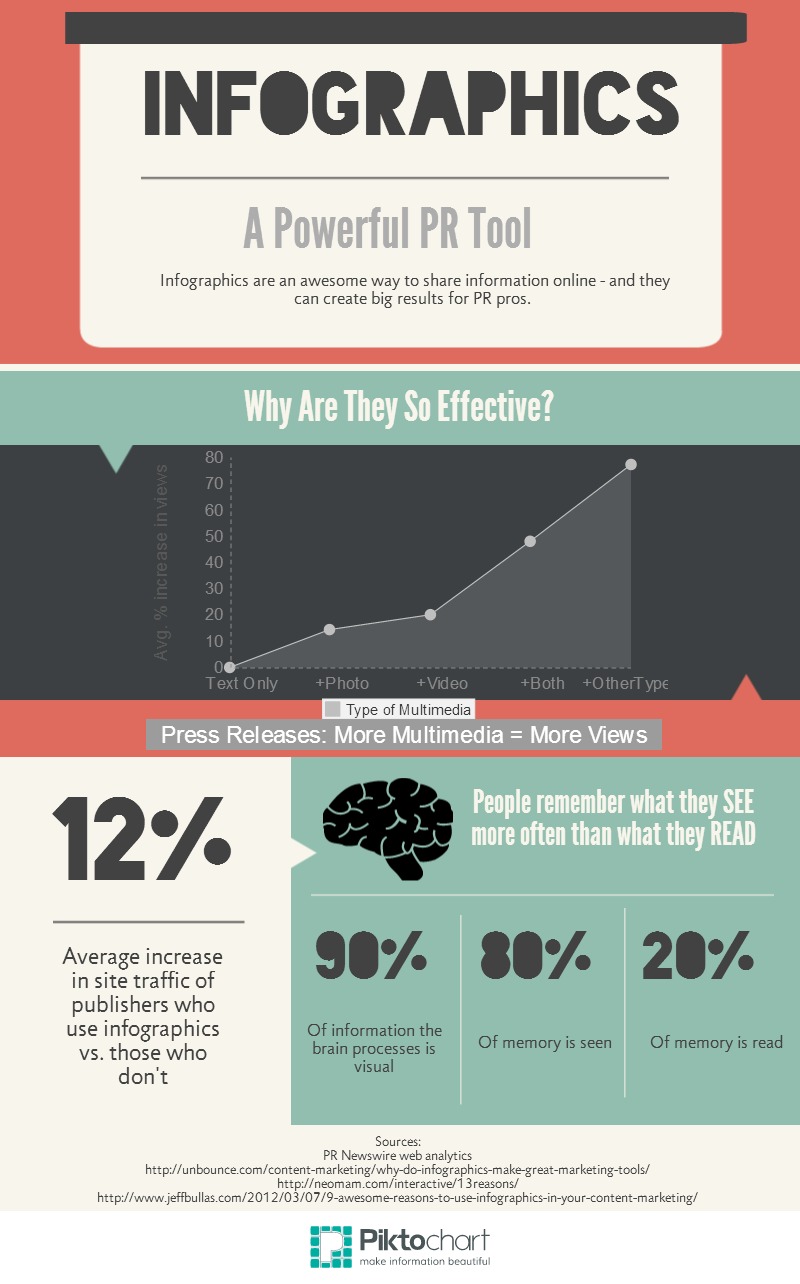
One of the most popular tools is Piktochart, an infographic design app that claims it requires very little effort to produce simple and high-quality graphics. I decided to test this claim by creating my first-ever infographic using the tool, and it certainly lived up to its assertion.
I simply had to choose a template, drop in my data and scale each piece to fit. Piktochart even provides graphics to illustrate your data.
It only offers a couple free themes to choose from so there are probably quite a few other infographics that look like mine, but if you’re willing to pay for a subscription your options expand immensely.
My infographic may not be the most visually innovative, but Piktographic is a great tool for people with limited design skills who want to build their own infographics.
Below is the infographic I created on what makes infographics such a powerful PR tool.
One of my goals in 2014 is to more regularly connect with former colleagues, clients and journalists. It is not always easy to find time to network, but to keep a pulse on the business community as well as to maintain personal connections with the people who have made a difference in my life, it is important to take time to connect face-to-face.

As I was considering my goal, I began thinking about best practices for maintaining connections and relationship building. Here are my thoughts.
- Make Connecting In-Person a Priority. Working in the deadline-driven world of PR is often ridiculously busy and, like most careers, time-consuming. Given this, it is not always easy to make time for lunch or coffee with a former colleague or client. However, if you are going to maintain relationships, you need to connect in-person on a semi-regular basis. This might be once a quarter, twice a year or annually. Determine what makes sense for you and the people that you value, and set up alerts or reminders so you do not forget to reach out to them. LinkedIn has a wonderful new tool allowing users to set reminders to take place in a day, a week or a month.
- Focus on Developing and Maintaining High-Quality Relationships. I am a firm believer in quality over quantity. To develop quality relationships, it is important to understand people’s business and personal goals and to think about how you can add value to the other person’s life. In advance of meeting, I recommend coming up with the questions you want to ask so that you are honing in on the things that the person will be excited and proud to share. You must ask the right questions. These are ones that make the person feel good as opposed to making them feel as if you are wasting his/her time. For instance, you might ask: “What are you focused on that is important for you?” Listen carefully to the response and follow it up with a question to find out why it is important. A wonderful resource for questions to ask to deepen relationships and for advice to hone one’s listening skills is a book titled, “Just Listen,” by Mark Goulston.
- Promptly Follow Up and Follow Through. Send a thank-you note and recap any action items that you promised to execute or identified coming out of the discussion. Ideally, you are going into the meeting with the goal of adding value and offering the other person an upfront benefit, so you should be coming out of it with some ideas of things you can do. This may be sharing an interesting article or book, or brokering an introduction to someone in your network. Do not expect anything in return, but instead be pleasantly surprised when the person returns the favor.
Finally, I recommend staying current on networking best practices. There are a number of wonderful articles on this topic on Harvard Business Review’s website. I especially found Dorie Clark’s post, “Three Mistakes to Avoid When Networking,” interesting and informative, especially when trying to make new connections with people who don’t know you or are perceived as above you in status.
Networking takes work, but the results can be extremely rewarding with new or reaffirmed friendships and business relationships. The key is to make sure you make it part of your regular routine, invest in preparing and follow through. Taking these critical steps can make all the difference to building meaningful and long-lasting relationships.