
Insights for Leaders Navigating
Visibility, Credibility, and Growth.
From media strategy to reputation management, we explore the trends shaping public perception and share the approaches that drive measurable results for growing brands.
We thought you’d be interested in our recent results for OnRequest Images, the leading provider of powerful, custom photography services for the Global 2000. In the past several months, we have placed and written the following byline articles on behalf of CEO Carla Stratfold. These articles can be a fabulous way to establish thought leadership.

1. Atlanta Journal Constitution – “Good images create a great image: Photos gain key role in branding”
2. Atlanta Journal Constitution – “Creativity is critical today to outsmart the competition”
3. Entrepreneur Magazine – “Beware the Mobile Rogue”
4. Media Post’s Marketing Daily – “Establishing an Iconic Brand”
5. AMA Marketing News Blog – “Getting the Most for Your Photo Bucks”
6. AMA Marketing News Blog – “Creating Brands that Stand the Test of Time”
7. AMA Marketing News Blog – “Fundamentals of Brand Resonance”
8. The Advertiser – “Image is Everything”
If you’re interested in learning more about byline article placement, please feel free to call us. We’d love to provide you with counsel or assistance as you pursue the right results for your company.
Pizza lovers rejoice – Pizza Hut recently launched a new iPhone application that will let you order your Friday night takeout directly from your phone. The free application, which launched in mid-July, has already received more than 100,000 downloads on the iPhone and iPod Touch.
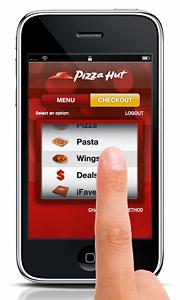
Pizza Hut, with more than 13,000 outlets in nearly 100 countries worldwide, has found a way to use mobile technology to make ordering pizza easier for its customers. According to Advertising Age, Pizza Hut’s application is the first of its kind in the pizza category.
The new application has earned positive feedback from Web sites including Mobilewhack.com, TechCrunch.com and ReadWriteWeb.com. TechCrunch.com’s review said, “It includes a so-called ëvirtual fridge’ where you’ll find coupons to add to your order and a free game called ëPizza Hut Racer’ that you can play while you kill time waiting for your food to arrive.”
Pizza Hut not only was the first in its category to provide a mobile application, but the company also allows customers to place orders online and through text messaging. They even have a Facebook profile where fans can place orders and hear about the latest pizza updates.
While the Pizza Hut application is currently free, this example illustrates how businesses can leverage mobile applications and social media sites like Facebook to increase revenue and streamline processes for customers. The mobile application market is hot right now and branded mobile applications offer a new way for organizations and groups to directly engage with customers and other key audiences. We anticipate seeing a tidal wave of these types of applications in the coming year; and with the anticipated arrival of Windows Marketplace for Mobile, the mobile app space should continue to be an interesting one.
AdAge recently published an article about a report from VMS, a news-monitoring service, which claims that Twitter has received nearly three billion impressions in the past month. According to the report, these impressions are worth nearly $48 million.
There has undoubtedly been a lot of hype about Twitter. It has made its appearance on CNN, Entertainment Tonight and countless other broadcast segments, and has also been featured in numerous print publications. In fact, according to the VMS report, the following outlets have contributed to the PR value of these impressions:
Television: 57%
Newspapers: 37%
Magazines: 5%
However, many bloggers such as TechCrunch and Scobliezer have pointed out, these impressions have not made a significant impact on Twitter’s business or proved that Twitter is a “strong business like Google, Microsoft, HP, Yahoo or even Facebook.”
Erica Iacono with PRWeek published a rebuttal to the AdAge article about the PR value of Twitter’s media impressions. Erica questions VMS’ method of coming up with the $48 million figure and opines, “it’s likely VMS used some kind of ad value equivalency model which ultimately compares editorial and advertising, two things that are vastly different from each other.” She concludes, “Applying a dollar value to media coverage doesn’t take into account whether the PR efforts met any of the company’s business goals.”
There are many techniques for measuring the value of PR including measuring media impressions, ad value equivalency, return on media impact, return on influencers and share of voice.
While there is no magic bullet when it comes to evaluating PR results, it’s important to work closely with your client or executive team to determine what success looks like and how it impacts an organization’s business objectives.
Twitter users can now broadcast themselves live using a new service called Twitcam. The service, introduced by Livestream, provides users with an opportunity to add live streaming video to their Twitter feed and host live chats.
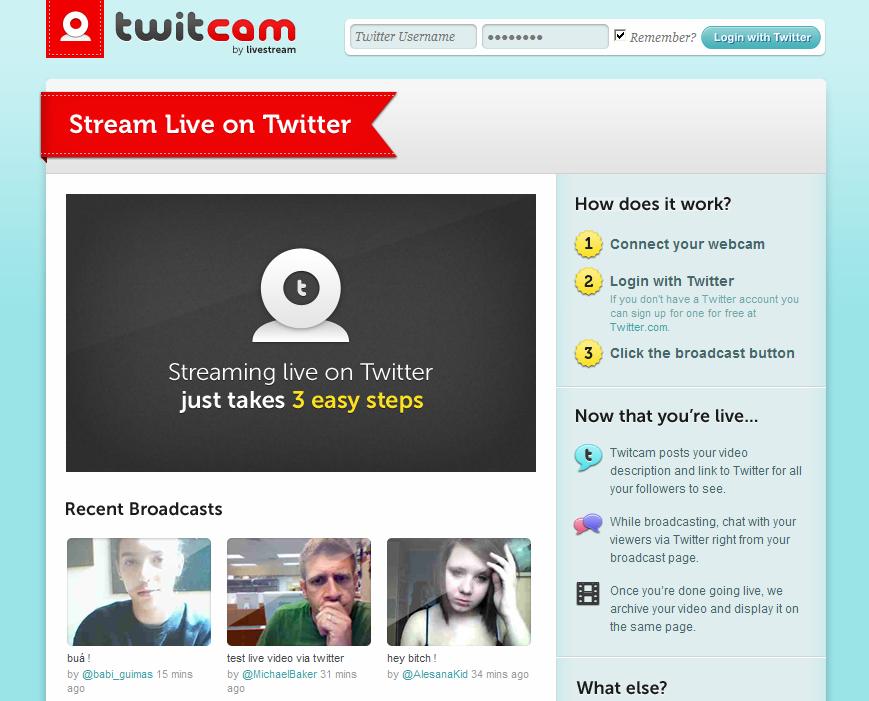
In a press release by Livestream, the company said, “Twitter-centric services for sharing photos and videos have been exploding and are in high demand by Twitter users. Twitcam fills the application void for those wanting to stream live and chat with their followers with a single click.”
Livestream is right. There has been an explosion of new Twitter services for users to get more out of their Twitter experience. From Twitthis, a service which allows people to send Twitter messages about a blog post or Web site, to Twitpic, a site that lets you share photos on Twitter, users have more options to interact on Twitter (check out Mashable.com’s Twittermania blog to see a comprehensive list of Twitter tools).
But what we really like about Twitcam is how easy it is to use. Twitter users simply visit the Web site, log on using their Twitter username and password and click on the ëlive’ button. Livestream’s Twitcam automatically detects the users’ webcam, generates a page and live video player, and posts the link in your Twitter feed.
Twitcam has received numerous reviews including positive feedback from technology bloggers and Web sites such as CNET and Mashable.com. Ben Parr with Mashable.com compliments the service saying the concept is simple, but solid. Twitcam is a great example of how companies are leveraging the power of social media sites such as Twitter to provide organizations with the tools they need to interact and engage with audiences in these mediums.
As organizations continue to incorporate interactive marketing strategies into their marketing plans, (see our recent blog post, “Interactive Marketing Proves More Effective Than Advertising“) Web sites such as Twitcam are well positioned to offer brand managers new, creative ways to interact with Twitter followers. From a PR perspective, Twitcam offers a variety of inexpensive tools to facilitate a press conference, conduct an audit with consumers to determine their perspective on a new product or service, and can be used to secure user testimonials for marketing materials.
With the continued explosion of social media Web services like Twitcam, it will be exciting to see what other services launch and how the way consumers interact with social networking platforms like Twitter and Facebook continually evolves.
Forrester Research recently published its Five-Year Interactive Marketing Forecast report and shared information about its results with the readers of Advertising Age. In an article titled, “Advertising Will Change Forever,” Josh Bernoff, an analyst with Forrester Research, explains how interactive marketing methods have proven more effective than traditional advertising.
The report predicts that interactive marketing activities including social media, e-mail marketing and mobile marketing will reach $55 billion in 2014 and represent approximately 21 percent of overall marketing spend. For many, the focus on interactive marketing comes as no surprise as strategies involving social media are providing companies with new and improved ways to engage directly with customers.
Further research from IPG’s Universal McCann and AOL also supports this trend citing one out of every seven minutes of media consumption today takes place via mobile devices. In fact, research from these two companies points out that there are 63 million mobile Web users in the U.S. It’s no surprise that brand managers rely more heavily on interactive channels like mobile versus more traditional avenues such as print advertising.
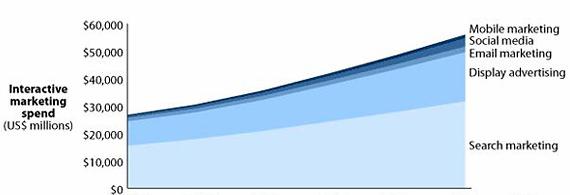
*The above Forrester graph illustrates the increase in mobile marketing, social media and e-mail marketing analyst predict through 2014.
Clearly, interactive marketing tools and strategies are paving the way for the future of marketing. Brand managers are now transitioning away from traditional tools and are taking a blended approach, rely more heavily on interactive marketing strategies that incorporate viral functionality.
Remember the T-Mobile UK Dance for its “Life is for Sharing” campaign? On January 15, 2009, 350 dancers spontaneously started dancing at the Liverpool Street Station in London. The event not only grabbed the attention of onlookers, but the video quickly became a viral online force as consumers captured the dance on their mobile phones and uploaded content online. The YouTube video has received more than 13 million views and there is a Facebook profile page dedicated to the T-Mobile Dance.
This was a great example that illustrates how leading organizations are introducing social media and interactive marketing into their strategies. Real change is happening in the way organizations are using marketing and PR and according to Bernoff, “If you’re in advertising, you’d better learn to speak digital, because that’s the way the world is going.”
Jason Falls of Social Media Explorer recently published a post titled, “Three Keys to Nonprofit Success in Social Media,” and outlined what he believes are the three keys to realizing success for nonprofits in social media.
1. Have a compelling story to tell.
2. Make a specific ask or establish a specific goal to reach.
3. Make it astonishingly easy to give.
We’ve included our take on these three keys to nonprofit success below. We also included a fourth tip in order to keep the campaign front and center with your target audience.
Have a compelling story to tell:
In order for a nonprofit organization to connect with its audience and drive a call to action, it must tell a compelling story which creates an emotional bond with its potential followers. For example, when I see someone talk about their mom or dad suffering from cancer it makes me think about my parents as potential victims of the disease. This creates an emotional bond between me and the organization and encourages me to support the cause.
Make a specific ask or establish a specific goal to reach:
In May, Communiqué PR partnered with the Seattle Children’s PlayGarden to launch its first fundraising campaign. The PlayGarden is a nonprofit organization dedicated to providing a place for both mentally and/or physically disabled children and their normally developing peers to share a safe, stimulating and fun playground environment. While the goal of the campaign was to raise $230,000 through Facebook and Twitter for the construction of the PlayGarden, the team asked social network users to donate a specific amount, just $10 or $20 each, to reach this goal. The campaign clearly outlined what the donations would be used for and how the PlayGarden would benefit the community.
Make it astonishingly easy to give:
It’s important to have a clear call to action. However, it’s equally important to make it easy for the person to donate. If you’re asking people to donate money, specify how they can do this – whether it’s by clicking a link and putting in a credit card number or dropping off their donations at a specific location – the less steps there are, the easier it will be for people to donate.
Keep your audience up-to-date:
Social mediums like Twitter and Facebook are also great for keeping your donors, potential donors and target audience up-to-date on the progress of the campaign or fundraiser. This is a great way to continually engage with your target audience and continue to generate awareness of your cause. Additionally, post regular updates to share how the donations are impacting the organization or those served by the organization.
Social mediums such as Twitter and Facebook are great for building awareness around global issues such as healthcare and education, but they can also be an effective tool for publicizing philanthropic events and social causes. However, as with any PR campaign, it’s important to establish clear strategies in order to gain advocates and supporters for your cause.