
Insights for Leaders Navigating
Visibility, Credibility, and Growth.
From media strategy to reputation management, we explore the trends shaping public perception and share the approaches that drive measurable results for growing brands.
Just as companies build brand awareness for products and services, journalists are now building brand awareness for their name. For journalists, creating a name is critical as they work to establish an area of expertise and build credibility among readers. This is especially important for freelance journalists who contribute to a variety of news outlets and rely on their reputation and quality of work to maintain a steady stream of work.
According to PR Week, a new company called True/Slant is helping journalists establish their branding goals, promote their work and interact with new audiences. The new Web site highlights the work from more than 100 journalists and allows them the opportunity to blog and write about a variety of their projects.
True/Slant also provides a way for journalists that are seeking work to share their articles, build their resume and attract readers.
What I really like about True/Slant is that it provides journalists with their own True/Slant homepage where readers can learn more about the journalist’s professional background as well as what interests him or her most. This can be extremely valuable for PR professionals who are looking to find out what a particular journalist’s hot buttons are to ensure they’re targeting the right media for a particular story.
For example, take Anne Field. Anne is a contributing writer and has published works in outlets such as New York Times, Business Week, CNNMoney.com, Portfolio.com and Fortune. Anne writes about small businesses, but really enjoys covering not-only-for-profit startups. When asked why she uses True/Slant she said, “I can write about something I not only report on, but care about–and do so in a community of fabulous journalists.”
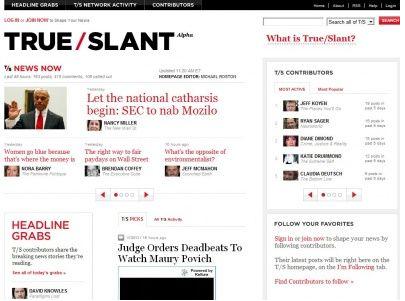
PR Week also points out how “more established press”, like True/Slant contributor and Good Morning America senior national correspondent Claire Shipman, utilizes the blog platform to discuss her family and promote offerings, like her book Womenomics, which is also the title of her True/Slant homepage.
Organizations and PR professionals alike will benefit from reviewing True/Slant and getting to know which journalists are passionate about topics relevant to their target audiences. Check out True/Slant at trueslant.com and let us know what you think.
It’s evident that the current economic downturn as well as the changing media landscape has dramatically affected daily newspapers – this can be seen in the closure of many newspapers across the country as well as many cost-cutting measures such as layoffs.

A report from the Inland Press Association states that print dailies have “seen an erosion of revenue and profits for at least five years even before the current recession.”
After examining financial data from 120 U.S. newspapers, the report concludes profits remain strong at many newspapers, especially smaller dailies. Moreover, Tim Mather, financial studies manager with Inland, reports that while the downturn is affecting nearly all revenue sources at daily newspapers the trend analysis average shows newspaper operating profits “still ranged from more than 11 percent to 15 percent of gross revenue in all circulation groups except 25,001-50,000.”
While smaller dailies may continue to flourish for the time being, the move towards digital will inevitably impact all print publications in the near future. We’ve already seen numerous daily newspapers such as the Wall Street Journal leverage micro-payment systems to counteract the negative impacts of the economy on advertising revenues.
As print publications and daily newspapers take a more niche focus to cater to specific audiences and as competition for article placement continues to increase, it is important to remember to craft pitches that have a strong local angle and have a timely hook.
It will be interesting to see if the newspaper industry will rebound from the current economic crisis and maintain pre-recession revenue levels or if print publications as we know will cease to exist. Let us know what you think about the future of the industry. We would love to hear your thoughts.
Bing, Microsoft’s new search engine which officially launched on June 3, is making headlines yet again as the company “dips its toes into a hot new area of real-time search.” The company revealed on July 1 it will include the latest Twitter updates from popular users such as actor Ashton Kutcher, technology journalist Kara Swisher, search analyst Danny Sullivan and popular news services on Twitter.

The Twitter accounts that will be featured in searches were chosen based on the number of followers and the volume of tweets they produce. Bing plans to update Twitter results approximately every 60 seconds.
Although all major search engines including Google and Yahoo currently catalog Twitter profiles and file older tweets, Bing is the first major search engine to leverage Twitter in this way, according to The New York Times.
While only a select few Twitter profiles were chosen to participate in this real-time search, it’s only a matter of time before other search engines begin rolling out similar services and the pool of Twitter accounts featured in searches increases.
As Twitter continues to gain momentum, discussions around real-time search and the immediacy of information continues to escalate. Sean Suchter, general manager of Microsoft’s search technology center in Silicon Valley comments, “We’ve been watching this phenomenon with great interest and listening carefully to what consumers really want in this space.”
While securing article placements in prominent publications is often the cornerstone of a successful PR campaign, the rise of social media and now real-time search of social networking platforms, is changing the shelf life of traditional news stories and diversifying the mediums in which news is disseminated. Clearly, Bing’s announcement is going to impact search engine optimization (SEO) strategies for organizations and it’s important for PR professionals to continue to educate their clients on how to strategically leverage social media so they can capitalize on these new SEO opportunities.
Bing’s move to include Twitter updates in search results is further validation that Twitter and similar social mediums like Facebook are here to stay. Organizations need to continue to evaluate and determine how to best leverage these tools in order to drive traffic to their Web sites, increase awareness of important events and ultimately achieve their overall business objectives.
To learn more about the importance of participating in Twitter and its benefits visit our past blog entitled, “Businesses Cannot Afford to Ignore Twitter – Five Steps to Take Now.”
Since 2002, technology writer Peter Rojas has been developing Web site interfaces for the news and reviews of electronic gadgets. He has been involved with the creation of popular technology blogs such as Gizmodo and Engadget, and is now embarking on yet another start-up to change the way gearheads learn and communicate about electronics.

Earlier this week, Rojas and his business partner launched the first “gadget-oriented social network”, GDGT. Unlike his past blogs, GDGT does not rely on paid reporters, but rather on device owners who have opinions to share. Site users can create profiles and post questions, comments and advice to other users. Rojas envisions users driving conversation around “electronics devices they have, had or want to buy and helping each other decide how and when to replace them.”
Although there are hundreds of other gadget sites on the Web, Rojas believes GDGT will stand out because, “most gadget sites cater only to five percent of a gadget’s lifecycle – the lust phase. We are building the place where you can live with your gadgets online in perpetuity.” It is clear that Rojas believes in the idea of specializing social media sites to better facilitate discussions about users’ hobbies and interests.
The notion of a social networking platform devoted to niche topics such as gadgets shouldn’t come as a surprise. As more and more social media sites are gaining popularity, businesses are viewing this medium as an opportunity to connect with their consumers and provide them with a platform for communicating about products. Twitter and Facebook are already regarded by consumers as a trusted network to get opinions and recommendations on a variety of items as these opinions are coming from trusted people in consumers’ networks.
Only time will tell if users enjoy hearing other consumer’s opinions or if they will miss traditional product reviews. In order to ensure that the Web site won’t be home to uninformative one liners such as, “This product is terrible!” Rojas decided to allow only reviews with more than 200 words to appear on the site.
Although relying on citizen journalism can be potentially unstable, it appears communicating through social media is here to stay.
As for the veteran gadget Web site creators, GDGT’s social media platform is the future. “We view this as the final act. Gizmodo was the prototype. Engadget extended the idea. This could possibly be the last great gadget site,” said Rojas.
Social media has dramatically changed the way organizations interact with customers and key audiences. Opportunities to engage directly and in real-time through social networking platforms such as Facebook, Twitter and blogs have given way to new levels of engagement with instant feedback.
As more organizations evaluate how to leverage social mediums, many are asking questions such as, “How do I measure the impact of social media for my organization and brand?” and “How can I extract insight from social mediums to help improve my business?”
While there are some tools that exist today that can help measure public sentiment and number of company or product mentions in the social media sphere, the practice of measuring the impact of social media is a work in progress and continues to evolve. A recent PR Week article explores the topic of social media measurement and reminds readers that, although social media measurement has come a long way there are still many questions left unanswered.
According to PR Week Editor Tonya Garcia, “Progress has been made on two key fronts: End users have raised their level of understanding the issue and the capabilities of measurement and monitoring technology have gotten better.” In addition, many social media measurement tools now provide information about the age, gender and location of the social media user and also enable companies to determine influencers and brand evangelists.
As a result of this progress, organizations now have access to better social media measurement tools. A few of the social media measurement tools that are helping organizations today include:
Visible Technologies – A provider of online brand management solutions for companies and individuals, Visible Technologies makes two systems for tracking conversations on the Web including TruCast and TruView.
Radian6 – Provides tools for real-time social media monitoring and analysis that lets users track keywords (names of brands, companies, products, competitors, etc.) on all forms of social media including blogs, video sharing Web sites, social networking sites, microblogging sites and more.
Cision Social Media Dashboard – A dashboard designed for PR professionals and marketers that captures data in real-time and delivers it to dashboard analysis widgets. You can set up e-mail alerts and search terms, sort social media coverage dynamically, analyze and compare volume of social media coverage, easily share reports and social media coverage with key stakeholders, and more
As these tools continue to evolve and offer more sophisticated features, organizations will have more opportunity to extract data and leverage customer feedback, measure public sentiment about their products and solutions and monitor competitors’ activities – which will no doubt help them better see the value and impact of social media.
Social media has dramatically changed the way organizations interact with customers and key audiences. Opportunities to engage directly and in real-time through social networking platforms such as Facebook, Twitter and blogs have given way to new levels of engagement with instant feedback.
As more organizations evaluate how to leverage social mediums, many are asking questions such as, “How do I measure the impact of social media for my organization and brand?” and “How can I extract insight from social mediums to help improve my business?”
While there are some tools that exist today that can help measure public sentiment and number of company or product mentions in the social media sphere, the practice of measuring the impact of social media is a work in progress and continues to evolve. A recent PR Week article explores the topic of social media measurement and reminds readers that, although social media measurement has come a long way there are still many questions left unanswered.
According to PR Week Editor Tonya Garcia, “Progress has been made on two key fronts: End users have raised their level of understanding the issue and the capabilities of measurement and monitoring technology have gotten better.” In addition, many social media measurement tools now provide information about the age, gender and location of the social media user and also enable companies to determine influencers and brand evangelists.
As a result of this progress, organizations now have access to better social media measurement tools. A few of the social media measurement tools that are helping organizations today include:
Visible Technologies – A provider of online brand management solutions for companies and individuals, Visible Technologies makes two systems for tracking conversations on the Web including TruCast and TruView.
Radian6 – Provides tools for real-time social media monitoring and analysis that lets users track keywords (names of brands, companies, products, competitors, etc.) on all forms of social media including blogs, video sharing Web sites, social networking sites, microblogging sites and more.
Cision Social Media Dashboard – A dashboard designed for PR professionals and marketers that captures data in real-time and delivers it to dashboard analysis widgets. You can set up e-mail alerts and search terms, sort social media coverage dynamically, analyze and compare volume of social media coverage, easily share reports and social media coverage with key stakeholders, and more
As these tools continue to evolve and offer more sophisticated features, organizations will have more opportunity to extract data and leverage customer feedback, measure public sentiment about their products and solutions and monitor competitors’ activities – which will no doubt help them better see the value and impact of social media.