
Insights for Leaders Navigating
Visibility, Credibility, and Growth.
From media strategy to reputation management, we explore the trends shaping public perception and share the approaches that drive measurable results for growing brands.
It’s an age-old question: Why do some countries flourish while others flounder? Even in an economic downturn, we live amongst staggering wealth in America while many countries are mired in poverty. MIT Professor Daron Acemoglu has said, “Economic inequality has detrimental effects on economic growth in general.”
“Recognizing the role of institutions and why societies choose or accept institutions that stifle growth are crucial steps toward understanding why much of the world is still poor, and also in developing a better perspective for dealing with the current crisis,” says Jacques Lawarree, Professor, Associate Chair, Robert and Larina Davis Distinguished Scholar at the University of Washington.
Now more than ever, understanding the underlying economic factors that contribute to the wealth of nations is crucial. Which is why we’re excited about a new free, public lecture series being held at the University of Washington.
The First Annual Milliman Lecture in Economics will be held on May 20 at the University of Washington Waterfront Activity Center. Daron Acemoglu, an MIT professor of applied economics, will argue that we need to reconsider the factors that foster economic growth and success.
He will also explore the answers to some pressing questions about the global economy, such as:

How can a society ensure its continued growth and success?
Why do some societies succeed in growing rapidly for several decades, while others stagnate, unable to generate economic growth and a decent living standard for their citizens?
What is the role of institutions in economic growth, and why do some societies choose or accept institutions that potentially stifle growth?
This is a tremendous opportunity to learn about some of the factors that shape our global economy and gather information that may be helpful as you work toward growing your business. We look forward to hearing Professor Acemoglu speak. Will you be attending the lecture? We’d love to hear your thoughts.
Normally I am not a fan of publicity stunts. Often stunts seem too gimmicky, costly and offensive. And if they’re not well orchestrated they can be a disaster.
Consider Snapple’s attempt to build the world’s largest popsicle. It flooded Union Square in downtown Manhattan and the fire fighters had to be called in to block off the streets.
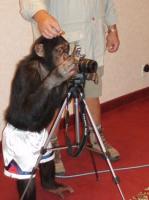
Another example of a stunt gone wrong is when newly launched Yahoo Tech went on the Today Show touting that digital photography is so easy, even a chimp can do it. Katie Couric went up against Codie the chimp who was supposed to take a photo, remove the memory card and print his photo. Nothing worked and it is an example of how risky it is to execute a publicity stunt on live TV. In fact, during the segment Couric said, “So much for Yahoo’s great marketing techniques” and “this was a complete disaster, but it was fun.”
Nonetheless, the publicity stunt clearly has its place. I recently read an article in PRWeek about a start-up company that secured some high-level press by dressing the founder up in a costume to run a marathon.
In case you missed the article, here is the gist of what happened: On April 20, Jason Jacobs, founder of FitnessKeeper, ran the Boston Marathon in an iPhone costume that featured his company’s RunKeeper application on the phone’s screen.
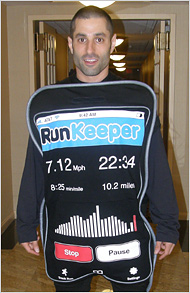
Leading up to the event he and a group of college students leveraged social mediums by posting video and photos of the training activity and costume creation on Facebook, YouTube and the company Web site. They established a Twitter presence and cultivated a fan base.
All of the activity paid off. On April 19, Stephanie Clifford, a reporter covering advertising and marketing for the New York Times media desk, wrote an article titled “An iPhone With Legs Plans to Run” and included a photo of Jason Jacobs in his special marathon suit.
And that was not the only coverage. From our cursory search, it appears that several TV news stations covered the stunt as well as Web sites, such as Phones Review, Into Mobile, and Geek.com.
So why did this work? The stunt was original, creative, relevant to the company’s product, visual and cost-effective. It sparked interest with journalists working for both print and broadcast – they had access to photos, videos and compelling sound bites.
If you have examples of a successful or not so successful stunt, we’d love to hear them. Please share your stories with us!
Twitter is growing at breakneck speed, and major brands can no longer afford to ignore it. According to social media guide Mashable.com, Twitter grew an astounding 752 percent in 2008. And according to market tracker Hitwise, traffic to Twitter went up 43 percent after Oprah joined Twitter on her show. For comparison, Facebook grew about 85.7 percent in 2008.
Two major companies – Dominos and Amazon – recently learned the hard way that they can’t afford to sit on the sidelines and ignore Twitter while customers drive conversations about their brands.
Chances are you’ve heard about the Domino’s Pizza YouTube fiasco, where two (now ex) employees posted a video of themselves preparing food in a very unsanitary way. The blogosphere erupted with angry comments from concerned customers. But rather than proactively addressing the situation, Domino’s kept quiet. Until the discussion moved to Twitter, at which point Domino’s joined the conversation and responded to comments via a Twitter account it established for that purpose. @dpzinfo now has 1,433 followers on Twitter. It also created a YouTube video, which according to AdAge.com has received more than 330,000 views. Richard Levick, president of PR firm Levick Strategic Communications, said he’d give Domino’s “an F for its reaction during the first 24 hours and an A for everything thereafter.”
Another interesting example of how customer conversations are driving company action is Amazon’s reaction to customer complaints. When Amazon recently removed books with gay and lesbian themes from its search results, Twitter users were angry – and very vocal. Amazon quickly broke its silence with statements over Easter weekend to address concerns and offer an explanation via Twitter. @amazondeals has 8,547 Twitter followers.
Jeremiah Owyang, a senior analyst at Forrester Research, recommends that brands secure their own domain names in social media networks and build a community. When a crisis happens, brands can use that community to their advantage.
Some companies have taken heed and embraced Twitter effectively. Instead of waiting for a crisis to begin using Twitter, JetBlue, the discount airline, regularly engages with customers. There have been numerous accounts of @JetBlue responding to passenger inquiries on Twitter by offering advice, directions or assistance in real time.
Actively engaging with customers via Twitter is no small feat, and it is up to each company to decide how much it wants to invest in the network. But for the sake of their brands and reputation, industry giants are realizing one by one that the benefits of embracing Twitter outweigh the costs.
=
We recently placed a byline article on behalf of our client, OnRequest Images, in the Atlanta Journal Constitution. The article, written by OnRequest CEO Carla Stratfold, details why photos play a key role in branding.
Carla notes that companies are gaining market share by using custom photography and digital assets to showcase their most affordable products and services to help define their brand and refresh their image. She includes an analysis of the important role photography played in campaigns for large companies such as Target, Starbucks and Coca-Cola.
Carla also presents the perspectives of Organics to Go, W.L. Gore and HartmanBaldwin Design/Build. Says Wendy Tenenberg, vice president of communications at Organic to Go, “We treasure our ability to create custom photos because we are able to truly control and manifest what we imagine our brand to be.”
Carla concludes the article with some wise advice for marketers:
“While the economy will continue to bedevil us all, savvy marketers will seize the opportunity to improve their position in the market by investing in their brand. And by leveraging the expertise of companies that can help streamline the process, they can make a big splash without draining their budget.”
To read the article, titled “Good Images Create a Great Image: Photos Gain Key Role in Branding,” click here.
It’s a sign of the times: As younger consumers lose discretionary income, advertisers are shifting their attention to an older generation. This shift has implications for print and broadcast as those media outlets which cater to an older generation are faring better in this economy.
Older generations were previously ignored by advertisers because they were considered less wealthy and resistant to change. But according to a New York Times article on the subject, older consumers today are more willing to try new products, comfortable with digital media and not strapped for cash. Says media investment director Andy Donchin, older consumers have “assets, not allowances.” And in this economy, that’s an attractive thing to advertisers.
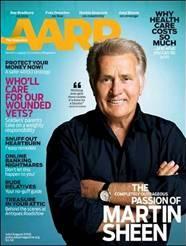
So what does this mean for the media industry? In short, those outlets catering to older consumers are doing well. The New York Times reports that CBS, home to shows popular with older audiences, is first in the network rankings. And magazines aimed at this demographic, including AARP Magazine and Family Circle, have experienced smaller declines in ad revenue than their counterparts courting younger readers.
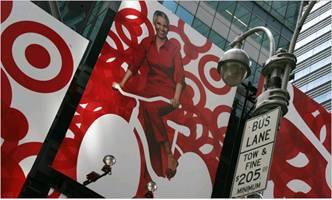
Major brands have taken note. Chrysler, Kraft and Target are all aiming to reach an older demographic. A Target billboard in Times Square, New York City, features a grey haired model.

As the baby boomer generation ages – they now range from 45 to 63 years old – this new advertising trend is likely to continue. Have you noticed a change in the kinds of ads in magazines or on TV? We’d love to hear your thoughts.
This month, Seattle Business Monthly readers will see the face of Jeremy Lewis, Big Fish Games’ president and CEO on the cover of the magazine. The magazine chose Jeremy for the cover to compliment the publication’s feature story “Breaking the Rules” about local companies thriving in a down economy.
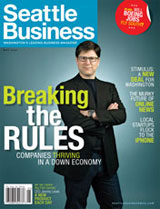
Big Fish Games is profiled in the article, “Game Changers,” and Jeremy shares his perspective on why the company is growing despite the recession. The article also provides data points to demonstrate the company’s continued growth.
Communiqué worked closely with the editorial team to not only facilitate the interview, but also to understand the selection process for the cover of the magazine. Gathering information about the decision making process ultimately helped us guide the direction for the actual photo shoot.
A few things to remember if you or an executive in your organization is being considered for a magazine cover include:
1. Ask questions. Understanding the magazine’s selection process is critical. This will ensure you are prepared for the photo shoot and set up for success. The art director or photographer will often share information about the right colors and attire to wear as well as the specific look or scene they want to set with the photo.
2. Schedule a scouting appointment. For the May cover, we coordinated a scouting appointment with the Seattle Business Monthly photographer. This gave the photographer the opportunity to visit the Big Fish Games office in advance and formulate ideas for the photo shoot. The scouting appointment was also helpful because it gave us a sense of what types of angles, props and setup we should anticipate or prepare for the actual shoot.
3. Decide your wardrobe in advance. In general, it is important to determine proper attire in advance of any photo shoot. Executives should avoid wearing busy patterns and should select an outfit that is comfortable. Typically, slacks with a shirt/jacket combo work well. In addition, executives should bring two to three back-up outfits to the office in case the photographer needs to change direction.
To read the full Seattle Business Monthly article and see more pictures of the photo shoot with Jeremy, click here.