Insights for Leaders Navigating
Visibility, Credibility, and Growth.

From media strategy to reputation management, we explore the trends shaping public perception and share the approaches that drive measurable results for growing brands.

Best Practices for Developing a Press List: Not One-Size-Fits-All

Press lists can seem daunting. In the ever evolving and widespread world of journalistic beats, it’s becoming increasingly difficult to pinpoint reporters’ editorial focus. This leads to the unintended inundation of email inboxes with unwanted content and failure to establish relationships. One master press list is not a sufficient one-size-fits-all approach. But don’t lose hope – there are things you can do in advance of establishing a press list that will set you up for success in your proactive pitching efforts.

1. Utilize Search Engines and Media Databases

One or the other is not the end-all, be-all. Exploring publications and reporters within search engines like Google and media databases like Cision both contribute to a healthy press list. Many times, the two work in unison, as Google or the publication’s site may provide the reporter’s name and editorial focus while Cision may provide emails and phone numbers.

2. Determine Reporter’s Beats

This doesn’t merely mean taking a look at the reporter’s general editorial focus. This means diving into their written work to determine their specific beat. A tech reporter does not necessarily cover both software and AI. To help diversify different topics within a subject in a press list, please see the following pointer.

3. Clearly Define Tabs and the Reporters’ Editorial Focus

For example, when creating a press list that will include both tech and business reporters, create tabs for each, and within those tabs create a column for “Editorial Focus” to be able to indicate exactly what that reporter covers.

4. Make a “Notes” Section

This allows you to keep track of how reporters respond to your pitches, specific content they like to receive, when you last sent a pitch to them, etc. The latter is important to consider when sending multiple pitches per month.

5. Create Specific Alerts

Use alert systems like Google Alerts or TalkWalker to be notified about specific topics by indicating topics and keywords. These are valuable resources when trying to identify what reporters are currently talking about. Topics and keywords can be broad or specific – “technology” would glean substantially different results compared to a type of technology such as “MacBook Pro.”

6. Keep Your List Current

As soon as you receive non-deliverable emails, check to see if the email is correct – if it is, proceed to see if the reporter is still with the publication. As time goes along, continue to search proactively for new media contacts to add to your press list.

As newsrooms decrease in size and the cadence of developing news ceases to slow, it’s increasingly important to keep tabs on journalistic beats. Just as one master press list is not a one-size-fits-all approach, the same goes for how you choose to manage lists. Overall, do your research, take good notes, and keep your list updated.

Workplace Burnout: It’s Real and All About Control

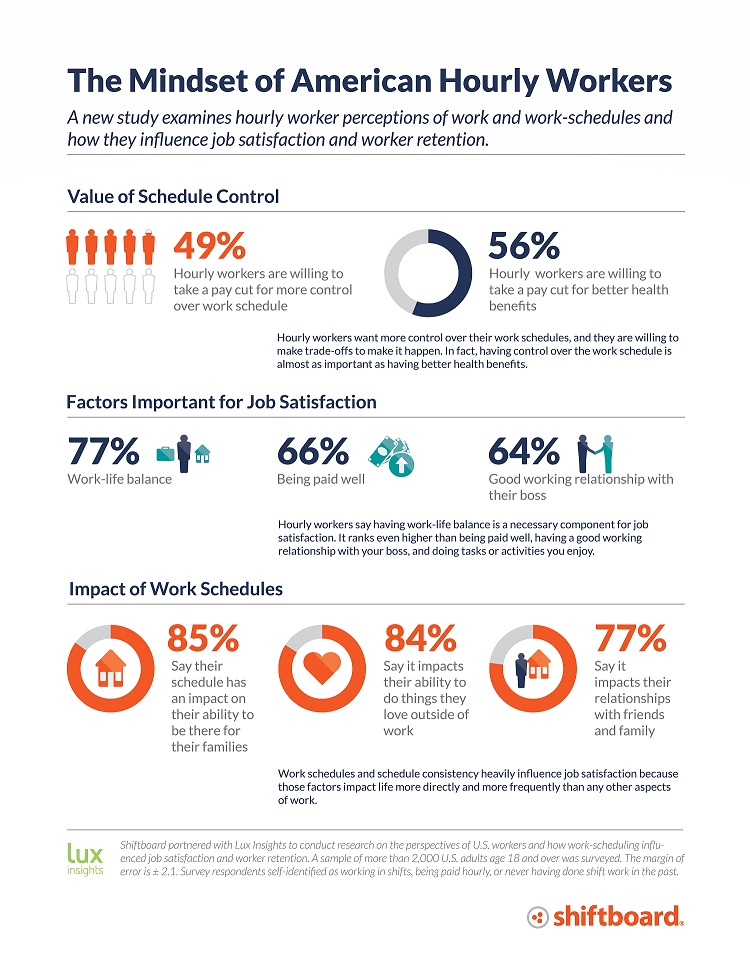
Shiftboard, a leader in enterprise scheduling software, recently unveiled the results of its State of the Hourly Worker report, which may be of significant interest to all employers in light of the World Health Organization’s recent announcement that it has classified workplace burnout as a legitimate syndrome.

Interestingly, many experts in workplace dynamics believe one way to combat burnout is to give workers more control over not only their work, but their schedules.

Shiftboard’s findings from a survey of more than 2,000 adults in the U.S. reinforce these beliefs. Consider the following:

  • Shiftboard found that nearly half of American workers would be willing to take a pay cut if they had more control over their work schedules.
  • Shiftboard also asked questions about the drivers of job dissatisfaction. When asked to respond to “My job is a serious source of stress for me,” 60 percent of hourly workers versus 47 percent of non-hourly workers indicated this to be true.
  • Shiftboard’s research clearly points organizations to an emerging opportunity to transform their employee-retention strategies by focusing on solutions that give workers more control over their time. One tangible way to do this is with better scheduling processes.
  • Finally, when employee satisfaction increases, employers see improvement in retention, labor costs and profitability.

These were just a few of the interesting responses from the more than 2,150 U.S. adults age 18 and over who responded to the survey. For the complete report, please visit The State of the Hourly Worker.  Below you’ll find a few of the recent articles about Shiftboard’s findings.

This is an important topic and, with the strongest labor market in the U.S. in 50 years, we anticipate there will be additional reporting about the innovative steps employers are taking to attract talent and keep them happy.

Finally, to give you some context on Shiftboard’s impact, it is important to note the company has helped employers schedule more than 245 million shifts, providing an employment pipeline for more than $3 billion in wages earned.

I know work-life balance is important to me and I look forward to more information on this important topic.
CISION’s State of the Media: 2010 vs. 2019

In 2010, Vocus, a public relations software company that would eventually become CISION, released its first State of the Media report. Now, nine years later, CISION released the 10th annual State of the Media report. The report shares unique insights about the industry and specifically highlights journalists’ perspectives on different topics and trends, serving as a useful resource in navigating media relationships.

As with most annual reports, the State of the Media report has evolved over the last decade. Originally, it was written as a white paper, with detailed analysis of the current state of the industry with predictions from Vocus’ Media Research Group. The report focused on the large number publication closures and reporter layoffs. It also highlighted trends believed to become more commonplace, including paywalls and online publications.

Now, the report is built around survey responses from thousands of journalists and analyzes the current trends influencing the industry. With 10 reports completed, I thought it would be interesting to see how the industry has evolved.

What Predictions Came True from 2010?

The original report was written not long after the Great Recession, which greatly impacted the media industry. In 2009, approximately 293 papers folded, and major newspapers had 421 layoffs and buyouts. 

Due to the dwindling number of staff and papers, the report predicted that journalists would be “performing dual roles” and that more papers would adopt the paywall model. Clearly, both predictions came true.

As PR professionals, we see many journalists covering broad beats and needing to learn about a variety of topics that fall under those beats. For example, many reporters cover “tech.” This beat requires reporters to understand a broad range of technologies, including SaaS, IoT, AI, ERP, VR, etc. The breadth of topics that fall under one beat often makes it more difficult to develop a deep understanding of each variety of technology and stay up to date on the latest trends.

In response, PR professionals have become an important resource that can assist journalists in understanding specific trends and offer key industry experts to support the development of their stories.

Key Takeaways from 2019’s Report

As predicted in 2010, many publications are now available online and that has enabled readers to engage with content in unique ways and given journalists tools to track that engagement, which are playing a role in how journalists are evaluating stories. According to the 2019 report, 65 percent of journalists say availability of detailed audience metrics has changed the way they evaluate stories.

The survey analyzed how journalists from different countries valued different metrics. In the U.S., readership was the most important, closely followed by engagement. No matter the country, readership was the leading metric. The most engaging content has images, infographics and personalized data analysis. All resources that PR professionals and brands can assist in developing and offer to journalists.

Interestingly, staffing, a challenge that began around the time of the first report, continues to be one of the biggest challenges for journalists. Twenty percent of journalists said “staffing and resources” is the biggest challenge.

While the industry continues to face problems it faced in 2009, the third most common challenge is more recent: the ongoing conversation about fake news. CISION asked journalists if they felt the public had lost or gained trust over the last year, 63 percent said they believe the public lost trust. Though the number is high, its down significantly from 2017, when 91 percent of journalists believed the public had lost trust in them.

Be a Valuable Resource

The troubles that plague the industry also present an opportunity for PR professionals to act as a key resource for journalists. PR professionals can craft tailored pitches and unique stories, but also serve as a resource by driving new content, creating graphics and offering key experts to bolster a story.

Based on the 2019 report, it appears PR professionals are trending upward. In 2018, only 9 percent of reporters said their relationships with PR professionals had gotten better. This year, that number has increased to 27 percent.

Keep up the good work!

Social Acceleration: How 24/7 News, Social Media and FOMO Are Narrowing Our Attention Spans

PR professionals, like journalists, marketing professionals and other communications specialists, frequently traffic in media consumption – and there is no shortage of content. The influx of information is constant and ready for consumption, whether it’s CNN’s running news ticker on your TV screen or a scrollable list of news articles on your smartphone’s news app, or even the personal news feed on your Facebook or Twitter account.

Our 24/7 news cycle has shown that a new story is always right around the corner to occupy the public’s attention and satiate its craving for novelty. News junkies, whatever their poison – politics, crime, celebrities, sports – can always get their fix.

Sociologists, psychologists and other experts have long speculated the effects that a constant news cycle and fixation on social media have on the minds and attention spans of consumers. They’ve cautioned that a “fear of missing out” on breaking news and social media updates may lead to more fragmented public discussion and that a certain “social acceleration” – or the increasing rates of change within collective attention — is at play. But such a claim was largely hypothetical and lacked supporting empirical evidence. That is, until recently.

A study published in the peer-reviewed journal Nature Communications presented findings supporting that such rates of change are occurring and narrowing our collective attention span across the domains of social media, books, movies and other media.

The study was conducted by a team of European scientists from Berlin Institute of Technology, Max Planck Institute for Human Development in Germany, University College Cork in Ireland and Technical University of Denmark (DTU).

The team’s findings were based on studying Twitter data from 2013 to 2016, as well as books from Google Books going back the last 100 years, movie ticket sales dating back 40 years, and citations of scientific publications from the last quarter century. The studies also relied on data from Google Trends from 2010 to 2018, Reddit from 2010 to 2015, and Wikipedia from 2012-2017.

Researchers found “empirical evidence of ever-steeper gradients and shorter bursts of collective attention” attributed to each cultural item, resulting in a rapid exhaustion of limited-attention resources. To paraphrase, these cultural items rose in popularity faster than before but also fell out of it more quickly, with the researchers determining that the production of more content in less time is fatiguing our collective attention.

One example of the scientists’ findings came from a deep dive into the daily top 50 hashtags worldwide on Twitter, in which the scientists found that peaks have become steeper and more frequent. In 2013, a hashtag stayed in the top 50 for an average of 17.5 hours. In 2016, this decreased to 11.9 hours.

“The shortened peak of public interest for one topic is directly followed by the next topic, because of the fierce competition for novelty,” the researchers wrote.

The researchers found similar results for comments on Reddit and movie sales at the box office, though these results weren’t mirrored for scientific papers and Wikipedia entries.

DTU researcher Professor Sune Lehmann noted the importance of following up this study by researching beyond the effects on our collective attention and exploring how an overabundance of information affects the attention spans of individuals.

“We hope that more research in this direction will inform the way we design new communication systems, such that information quality does not suffer even when new topics appear at increasing rates,” Lehmann said.  

Read the study in its entirety here.

WGU Washington: A Thought Leader in Higher Ed

WGU Washington continues to disrupt the higher education space with an innovative, student-first model. With higher education costs soring and the needs of the workforce rapidly changing, WGU Washington offers a flexible and affordable online model that provides students with the ability to learn independent of time and place. This approach makes higher education more accessible by allowing individuals to fit their education into their lives, not the other way around.

We are honored to partner with WGU Washington to continue to raise awareness and build thought leadership for the university and its leadership through a combination of news coverage, placement of content and pursuit of awards.

For instance, we worked with WGU Washington Chancellor Tonya Drake on a series of opinion pieces highlighting mission-driven initiatives for the university such as employment resources for military spouses and state funding for low-income college students. We hope this fuels further discussion and thought about how to address these important issues.

More recently, we worked with Rob Smith at Seattle Business magazine to feature Tonya and her mentor, Edmonds Community College President Emeritus Jean Hernandez, in a cover story about the importance of cultivating the leaders of tomorrow. Giving back and paying it forward is part of Tonya’s DNA and is also a value that is evident in the university’s student-centric approach.

Outlined below are the earned media coverage highlights we secured on behalf of WGU Washington after naming Dr. Tonya Drake as chancellor in the spring of 2018.

These results are encouraging but our charge continues. There is plenty more to come – stay tuned.

Spotlight on Education Leaders: Intentional Futures, St. Thomas School and WGU Washington

One of my favorite aspects of working at Communiqué PR, and in an agency in general, is being able to dive into different industries, learn new perspectives, and secure deep understandings about a variety of businesses and their markets. From the manufacturing and telecommunications industries, to consumer products and enterprise software solutions, there is never a shortage of learning opportunities or the challenge to create and tell a compelling story.

In addition to the industries above, we also work with a handful of leaders in the education space. These partners include St. Thomas School (STS), an independent K-8 school in Medina; Western Governors University (WGU) Washington, an online competency-based university; and Intentional Futures (iF), an innovation studio who partners with visionary leaders to solve problems in the education sector, among many others. 

Within the last few months, we have had the opportunity to amplify some of the great work and innovation being driven by these groups. Below is a recap of some of the results we were able to secure, and a peek into the types of capabilities we tailor on behalf of our clients.

Bringing a story to life through broadcast

STS’ model for integrating technology into the classroom has received the attention of education leaders around the world who have traveled to the school to absorb techniques and best practices for integration. In March, delegations from Germany and Japan visited the school to learn more about STS’ approach.

Eager to tell this story and share how a local school is leading EdTech curriculum worldwide, we reached out to KING5 to help bring this story to life.

Love to local magazines

When partnering with WGU Washington and STS, local outlets are key to reaching each organizations’ target audiences. For both schools, print and digital magazines are great mediums to communicate with these audiences, while also amplifying general brand awareness among the community. We monitor magazine’s editorial calendars for relevant themes and opportunities to share our clients’ announcements, events and stories. 

Recently, STS was recognized in 425 Magazine’s Best of 425 as the Best Private Elementary School and Best Children’s Art Program. The recipients are selected by the community through a voting process, which we highlighted to STS for consideration. As a result of our media outreach and ongoing proactive pitching, 425 Magazine also covered STS’ longstanding achievement as a Microsoft Showcase School, as well as one of its alumni’s dedication to increasing girls’ education by planning a 5K race supporting Rwanda Girls Initiative.

WGU Washington’s chancellor, Dr. Tonya Drake, was featured in Seattle Business’ Daring Women column, as well as on the cover of the magazine’s May issue with her long-term mentor. These stories were both results of the team’s media outreach and ongoing content development efforts to build Tonya’s thought leadership.

Spreading awareness on social media

Intentional Futures (iF) partners with global game changers in education such as the Bill & Melinda Gates Foundation and Mastery Transcript Consortium. We’ve worked closely with iF to amplify case studies and raise awareness of these impactful projects via social media. 

Two projects iF recently designed in partnership with the Gates Foundation and Global Good, a collaboration with Intellectual Ventures, included a report on Executive Function’s role in improving student outcomes, and a website titledLessons in Courseware Development,” which is a resource offering adaptive courseware information to guide and increase educators’ access to digital tools and enhance student engagement.

We developed and distributed a series of social media content (tweets and LinkedIn posts) to help iF promote these projects among their followers. To stay up-to-date on the company’s  work, follow iF on Twitter @intentfutures and via LinkedIn at Intentional Futures.

All three of these organizations in some way or another are working to increase access to education and learning tools. In partnering with iF, STS and WGU Washington we are able to build a broader awareness for the good they are doing.

Editorial coverage with broadcast and local magazines, as well as social media and community management, are just a few of examples of our capabilities and how we tailor strategies for our clients.

Interested in learning more about us or partnering with our team? Visit our website at https://communique.innovisionwebsites.com/.