Insights for Leaders Navigating
Visibility, Credibility, and Growth.
From media strategy to reputation management, we explore the trends shaping public perception and share the approaches that drive measurable results for growing brands.

I have always enjoyed writing as an art. Words are fun to play with and the creative process excites me. Within the past year, however, I realized I need to upgrade the tools in my toolbox if I want to take my career to the next level. I am thrilled to say that Communiqué PR funded an online writing course through the Public Relations Society of America (PRSA). PR expert Michael Smart taught the comprehensive four-part course titled, “Writing Skills to Increase PR Reach and Results.” Smart covered a breadth of PR topics, including press release writing, proofing and grammar for PR, creating compelling, engaging content and more.
Thanks to the course, I now have a better understanding of the broader PR industry, what works and what doesn’t in PR writing and I learned new skills that can be applied to almost all writing projects. Following are snippets of what I learned that might help you improve your PR writing skills.
- Avoid cursed words/hype/buzzwords: There are several words used in PR documents that have lost their meaning, like state-of-the-art, best-in-class, cutting edge, beautiful, revolutionary, leading edge, world class, unique, among others. Delete these words from your writing in order to be simple, straightforward and factual. If you need to use a hype word, try replacing it with alternatives.
- Cut meaningless modifiers and descriptors, and use qualifiers sparingly: Do this as often as you can, because strong PR writing is clear and simple.
- Examples of modifiers are: basically, essentially, actually and various.
- Examples of descriptors are: great, really, very and good.
- Examples of qualifiers are: usually, could, sometimes and often.
- “XX is a leading…” This is one of the most common empty claims in PR writing today. For example, “a leading database…”. PR writers can use this word if they must, but be sure to back it up with facts on why/how it’s leading. Otherwise, readers may be skeptical, which could hurt your credibility, because everyone today says they are leading in something.
- Remove jargon: Jargon is a common red flag for journalists and hurts the author’s credibility. PR writers should replace any terms that might be difficult to understand or are unfamiliar to your target audience, including acronyms. Try using plain-English alternatives, explain what “it” is by using descriptions or substitute “it” with a code word.
- Bad Example: The drug works by inhibiting cyclooxygenase-2.
- Good Example: The drug works by stopping the cell that causes pain and inflammation.
- Shorten sentences: The shorter the sentence the better. The goal as a PR writer is to make all sentences 25 words or less. We should always balance sentences with long and short variations too.
- Facts, facts, facts: The absence of facts is one of the biggest weaknesses in PR writing today. Good PR writing must support claims by using data, facts and/or anecdotes.
- Validate your claims: The best validations come from third-party sources, not from within your company. Journalists are also more likely to trust outside sources.
- SEO with press releases: Make sure to include the company’s keyword(s) in the headline or subhead, in the first paragraph of the release and in the boilerplate. Use hyperlinks in natural language and avoid saying “click here” with a hyperlink. Also, use only one hyperlink in your boilerplate, because link overkill actually hurts your SEO.
- Tone and style: Press releases should match the tone and style of your target media outlets. If the release is good enough for top-tier outlets, like The Wall Street Journal, The Economist or The New York Times, then the release will be good enough for everyone else.
- Use single verbs instead of phrases: This will help with word count, because strong copy is succinct. For example, replace make use of with use; think carefully about with consider; and keep it going with maintain.
- Avoid inadvertent sexism: Don’t use the male pronoun when referring to both genders. A good way around this is to use plurals instead, because neutral pronouns are plural.
PRSA is the world’s largest organization of public relations professionals. I was a member of the Public Relations Student Society of America (PRSSA) while studying at Seattle University, where I met successful PR professionals and toured large and small agencies in the Seattle area. PRSA is a trusted resource for PR and communications professionals. I recommend looking into the organization to network, learn new skills and advance your career.
I hope this information was helpful for those of you looking to improve your writing skills. I also recommend checking out our blog post that has a handy writing checklist or the post that lists seven habits of highly successful writers. If you would like to know more about what I learned or if you have questions about PR writing, please don’t hesitate to reach out!

In light of Microsoft’s historic acquisition of LinkedIn and our client Apical’s acquisition by ARM, it’s opportune to consider the important role PR can play in helping companies achieve a successful exit, whether that’s an IPO or an acquisition.
PR is a critical driver on the road to an exit for two reasons: 1) It raises awareness of your company with potential acquirers or investors; and 2) coverage can shape public perceptions positively, leading to an increased valuation.
As companies leverage PR to help achieve an exit, they should look to hit the following milestones:
- Secure marquee customers & showcase key customer wins – Our recent client VoloMetrix, which was acquired by Microsoft in September 2015, built an impressive number of client partnerships with well-known companies, including Facebook, Symantec and Qualcomm. Amplifying the win(s) through case studies, a mention on the company website, or a momentum announcement to showcase a series of customer wins can drive awareness of a company’s success in the market and validate its product or service offering(s). It’s important to note that addressing PR during the contract negotiation process between the company and the client can make it easier to publicly announce clients down the road.
- Demonstrate executive & category leadership – Companies headed toward an exit need to have established CEO leadership. Developing a solid thought leadership platform and cultivating relationships with key media can go a long way toward these ends. For example, VoloMetrix’s CEO built his thought leadership platform on big data in the workplace, in part, through contributed content in Xconomy, Entrepreneur and Harvard Business Review. In addition to demonstrating executive-level leadership, it’s important for companies to establish leadership within their respective categories – on a quarterly basis, is the company’s share of voice waxing or waning?
- Showcase strategic partnerships – Cultivating and showcasing strategic partnerships demonstrates company viability, longevity and interoperability. For example, Apical partnered with Tend, a vision-as-a-service platform, to bring reliable people detection to smart home cameras. This partnership elevated both companies and enabled them to bring their products to market more quickly. LinkedIn has engaged a number of partners, from EY (formerly Ernst & Young) to a host of startups, including Rallyverse. LinkedIn also offers a Partner Program, which provides partners with additional API functionality and data access.
- Drive valuation through data – Troves of data can be tremendously attractive to potential acquirers or investors. According to Melissa Parrish, vice president and principal analyst at Forrester Research, “With deep access to the LinkedIn social graph, Microsoft will be able to power new capabilities for accelerating work and collaboration across an employee’s personal connections inside and outside the firm.” According to LinkedIn, its data is “an economic graph,” a digital map of the global economy – of how professionals are connected and who works where. Though LinkedIn’s $26-billion price tag seems like a steep price to pay for a social network, according to Recode, Microsoft “got a great deal on LinkedIn” due to LinkedIn’s data.
PR can play a powerful role in laying the groundwork for an exit by highlighting a company’s success in the market place, elevating its leadership team, and showcasing its IP and data. But PR isn’t over once the deal’s signed – PR plays a pivotal role in communicating the exit to the public and to employees.
Content marketing is king among brands in today’s connected world. According to the Content Marketing Institute, 72 percent of all business-to-business marketers focus on creating engaging content for potential customers, citing it as the top priority for internal content creators over the next year. By 2019, the content marketing industry is projected to reach $300 billion globally, and we are witnessing first-hand how content marketing strategies are now a part of most integrated marketing and public relations plans.

The emergence of content marketing is evident when you think about what it can do for a brand. Its reach can extend across various audiences and be more impactful than traditional forms of advertising. Companies and customers can interact and collaborate, allowing a brand to learn from its target audience to create new products or improve current services. And when a brand is able to seed content to the public, it creates an opportunity to educate, attract and create new customers, ultimately helping to ensure business goals are achieved.
But with any piece of content, ensuring that the right audience is able to view it is just as import as the messaging itself. There is no point in meticulously refining a byline designed to show industry thought leadership if nobody is able to see it. This reality is becoming a problem for many brands today: Because of the varying ways audiences get their news online – smartphone, tablets, desktops, laptops – marketing content needs to be developed and adapted to all communication channels and devices.
Crossing the Divide
One company leading the way in mobile content distribution and ensuring brands optimize content marketing is Zumobi. According to its website, “Zumobi enables marketers to more effectively distribute content like blogs, social media and videos across important mobile touch points, including apps, web and media.” Through the award winning Zumobi Brand Integration (Zbi) Platform, which was launched in 2012, marketers can increase the “discovery, engagement, activation and conversion [of potential customers] in their apps, mobile web and mobile media.” The platform also captures a host of consumer data that marketers can use to refine current or future marketing campaigns.
So what does this mean exactly? The company helps brands create “dynamic” experiences for audiences by leveraging their content in mobile-friendly formats. They can do this in a number of different ways, but what caught my attention is the company’s development of something called a “Microzine,” which as the name suggests is almost like a miniature magazine.
In a nutshell, a Zumobi Microzine pulls information and content from various online touchpoints including social media, videos, blogs and other web-based applications. Presented in an easy-to-read, mobile-friendly format, consumers can browse the content at their own pace and timing of their choosing, while marketers can update the content in real-time. But the really compelling thing about a Microzine is that it also features shoppable content. This means when a consumer is viewing a product on a Microzine, they can actually purchase it directly in the experience. Facebook actually announced a similar function recently where users can tap on platform video ads to buy the product.
“Since mobile overtook desktop, advertisers and brands are starting to think mobile first, and for them Microzines make perfect sense,” said Marla Schimke, vice president of marketing at Zumobi. “Microzines are great [for the brands] because they take content already developed and put it in front of a mobile audience. And for retailers, [Microzines] can be shoppable and become an additional revenue stream.”
Bag Borrow or Steal – an luxury online retailer – is one company utilizing Zumobi’s Microzine to increase sales and create enhanced mobile experiences for its customers. According to a March announcement, the Microzine pulls from Bag Borrow or Steal’s “blog, Twitter and Instagram feeds” to aggregate the content and offer “luxury bags and other items recommended to shoppers based on the individual’s interest.” This type of targeted, mobile-friendly programing is not only a way to improve ROI on marketing strategies, but also serves as a way to connect and reach new consumers with quality content.
Are Microzines and other interactive platforms the future of content marketing? Only the future will tell, but it looks like that is where the industry is trending. In the years ahead, marketers will need to create content that is more rich, interactive and analytics-driven to stand out from the crowd. A consumer’s interest in a simple article or blog is bound to wane in comparison to interactive and other creative content marketing strategies, and expect to see many new content marketing tools and technologies to leverage in the not so distant future.
##

This year, the NFL announced it will live stream Thursday Night Football games on Twitter, Facebook launched its new video streaming capabilities through Facebook Live, and in 2014 Snapchat experienced a growth of 57 percent. The idea of video streaming via social media is clearly an idea that is sticking with consumers and driving high adoption rates. Marketers and advertising professionals are beginning to leverage these live streaming platforms through things like sponsored geo-tags on Snapchat, but what will this mean for PR pros? Will live video streaming become a new tool used for announcements and brand campaigns?
The Rise of Images and the Fall of Text
In Mary Meeker’s 2016 Internet Trend Report, she notes that the leading social networks are those that focus on visuals, with Snapchat holding the no. 1 spot for monthly minutes-per-visitor, and Instagram not far behind it. The two apps with the lowest average monthly minutes-per-visitor are Twitter and LinkedIn, both apps that are text-heavy.
While I don’t think the press release is in danger of going extinct, it does beg the question: Will companies need to incorporate more videos and images to help spread awareness of their announcements?
For example, SpaceX and Blue Origin are both making impressive strides in the space industry, and while footage of a launch almost always appears shortly after the fact, would the companies be able to garner more attention for the strides they are making if they were live-streaming it via one of these platforms? Companies that have visually compelling news are likely considering how to be more creative by announcing the news through semi-live and live video streaming. (Semi-live is video that viewers can see limited period of time after it is filmed e.g. Snapchat videos must be viewed within 24 hours of being posted).
Users-Generated Content
As we all know, not all editorial coverage results from large company announcements or press releases. Sometimes coverage is the result of a proactive pitch that leads to a features story or commenting on a relevant trend. However, with live video streaming, consumers are joining the conversation like never before and sharing real-time, authentic reactions. One of the most recent examples of this was from Candace Payne, better known as “Chewbacca Mom.”
Payne recently posted a live video of herself laughing hysterically after purchasing a Chewbacca mask that made the famous Wookie noise. The video had over 150 million views on Facebook Live and resulted in her appearing on Good Morning America, The Late Late Show, and throwing the first pitch at a Tampa Bay Rays game for Star Wars night. But the real PR story here is how Kohl’s leveraged the entire event. In the video, Payne noted that she made the purchase of the mask at Kohl’s and within 24 hours of the video going viral, Kohl’s sent Payne a set of masks for the whole family, $2,500 in gift cards, and 10,000 reward points for her birthday. This move resulted in more coverage for Kohl’s and massive sharing of the event across social media platforms.
Video streaming is experiencing significant growth and adoption and brands are seeing the benefits it presents for marketing. Creating innovative and original content is the best way to capture attention and PR professionals can now begin to develop creative ways to leverage authentic user content and video streaming to continue enticing the interest of their desired audience.
For more insight into using video, please check out these links:

Congratulations to our recent client, Apical, a London-based company specializing in embedded imaging and vision technology, for its acquisition by ARM!
ARM Holdings, one of Britain’s few large global tech companies, acquired Apical for $350 million to accelerate ARM’s long-term growth strategy into new markets, such as driverless cars, security systems, robotics and other connected devices. The acquisition closed on May 17, 2016 and the news garnered dozens of articles from top-tier news outlets, including The Wall Street Journal, Reuters, The Guardian, to name a few. With this acquisition, ARM gains access to Apical’s advanced imaging products, which ARM will leverage to make a splash in the exciting world of the Internet of Things (IoT).
According to the press release, Apical’s existing technology will complement ARM’s Mali graphics, display and video processor roadmap. Apical’s current technology includes:
- Spirit: A power-efficient computer vision technology, Spirit gives ARM and its partners the ability to offer advanced image computing. It comprises dedicated silicon IP blocks that deliver an on-chip computer vision capability by converting raw sensor data or video into a machine-readable representation of an image.
- Assertive Display: Based on more than a decade’s research into human vision, Assertive Display enables screens to adapt to changes in light by overcoming brightness limitations, while reducing power consumption.
- Assertive Camera: Configured as a range of image signal processors (ISPs) and software packages, Assertive Camera delivers advances in performance including high dynamic range, noise reduction and color management.
Simon Segars, CEO of ARM, said it best in the press release announcing the acquisition: “Apical is at the forefront of embedded computer vision technology, building on its leadership in imaging products that already enable intelligent devices to deliver amazing new user experiences. The ARM partnership is solving the technical challenges of next-generation products such as driverless cars and sophisticated security systems. These solutions rely on the creation of dedicated image computing solutions and Apical’s technologies will play a crucial role in their delivery.”
Apical’s acquisition illustrates the important role PR can play in increasing awareness for companies. Through a strategic combination of proactive pitching, press announcements, bylines and speaking engagements, Apical garnered meaningful and influential coverage in business, tech and trade publications. Following are coverage highlights we are pleased to share:
- CNBC: How your home will know what you need before you do
- CE Pro: Apical’s Secure, Smart Home Motion Sensors Work Like Video Analytics without Video
- GigaOm: In a data coup, Apical analyzes visual data without the video
- Informationweek: 14 Ways IoT Will Change Big Data And Business Forever
- Information Age: Video in the smart home: The problem or the solution?
- San Jose Mercury News: New tracking technology raises privacy concerns
- VentureBeat: This home “vision-as-a-service” system now knows when there’s a human in view
It’s an exciting time for Apical and we are proud to have played a small role in the company’s acquisition. Apical is a dynamic and successful company that’s helping unlock the potential of IoT and we look forward to seeing how ARM and Apical work to advance the connected world.
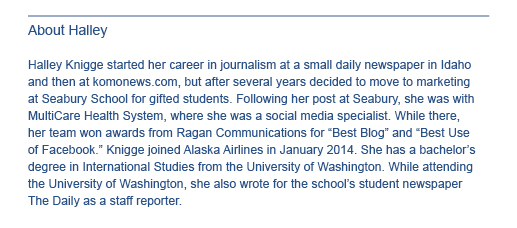
Some companies take blogging to new heights. One of them is Alaska Airlines. It launched its blog (https://blog.alaskaair.com) in June 2014 and in two years the blog has published more than 230 stories that people are actually reading. Halley Knigge, who signed on with Alaska Airlines in January 2014, runs the blog.
Knigge, a former newspaper and digital reporter, leverages many of the key principles she learned reporting in her work for the Alaska Airlines blog. Her essential skills include newsgathering, interviewing, writing and creating stories, and production
1. What was it like to be in Cordova, Alaska, to cover the opening of the Copper River salmon season for Alaska Airlines’ blog?
Cordova was amazing. During the past two years, I supported the Copper River salmon season opening from Seattle. But having the opportunity this year to travel to south-central Alaska and meet the fishermen and the larger community there, to see firsthand how Alaska Airlines helps them get their prized salmon to market, was an outstanding experience. People in Alaska really support one another. The relationship between Alaska Airlines and the communities we serve in the state of Alaska is different than in the Lower 48. Only three cities in Alaska are connected by road, so many times [our planes] are bringing the groceries and the mail. People really rely on Alaska Airlines. One other thing that I love about Cordova – and other places in Alaska – is that people live by the principle “leave no man behind.” As an example, en route to Cordova from a trip to the Copper River delta, our car got a flat tire and one of the locals stopped to help us. He would not leave until he helped us fix it and made sure we were safely on our way.
2. Can you talk about the value of developing and maintaining the Alaska Airlines’ blog? How has it helped the airline?
The blog has helped us in some significant ways. It allows us to tell great stories about our company and our amazing employees who go “above and beyond” to make the travel experience better for our customers. We also fly to some fascinating destinations like Barrow, Alaska, the northernmost city in the U.S., so we love to tell the stories about the unique places we fly to – ones that often no other airlines serve. Finally, and perhaps most importantly, we use the blog to share critical information during storms or other times of irregular operations. For instance, in September 2014, when the category 3 Hurricane Odile slammed into Mexico, we were able to use our blog to communicate and share information about the situation in the cities of Los Cabos, Mazatlán, and Loreto, which was a huge help to many people in both Mexico and the U.S. We also wrote about Operation Ayuda (“help” in Spanish), which was Alaska Airlines’ humanitarian campaign to assist our customers and their families during this very difficult time.
3. What does your blog’s editorial calendar look like? How do you plan and secure content for the blog?
We plan our editorial content on a month-by-month basis and make sure the themes for stories align with our marketing priorities and goals. When we plan stories, we work to ensure they will be valuable when we publish them and stand the test of time. Content needs to be evergreen, meaning it is relevant both today and three to five years from now. For instance, we did a story about how to make air travel easier for children with autism. This story was timely for the blog because of an event we held in Boise, Idaho, where we invited parents and children with autism to “practice the airport.” The topic is still relevant today because we included practical travel tips in the article. This ensures it will be valuable for families and caregivers traveling with children with autism for many years to come.
4. What makes a good blog story for Alaska Air?
Day-of travel tips really resonate with our readers. People always want to know how to travel with less hassle and stress. The other popular topics are the in-depth destination stories. People like to know what they should see that is off the beaten path. They often want to discover something new when they travel. Stories where we can offer expertise that is unique or authentic really resonate with our readers.
5. What are two stories that you are most proud of publishing? And what made them special?
I loved the series Robert Reid wrote about his trip to China earlier this year, starting with A Walk Around Suzhou, China’s Historic Heart. Robert’s writing is beautiful and his pieces helped us educate our readers about Alaska Airlines Mileage Plan partners. His stories were part of an ongoing series that pairs some of my favorite writers with our international airline partners. Our international partners are important and allow our customers to fly to more than 800 destinations worldwide. Many people don’t know this. I am also proud of a recent series we launched featuring our new uniform designer Luly Yang. Luly will be providing fashion-related travel tips for our customers, and who better to share them than an internationally known fashion designer? Our first story, “Flying with Luly: How to pack a wedding dress,” featured videos and step-by-step instructions for packing different styles of wedding dresses. I love this because while it is a very specific, niche piece of content it will be vitally interesting to a very specific group of people: brides traveling to a far-away wedding.
6. How do you measure success for the Alaska Airlines blog?
I look at three things when I judge whether a post resonated with our audience: views (were people interested enough to click into it?), time spent on page (did most people actually read it?) and engagement (if people read it, were they engaged enough to share it with their friends or leave a comment?). These three metrics work together to give me key insights that help me plan future stories, and of all three, I place the least weight on views. One post may get 40,000 views, while another gets just 5,000, but depending on the other metrics I may deem them both a success. For example, the post about making travel easier for children on the autism spectrum is at the lower end of that view range, but had an average time spent on page of more than four minutes and an engagement rate of more than 50 percent. That tells me that we created a piece of content that was uniquely valuable to a very specific, highly engaged audience, and at the end of the day were able to help make travel easier for some of our customers. So far in 2016, we’ve averaged more than four minutes per story (weighted for views) each month. To me, that is a success.
7. How do you think the communications landscape will continue to change?
Blogging and content creation will continue to be important for companies. The communications landscape is changing, but there will always be an opportunity to apply the skills from traditional journalism to tell authentic and credible stories that help people. This is one of the things that I love about my job. The skills I learned as a reporter I can apply to telling Alaska Airlines’ story.