
Insights for Leaders Navigating
Visibility, Credibility, and Growth.
From media strategy to reputation management, we explore the trends shaping public perception and share the approaches that drive measurable results for growing brands.

Perhaps one of the most enjoyable tactics in the PR and marketing tool bag is the creative campaign. We’ve all seen brilliant examples of well-produced, creative brand campaigns which lead to massive brand awareness and adoption.
Possibly the most successful creative campaign in recent history is “The Man Your Man Could Smell Like,” conceived by Weiden + Kennedy and launched in 2010 in an effort to transform Old Spice from a fuddy-duddy brand into one that’s cool and hip.
The campaign launched as a series of TV commercials over Super Bowl weekend and continued as a combined video / Tweet campaign. After all was said and done, campaign impressions topped 1 billion and sales soared. In fact, the company claimed “more people watched its videos in 24 hours than those who watched Obama’s presidential victory speech.”
The one company today who consistently uses creative campaigns as a means to drive market share and mindshare – and does it brilliantly – is Uber. It’s hard to believe that this $41 billion powerhouse began just six years ago, when its founder, Travis Kalanick, had difficulty locating a taxi in Paris during a trade show. Since that time, Uber has taken the world by storm, thanks to creative marketing, dogged persistence and an uncanny ability to understand and deliver just what their target markets want. Here are a few of my favorite Uber campaigns:
#uberKITTENS
In October 2013 and 2014, Uber teamed up with local ASPCA organizations in large metropolitan cities to deliver kittens ($30 for 15 minutes of cuddle time), with proceeds benefiting local animal shelters. And of course, patrons were given the option of adopting the kittens.
#UberSpringCleaning
A recent campaign email that made the rounds at the Communiqué offices was the May Spring Cleaning partnership between Uber and Goodwill. Uber users in over 50 cities in the U.S. were offered free pick- up and delivery to Goodwill of items for donation. A win-win-win situation.
UberAngels
In response to low smartphone penetration in Columbia, Uber came up with a unique campaign to help combat alcohol-related traffic fatalities while at the same time gaining market share. Called UberAngels, the service operated during peak night-time hours and offered patrons a ride home in their own car. Cost for the service: 10,000 Columbian pesos, or the equivalent of $4.50.
UberEats
In December 2014, after almost constant opposition from policy-makers and taxi companies, Uber all but ceased operations in Spain. But then the company came up with a new idea: food delivery. Based on UberFresh, a similar service offered by Uber in California, Barcelona-based Uber drivers now deliver fresh, prepared meals for about €10 plus €2.50 delivery fee (or less than $15).
UberSuperCar
In order to make inroads in Singapore, with its sophisticated public transit system and large number of high net worth individuals, Uber came up with the idea of UberSuperCar. For S$165 to S$200 (approximately $125 to $150) patrons were offered a 15-minute ride in a Maserati or Lamborghini, and then S$7 (or $5) per minute thereafter.
In addition to the above, there are countless other creative campaigns Uber has implemented, many on a global scale. The popularity of these campaigns and the resulting buzz generated in the media and on social channels ensures that Uber is top of mind. It’s no wonder the company name is now used as a verb! Check out UberIceCream, UberTree, and UberSleigh for more super cool ideas.
Uber Spin Offs
Given the success of Uber, it’s not surprising that there are a multitude of copycats out there. The New York Times recently ran a story with the headline, “There’s an Uber for Everything Now”, and indeed it seems there is.
From the article: “Washio is for having someone do your laundry, Sprig and SpoonRocket cook your dinner and Shyp will mail things out so you don’t have to brave the post office. Zeel delivers a massage therapist (complete with table). Heal sends a doctor on a house call, while Saucey will rush over alcohol. And by Jeeves, cutesy names are part of the schtick—Dufl will pack your suitcase and Eaze will re-up a medical marijuana supply.”
If imitation is the sincerest form of flattery, Uber should really be feeling the love.
What are your favorite creative campaigns? Drop us a line and let us know!

Losing a client can be a tough pill to swallow, but knowing that the loss is due to the client’s successful transition or achievement of a significant milestone can provide the spoonful of sugar to make the medicine go down easier. Such was the case with Mobidia, a leading provider of mobile measurement and analytics and one of Communiqué PR’s valued clients over the past eight or so years.
Coming off an enormously successful 2014—which saw placement for Mobidia in over 180 articles and in many national press outlets such as Forbes, the Wall Street Journal, FierceWireless, TechCrunch and Telecompetitor—we were saddened last month to receive word that our firm would no longer be working to drive awareness of its mobile data platform and consumer app, My Data Manager. The company was in the final stages of negotiations around the terms of an acquisition, and we recently learned that Mobidia was joining the corporate family of its direct competitor—App Annie. We had always known that acquisition was an end goal for Mobidia, so while we experienced the disappointment of an unexpected breakup, we were also excited for our friends at the company and proud that our work contributed to this next stage in its life cycle.
Our relationship with Mobidia began in 2008, providing project work to the startup, which at the time wanted to promote its data software platform to mobile telecoms in order to increase network efficiency and enhance subscriber and service policy solutions. During this early stage of our engagement, we helped the company drive awareness by providing strategic counsel, developing press releases around the performance results of its software platform carrier trials, and conducting outreach to media around key news. We also implemented an analyst relations campaign to help increase the company’s profile leading up to Mobile World Congress 2009, securing briefings with eight analysts and analyst quotes that Mobidia Senior Vice President Chris Hill considered “instrumental” in helping the company prepare for its campaign at the event. For more about this effort, check out “Mobidia & Our Results Working with Industry Analysts.”
Over time, our work with Mobidia expanded in conjunction with mobile subscribers’ increased reliance on data-driven tools such as smartphones and tablets. Responding to this growing cultural trend, Mobidia pivoted its marketing efforts from targeting telecoms, with which it had successfully built strong relationships, to providing tools to wireless subscribers that help to monitor data usage and prevent bill shock. In 2010 we helped Mobidia build its foundation by developing key messages, successfully continued our analyst campaign, and began positioning executives as thought leaders by placing byline articles about solutions for mobile operators to manage the growth in data traffic.
Mobidia’s main commodity both for industry and consumer audiences is the data it gathers from users of its My Data Manager app. Capitalizing on this valuable information and the rise of mobile apps, we continued to expand our strategies, incorporating the pursuit of awards and proactive pitching to journalists who actively write using mobile usage data. By employing this mix of strategies and building on what we had learned from previous years, we were able to drive increased coverage for Mobidia year over year, culminating in the previously mentioned 180 articles in 2014. In addition, we secured 10 briefings with journalists and analysts in 2014—excluding company or product news—many of which contributed to increased sales of the company’s data.
While we will miss the opportunity to continue achieving great coverage for Mobidia, we are proud to know that our efforts contributed to its reputation as a respected leader in the mobile data space and, ultimately, an attractive acquisition for App Annie. We look forward to watching as Mobidia’s role in the App Annie family continues to evolve and wish the team all the best in the future.
To learn more about the strategies we employed on behalf of Mobidia over the years, we have highlighted our work and key milestones for the company in numerous blog posts available on the Communiqué PR website.
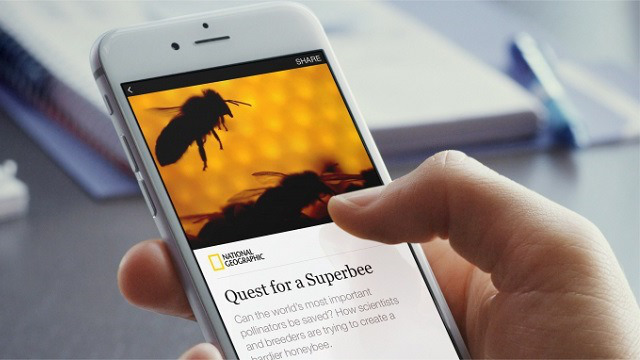
Since the advent of the Internet, news outlets have been looking for innovative ways to monetize their content and cope with readers transitioning to digital news consumption. The rise of digital content coupled with increased social media use has led to a shift in how people consume the news today.
Capitalizing on the changing consumption preferences, Facebook recently announced Instant Articles, a feature that will directly host articles from news publications. Thus far, five American publications and four European outlets have agreed to the deal—these include NBC News, BuzzFeed, National Geographic, The Atlantic, The Times, The Guardian, BBC News, Bild and Spiegel Online.
According to Facebook, Instant Articles was designed “to give publishers control over their stories, brand experience and monetization opportunities.” The new feature will give publishers the ability to track data and traffic through comScore and other analytics tools, a considerable opportunity given the 1.4 billion users Facebook boasts. Instant Articles will also allow readers to view the articles up to ten times faster since they will appear directly in news feeds, as opposed to requiring users to click a link to load a different site—possibly incentivizing users to actually read more articles.
Despite these seemingly robust opportunities, this change has brought about mixed emotions, similar to that of the transition from print to digital. Publishers are wary of losing control of their content and are particularly skeptical of Facebook’s “autonomous” algorithm, which has seen quite a few changes in recent years. However, directly hosting content on social media platforms illustrates a previously untapped resource for news outlets. This is an opportunity for publishers to utilize the platforms to push their content to users who are already on the social media sites.
Social media has become quite a powerful tool. Twitter and Facebook are two of the largest discovery channels, and many people use both as resources for current events. In fact, according to a survey last year by the Pew Research Center, 48 percent of American Internet users accessed political and governmental news on Facebook during the course of a week, nearly the same as those who viewed this news on local television.
Clearly digital content and social media are having a large impact on how we consume news, and while publishers may be wary of Instant Articles and Facebook’s true motives, there’s an opportunity to capitalize on the changing landscape and stay ahead of the curve. I am interested to see how the early adopters fare, what the implications will be for journalists, and if this will change how PR pros interact with the media.
With just one month left in the quarter, corporate earnings season is right around the corner and chances are the next quarterly earnings article you read will not be written by a business reporter, but by automation software.
In 2014, The Associated Press (AP) began using a platform called Wordsmith to automate the writing of earnings reports. Wordsmith, which was developed by Automated Insights, uses natural language generation to turn raw earnings data from Zacks Investment Research into a story, in AP style no less.
Before Wordsmith, the AP estimated that it was producing quarterly earnings coverage for approximately 300 companies. For context, at the end of 2013 there were approximately 5,000 public companies traded on major U.S. stock exchanges, each required by the Securities and Exchange Commission (SEC) to file their quarterly and annual corporate earnings reports.
With the new automated system, the AP has been able to produce 3,750 earnings reports every quarter – more than 10 times its usual capacity. Of those, only a fraction need a human touch, either by updating the original story or by writing a separate follow-up article.
Recently, NPR put Wordsmith to the test, going head to head against the algorithm to recap Denny’s Corporation’s first quarter earnings report. Following below are the two stories – one written by veteran NPR reporter Scott Horsley in seven minutes, the other written by Wordsmith in two minutes:
Which Denny’s earnings story did you like better? The differences are pretty obvious, but spoiler alert: the first story was written by Wordsmith and the second by Horsley.
Earlier this year, the AP announced it would further streamline its reporting by using Wordsmith to write sports stories as well, mainly college baseball and some college basketball and football stories.
So will platforms like Wordsmith mean an end to journalism? Not so fast.
On the surface, it may seem like Wordsmith could easily do the job of a business or sports reporter. For data-driven, just-the-facts reporting, automating stories like earnings reports and game summaries would seem like a logical progression and Wordsmith clearly does the job.
However, articles requiring any kind of “color” still require a journalist’s expertise, intuition and uncanny ability to tell a story. According to the AP, automation has “freed up valuable reporting time and reduced the amount of data-processing type work.” In turn, automation could allow reporters to focus on writing bigger stories.
Where automation could have greater impact is in the general arena of content creation. As a result of the escalating need for content and the increasing appetite to consume it, Wordsmith now generates millions of content pieces every week for partners that include Allstate, Comcast and Yahoo!
A quote from Automated Insights CEO Robbie Allen in a March 2015 WIRED article sums up best where the future of content creation could be headed:
“We sort of flip the traditional content creation model on its head. Instead of one story with a million page view[s], we’ll have a million stories with one page view each.”
How do you think technologies like Wordsmith will impact journalists and/or content creators?
When it’s time to write a blog post, more often than not, I find myself searching for inspiration. I want the post to be intriguing, educational, helpful, relevant and relatable for readers, but finding a topic that encompasses all of these attributes is, without fail, incredibly difficult.
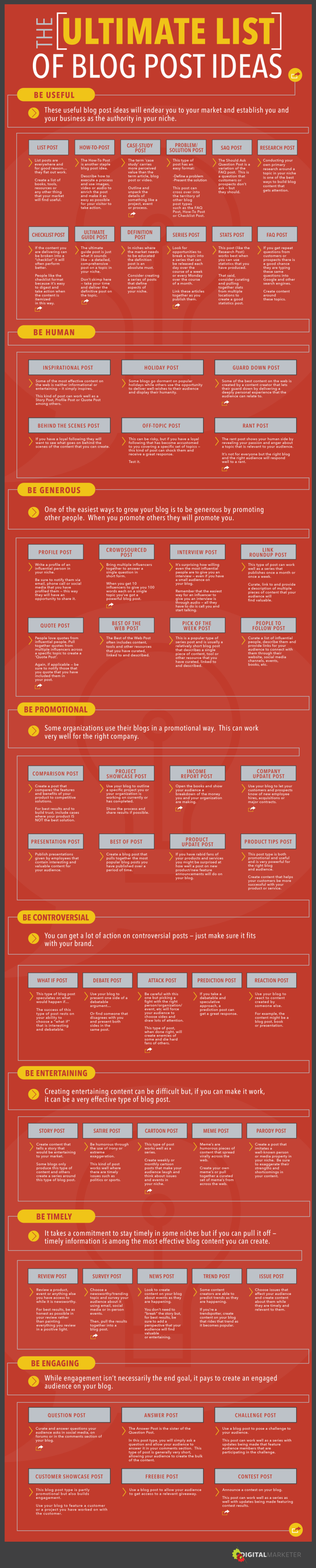
As I scoured the news, blogs and Google to try to discover a topic that would lead to creative genius for this particular post, I stumbled across an infographic that not only addressed the previously mentioned features of an ideal blog post, but would also solve my monthly battle with writer’s block.
Thanks to DigitalMarketer, we now have access to 55 blog ideas in one infographic. The infographic provides eight categories and within each of the categories offers several subcategories. The category that resonated with me was the one that advises bloggers to “be human.” The reason being, readers tend to relate to an author who provides them with insight to a thought process or personal experience. This is particularly applicable to public relations because a common tactic is assisting in the development of bylines. We’ve found through our experience that the bylines that garner the most traction and seem to be the most impactful reveal something about the executive and their thoughts, be that an opinion or failure or prediction.
In attempts to define my own, I found this post could be categorized as a rant post, a problem/solution post, inspirational (hopefully this has inspired you to tackle a blog post or byline) and a how-to-post. As you write your next post or byline, I hope you find this infographic helpful! Good luck with future writing!
For more helpful tips about writing, check out these posts on the Communiqué PR blog:
- Overcoming Writer’s Block
- 5 Ways to Propel Creativity in PR
- Seven Habits of Highly Effective Writers
Recently, Mashable pulled together a group of brand experts to conduct a Twitter chat focused on strengthening your personal brand. A full summary of the questions and answers posed by @mashbusiness can be found here. After my own review of the feedback from the experts, I came to three overarching ideas that can stand as the building blocks for creating your unique, personal brand.

Figure out who you really are
In today’s tech-focused world, more often than not, others’ first impression of you is going to take place online and people are only going to know you by what you choose to share through online channels. Take advantage of this by creating a brand image that honestly demonstrates the values and skills that you have to offer. A great exercise is to be able to describe your personal brand in no more than five words while still portraying your abilities, personality and passions. For example, Disney’s mantra is “fun family entertainment.” Within this mantra, you can identify an emotional appeal, a descriptive modifier, and the company’s overall function. Experts suggest identifying your personality, who or what you are trying to appeal to, and what it is that you do. Taking the time to do this will aid in creating a consistent and more powerful on and offline brand that you can be confident about. This can be a daunting task as it calls for putting egos on the backburner and reflecting on one’s self. Although this exercise is called personal branding, it’s important to consider that your brand is about more than just yourself; it can be used to influence and inform those around you too.
Pick your platform(s)
So you have identified your brand message, now what? When branding yourself, connections mean everything. Pick a few channels to focus on and really showcase your brand. LinkedIn, as this is often the first place people will go for information, is a great place to start. Avoid spreading yourself over too many channels to maximize your chances of connecting with like-minded professionals as well as your target audience. Personal blogs and websites are one of the greatest ways to get your name noticed, especially on search engines. You can also use your blog to highlight design elements that showcase your creativity and personality. Social media outlets such as Twitter and Facebook should not be forgotten however, as they are the key to two-way communication with your audience. Regardless of what platform you choose to utilize, always be mindful that the content you are creating or sharing is of value and in line with your brand. Think quality over quantity.
Get feedback
Personal branding should be satisfying and a way to express who you are, but it also needs to resonate with your audience. Like many things, your first efforts at personal branding may require some revisions and listening to feedback will be crucial to help you in the editing process. Quantitative feedback, including likes, retweets, and mentions, as well as tools such as Google analytics, is a great way to assess whether or not you are striking interest with your target audience and followers. Setting goals and benchmarks for measuring your success will help you gauge your rate of return. The measures that you set should be unique to you and reflective of what you are trying to achieve (i.e. followers, opportunities, revenue). As part of your goal setting, create a schedule for regularly measuring your goals against your brand progress. While it is important not to get too hung up on the numbers, connections and views are going to be a good way to examine whether or not your brand resonates with your audience. Consider feedback carefully and then tweak your brand strategy accordingly.
Taking these tips into account will help strengthen your personal brand foundation and allow you to not only leave your footprint online, but to extend beyond the web as well. As you decide to begin cultivating your brand, realize that it is only going to be reinforced by reaching out for face-to-face meetings with people who would be interested in your brand message. Taking advantage of every opportunity presented to you to network and meet new people will allow your message to be communicated as broadly as possible.
For even more great tips, see our blog on Three Guidelines to Establish Your Personal Brand