
Insights for Leaders Navigating
Visibility, Credibility, and Growth.
From media strategy to reputation management, we explore the trends shaping public perception and share the approaches that drive measurable results for growing brands.
Groupon, like many start-ups of the 21st century, began with a unique idea. Its success came from distributing this idea using relevant technology, maintaining customer service, and consistently growing and developing its outreach. However, as with any well executed venture, other like-minded companies have begun saturating the market, leaving Groupon in a predicament that often repeats itself as industries evolve: How do you differentiate your brand from other, similar services?
Groupon has turned to several communication tactics to maintain relevancy and showcase its services. Currently holding 50 percent of the market share in the exclusive coupon and group deal vending sector, Groupon has obviously deployed a successful strategy. As its director of communications, Julie Messler, noted in PR Week, “We have so many new products, services, and features…PR is a critical arm in marketing that.”
By observing Groupon’s strategy as it continues to find success, in spite of competition from similar companies, we are able to see the raw power of a well executed brand and communication strategy. The fundamentals of Groupon’s approach can educate any company that is expanding its communications with the goal of establishing a unique brand and gaining industry clout.
What exactly can Groupon tell us about maintaining prowess in a slew of similar service providers?
Know your audience. Groupon chooses to disperse a combination of press releases and blog posts, with the majority of information being released on its blog. A blog is a more personal, friendly, and interactive platform, and because Groupon’s customer base is made up of individual consumers, this is a better way to relate to it than a formal press release. Groupon also makes an effort to steer clear of corporate-speak in its press releases, so that it is able to inform its target audience.
Social media: adjust as necessary. We recently posted on the topic of when social media is useful. Groupon follows a similar, critical mindset when it comes to social media. Instead of designing an overall social media plan, Groupon tailors its social media outreach based on the products and services they are offering, and when they are offering them. In this way, Groupon adjusts the timeliness of its social media outreach, and avoids committing to an ill-fitting plan. However, if you are operating in an industry that has a slower change rate, or a more consistent pace, a long term social media plan may be more adequate for your needs.
Use marketing to instill the usefulness of your product. Groupon’s campaigns are not designed to simply raise awareness. The goal is to promote the usefulness of its brand, and maintain its relevance to consumers. For example, they recently staged the “Live off Groupon” campaign, in which Josh Stevens received a $100,000 prize for living solely off Groupon goods for an entire year. This promoted brand awareness by showcasing Groupon’s usefulness, not by simply getting its name out there.
Companies will always jump on the bandwagon when it comes to a successful idea. When you log in to Google+ or Facebook, remember that it all started with Friendster. When you grab an iced latte from Peet’s, think of how Starbucks made corner coffee shops a trend. What determines the success of these brands is the way they separate themselves from the pack — and Groupon is showing us all how this can be done.
Remember what life was like before we had cell phones? It’s hard to recall what we did without the constant ability to connect with people and more recently, the persistent ability to connect to information with the increase in smartphones.
Social media is another innovation that’s fast becoming an engrained part of both our personal and professional lives. How long do you go without checking your Facebook account or posting a tweet?
Today, social media is a highly effective way for organizations to share content, build brand awareness and reach target audiences. So why wouldn’t this work for political campaigns? Given many of us (probable voters in particular), are active social media adopters, it makes sense for politicians to leverage social media as a campaign platform to reach constituents. In fact, some might say that social media is a much needed, critical engagement strategy for any election campaign.
Ad Age posted a recent story that poses three interesting points concerning why social media now has the power to make or break election campaigns.
- Audience: It’s no longer just tweens, teens and young Obama voters who use Facebook and Twitter. Social media use by people over 50 is on the rise, and during elections, voters on both sides of the fence are relying on social media to connect to campaigns. According to Ad Age, Facebook has 150 million U.S. users old enough to vote, and the average user has 130 friends. The social media audience is huge, continues to grow, and users are quick to share information that they’re most passionate about.
- Influence: Ad Age also notes that the median age of a TV evening news viewer is approaching 63, so it’s possible that voters aged 18 to 35 won’t even hear a candidate’s message unless it’s coming to them through social media. Social media users rely heavily on their connections for advice on what to eat, wear, watch, and who and what to vote for. Getting messages into the billions of news feeds on Facebook is critical to entering conversations and getting messages across.
- Money: Realizing the size and power of social-media audiences, top brand advertisers (both commercial and political) are funneling serious money into online and mobile advertising. Because of the recent Supreme Court decision to end a ban on political spending by corporations, the amount of money invested in campaign advertising and therefore in social media, will rise significantly. Additionally, because earned media is furthered by viral sharing through social media, social media engagement can be the most cost-effective way to reach targeted audiences at scale.
So, what do you think? Can social media really make or break an election? I believe the proliferation of social media during the 2008 election was a good indication that 2012 election campaigns will be heavily focused on online engagements as a key strategy to gain votes and generate excitement for political candidates.
We recently started working with RPI, Inc., a leader in make-on-demand private label personalized products, such as photo books, greeting cards and stationery products, for mass and specialty retailers. As we began our engagement, it was fascinating to learn more about mass customization (the ability for a consumer to tailor a product’s appearance, features or content to their own liking), and how retailers are responding positively to this rising trend.
Over the past 30 years, RPI has pioneered the mass customization industry by leveraging its consumer insight, creative product development expertise, and developing the technology to manufacturer the highest quality personalized products for their customers. Most recently, the company acquired the assets of Paro Group, a respected manufacturing and fulfillment company headquartered in the Netherlands, with the goal of creating a stronger mass customization platform to meet the ever-changing needs of its customers.
In the weeks leading up to the announcement, our first priority was to collaborate closely with executives at RPI and Paro Group to identify their key messages and develop the corresponding materials to communicate the significance of this acquisition to media, their employees and customers. Once developed and finalized, we conducted outreach to a select group of influential media to pre-brief them before publicly distributing the announcement.
As a result of our efforts, RPI garnered coverage among leading publishing and print industry publications as well as business media outlets. Some of those recent articles include:
- Print Week: Seattle-based RPI looks to Europe for expansion
- What They Think: RPI’s Bellamy Comments on Acquisition of Netherlands-based Paro Group BV
- The Manufacturer: RPI acquires Dutch subsidiary of JP Media Group
- PMA Magazine: RPI acquires Paro Group in the Netherlands
- 6Sight Report: Photo Book printer RPI acquires Paro Group
We have enjoyed working with RPI to learn more about the mass customized industry and to support its PR activities. On a personal level, I have often been a “creator” of personalized holiday greeting cards and party invitations, and found it fascinating to see how these products are produced and manufactured at RPI’s facility in South Seattle. I look forward to seeing what innovative new products RPI will create as result of this acquisition – the possibilities are endless!
Changes in executive leadership can be an exciting time for a company. Change often signals a continuation of momentum or the start of a new direction. These announcements are also interesting to media, who get to know executives in their given industries over time through numerous briefings and product announcements.
Recently, Opscode, the leader in a burgeoning IT industry segment called cloud infrastructure automation, appointed Mitch Hill, formerly of cloud computing giant Avanade, as CEO, and asked us to help with his introduction. To ensure this announcement was a success, we reached out to key journalists and analysts to alert them to the transition and provide them the opportunity to interview Hill, as well as former CEO and now Chief Community Officer Jesse Robbins.
We also ensured that we were leveraging social media properly for this announcement. Specifically, we suggested Jesse Robbins develop a blog post for Opscode’s website explaining the transition and his new role with the company. This also served to continue generating excitement around the transition.
The news was well-received, with most reporters recognizing that leadership transitions such as this are often a natural part of a start-up’s growth. We saw coverage in print editions of local newspapers and on online news sites, as well as several national industry publications. Below is a summary of coverage:
- Brier Dudley’s Seattle Times’ Blog, Aug. 9, 2011, “Opscode names Mitch Hill CEO”
- Data Center Knowledge, Aug. 9, 2011, “Mitch Hill Takes Helm as CEO of Opscode”
- Dow Jones’ VentureWire e-newsletter, Aug. 9, 2011, “Mitch Hill Takes Top Spot At Opscode”
- Geekwire, Aug. 9, 2011, “Ex-Avanade boss Mitch Hill jumps back into the startup world, joins Opscode as CEO”
- GovConExecutive, Aug. 9, 2011, “Opscode, Inc. Names Mitch Hill to Succeed Jesse Robbins as Company CEO”
- Northwest Innovation, Aug. 9, 2011, “Opscode Names New CEO”
- Puget Sound Business Journal, August 9, 2011, “DocuSign, Opscode name new CEOs”
- TechFlash, Aug. 9, 2011, “Opscode taps tech executive Mitch Hill as new CEO”
- Xconomy, Aug. 9, 2011, “Former Avanade Chief Takes the Helm at Cloud-Services Startup Opscode”
If your company is getting ready to announce a leadership transition, be sure to plan properly and allow the media enough time to digest the news. This will ensure that you have enough time to work out any of their questions or concerns, and that the proper messages will shine through.
There are many uses for social media sites such as Twitter, and regardless of your objectives, gaining influence, followers and social connections will help you get there. Rarely does an organization create a Twitter account with no hope of being found or followed. One of the key ways to have your Twitter handle found and followed is to improve the SEO value of your Twitter account. However, increasing your SEO is not just about the number of followers or tweets you have, there are other items to consider in maintaining a successful Twitter account.
I read an interesting article on this topic from MarketingProfs, “How to Improve the SEO Value of Your Twitter Account,” written by Daniel Rosenhaus. It offers seven suggestions, and I was surprised by some of the things that can actually hurt your SEO value. Consider this:
- Find your target demographic. Focusing in on a target demographic will help your social connections appear relevant. Randomizing your tweet topic can actually hurt your influence because it makes it difficult for people to find you and determine if they want to follow you. For example, if you are a fitness enthusiast and often Tweet about the latest workout or diet, you will likely rank high for people interested in fitness. Also, according to MarketingProfs, you should be sure to follow people that are also relevant to your interests, “by following and being followed by relevant Twitter accounts, you increase your account’s influence, ranking, and SEO power.”
- Write a bio to attract the right followers. So now that you know who you want to attract, how do you do it? You do this by writing a bio that appeals to your target audience. This will increase your chance of being followed by the people that have similar interests. It can also be helpful to include keywords in your bio that people interested in a particular topic might search for. For example, if you are passionate about fitness and that is your focus, include that in your bio. This will be helpful when people search Twitter for “fitness” and encourage them to follow you for more info on the topic.
- Use Twitter lists. Twitter lists help you organize people you are interested in following and monitoring based on categories. You can also set these lists to public view, which will allow others to see themselves on your lists as well as see the lists you’ve created. By creating lists, you are helping your own SEO and that of the people you find most influential, which can in turn increase your followers. MarketingProfs recommends naming your lists using simple key words that are easy to search for. For example, you could have a list for fitness trainers, fitness gear and events.
- Do an audit of the people you follow. Just like spring cleaning, updating your phone contacts and deleting Facebook friends that are no longer current, be sure to take care of your Twitter account. Following people is not always a good thing in terms of SEO. If you follow more people than are following you, that is a ding against your SEO potential. Lopsided numbers can hurt you, “because to the search engines it looks like you benefit from others more than they benefit from you.” Make sure you are following relevant people that are likely to reciprocate the follow.
- Follow accounts that everyone in your industry follows. Twitter makes suggestions to people about who to follow partially based on whom the person follows and who they in turn follow. If you want the suggestions to really work for you, follow big names for a particular industry. Using the fitness example, following Nike or a well-known trainer can be helpful. It will likely be difficult to get a reciprocal follow, but it will be a good source of content and help lend credibility to your Twitter account.
- Eliminate the Twitter spam following you. Twitter spam is not only an annoyance, but can be detrimental to building the influence of your Twitter account. On the surface it looks nice to have those extra followers, but it can damage your social network and hurt your SEO. Search engines will often penalize accounts with spam links. If a large number of your followers are spam, your true followers will likely unfollow you and you can lose credibility. MarketingProfs recommends watching for Twitter accounts with no picture, bio, or tweets and those accounts that are only tweeting about their company’s products and services (i.e. broadcasting but not engaging with others). Typically from our Communiqué PR handle we don’t block followers that match this description, we only block those that tweet spam, so this was an interesting perspective.
- Shorten your links. There are several free services that shorten links and allow you to see how many clicks your links get, such as http://bitly.com. By using free services like this, you can accumulate statistics on who clicks through your links and this information is helpful when you are trying to determine what content your followers find relevant.
By following these helpful suggestions, your organization can be positioned as an influential part of the Twitter community. However, it is also important to keep current. Some of these tips require attention on a regular basis. A well run Twitter account can help your organization be seen as an industry influencer. For PR purposes, this can help position you and your organization as a potential resource for stories.
For more information about the power of social media and if your company should invest, read our previous post on “Should Every Business Invest in Social Media?”
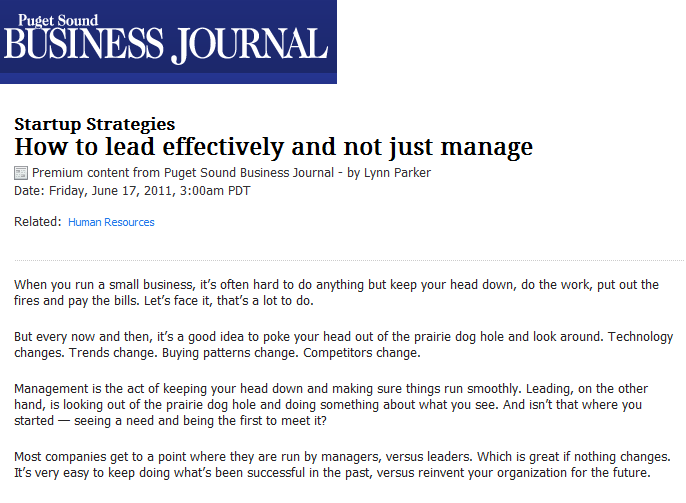
Several weeks ago I was perusing the Puget Sound Business Journal and came across an article by Lynn Parker titled, “How to lead effectively and not just manage.” The headline immediately caught my attention, and as I read the article, which was orientated toward people running small businesses, I could not help but think how applicable the points are for leaders of PR or marketing departments.
Lynn asserts that good management is, “the act of keeping your head down and making sure things run smoothly. Leading, on the other head, is looking out…and doing something about what you see.”
She goes on to share five tips and explains that leaders anticipate what might happen and plan for it. Leaders engage team members and solicit ideas from them. Leaders innovate looking for new ways to solve problems, they ask their customers questions and they talk with their peers.
Clearly, strong account managers or PR department leads need to exhibit these leadership skills and abilities as they can anticipate changes in their industry, understand the competitive landscape, internalize customers’ needs and wants, develop plans and motivate and mobilize their teams.
If you have a few minutes and are in a marketing or public relations leadership role, I’d encourage you to read this article. It can be found here on the Puget Sound Business Journal’s website.