
Insights for Leaders Navigating
Visibility, Credibility, and Growth.
From media strategy to reputation management, we explore the trends shaping public perception and share the approaches that drive measurable results for growing brands.
A couple months ago I came across a really interesting read in The New York Times that posed a thought provoking question: should every business invest in social media? My initial reaction was, of course! While the level of investment should definitely vary depending on an organization’s size, goals, and about a million other variables, social media has been a proven, powerful platform to engage with your target audiences, increase brand recognition and convey key messages. Based on those benefits, why wouldn’t you want to hop on the social media bandwagon? However, after reflecting on the question further, I started to think, does it really make sense for everyone.
The New York Times used a great example of an off-site airport parking lot that took great care to make their social media presence known. Really? Is social media necessary to boost the success of an airport parking lot? Before you automatically dive in to social media, The New York Times shares some common myths to help you better evaluate whether it’s worth the investment.
Myth 1: It’s Free Advertising -There’s a widely held perception that social media is free. But doing it right requires good strategy and an investment of staff time, giveaways and/or advertising to build and keep a following. Most small companies have limited budgets and should evaluate social media with the same rigor they would other marketing tools. Tending the social media garden takes lots of time. And, time is money, whether you do it yourself or pay someone to do it. It’s like saying it’s free to install your own kitchen cabinets. It’s not.
Myth 2: Every Business Should Invest in Social Media – All businesses can use more awareness, and social media can certainly help shore up customer loyalty. If your target audience is on Facebook and Twitter, you should be too. But, if you’re selling services people rarely need, is this a good investment? It sometimes surprises me when I see funeral homes on social media. Is this the kind of organization I really want to engage with? Do people have the time and energy to follow a company that’s not relevant to their daily lives?
Myth 3: Everyone Will Really Like Us – There are several organizational Facebook pages where companies really beseech others to “like” them. This can make consumers question the company and why they should consider a relationship with them. Most people have only a few moments to engage with a brand each day on the social web. Reward them by making it a positive part of their day to help drive people to your page and keep them engaged. It’s essential to offer something of value. This could be coupons, freebies, contests, specials or articles of interest. Also remember that consumers also have a personal brand to maintain and every company someone “likes” on Facebook or “follows” on Twitter is out there for their universe to see. For example, at Communiqué PR, we often “like” our clients or new business prospects to show our support. However, ever since a colleague “liked” a potential client that happens to be in the fertility business, she’s been fielding all sorts of questions from friends and family on whether she’s trying for a baby.
Even though it seems as though everyone’s hopped on the social media train (and primarily for good reason), don’t climb aboard solely because everyone else is doing it. Make sure to thoroughly consider whether the investment can truly help your business and whether you have the time and resources to invest in a truly effective way.
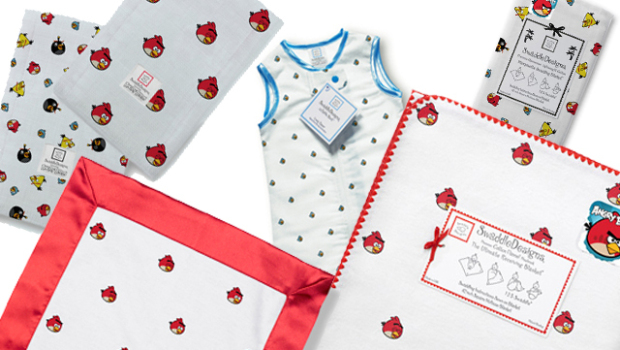
What do Rovio’s Angry Birds, one of the world’s hottest and most popular entertainment and media brands, have in common with SwaddleDesigns®, an award-winning, Seattle-based baby product company? Beyond the common characteristics of loving and protecting their offspring, SwaddleDesigns and Rovio recently announced their definitive agreement granting SwaddleDesigns licensing and merchandising rights to produce Angry Birds Baby products.
To delight the millions of Angry Birds fans around the world, SwaddleDesigns recently introduced multiple best-selling and award-winning products featuring the fun, playful and loveable Angry Birds characters. Communiqué PR had the opportunity to help SwaddleDesigns and Rovio raise awareness around the new retail partnership, generate visibility into how the partnership fits into Rovio’s overall merchandising strategy, and drive pre-sales of Angry Birds Baby products (which, by the way, fans who place a pre-order in the value of $50 or more, will receive a free, adorable Angry Birds Plush toy.)
In the weeks leading up to the Angry Birds Baby product launch, we collaborated closely with SwaddleDesigns and Rovio to build out a PR strategy, identify key messages and develop corresponding story angles and media materials.
As a result of our efforts and partnership, SwaddleDesigns and Rovio garnered more than 20 media placements across top-tier tech trades, business publications, gaming outlets and parenting sites. Of note, Communiqué PR was able to secure an exclusive story with Reuters, which successfully shaped and helped to ignite the incoming news cycle. In-line with our strategy, the majority of coverage highlighted Rovio’s success in the retail space and its partnership with SwaddleDesigns, and showcased images of the Angry Bird Baby products with a link for readers to place pre-sale orders.
Below are a few additional coverage highlights:
- Mashable: Angry Birds Now Appearing on a Baby Near You
- Babble.com: The Angry Birds Are Coming… to Your Layette Set!
- Kotaku: Babies are Already Angry, Might As Well Put Birds on Them
- CNET: Angry Birds cute baby products
- MomFinds: Angry Birds Baby Line
- CBS News: Angry Birds cute baby products
- Geekwire.com: Snuggle up with an Angry Birds blankie
It was so much fun working with SwaddleDesigns and Rovio to support their PR activities. Who doesn’t love Angry Birds and babies? So, it just makes sense to combine the two! I think we can all expect great things in the future from both of these innovative companies.
Late last year, Communiqué PR started working with The Shops at The Bravern, an open-air retail shopping center in Bellevue, Wash. Since that time, we have focused on building awareness of The Bravern both with consumers and the broader shopping industry.

We have had the opportunity to promote a variety of events and work with a number of lifestyle, retail and business media outlets and bloggers, whose articles and posts mentioning The Bravern have generated more than 120 articles, totaling 83 million impressions thus far in 2011.
Some of those recent articles include:
- A cover story featuring The Bravern in the August issue of Shopping Centers Today.
- Alaska Airlines Magazine included The Bravern in a May article, “Seattle Itinerary: Spectacular Shopping.”
- Inclusion in “Destination Washington: Bellevue,” which appeared in the June issue of Alaska Airlines Magazine.
- The July/August issue of AAA’s Journey magazine highlighted The Bravern in “Next Stop: Bellevue.”
Most recently, we helped promote “Be Bold. Be Bald.” – an event hosted by John Howie Steak and The Bravern in conjunction with Sips & Sounds, The Bravern’s weekly summer happy hour. The event raised money to support a local woman and employee of Chef John Howie, Tomoko Bryant, and her participation in the Susan G. Komen 3-Day for the Cure. In advance of the event, local media such as 425 Magazine, Bellevue Patch, KOMONews.com, Seattle PI and Seattleite shared details of the event with their readers. KOMONews.com also posted a fun slideshow of photos from the gathering – including images of Chef John Howie getting his head shaved!
We are excited to partner with The Bravern to build awareness for its second annual Fashion’s Night Out celebration taking place Thursday, Sept. 8. The free event is open to the public and will include a variety of activities including fall runway shows hosted by Neiman Marcus and Anthropologie. Additionally, during Fashion’s Night Out, shoppers can take advantage of special in-store activities, offers and gifts with purchases such as a free Fashion’s Night Out tote to customers that spend more than $100 at Tory Burch.
We hope you will join us at this fun event in September! For more information on Fashion’s Night Out at The Bravern, visit www.thebravern.com/fno.
In a world where your work force might be spread around the globe, being an effective communicator via email and phone is imperative. Though we use the phone to communicate daily with co-workers, clients and friends or family, we use a different set of principles and guidelines than are needed for a phone interview.

Chances are that someone in your organization will be called on at one time or another to give a phone interview with a journalist. Like any interview opportunity it is essential to deliver a clear and compelling message that positions your organization for success.
The difference between a face-to-face interview and a phone interview is that the only tool that you have to communicate your message is your voice. Ragan’s PR Daily posted an article titled, “7 tips for giving a better phone interview,” that offers some helpful guidance. Consider the following:
- Get out of your office. If possible, don’t do a phone interview at your desk where you can be distracted by incoming emails, phone calls and visitors. Try to find an empty conference room with no distractions and tape a “Do Not Disturb-Interview in Progress” sign on the door. This will ensure that you are focused on the interview and are being respectful of the journalist’s time. Nobody likes to be interrupted.
- Bring your notes. Notes are a helpful tool for phone interviews. Since the interviewer cannot see you, you are free to glance at your notes. However, do not read directly from the notes. Use them as a tool to trigger your memory or from which to recite statistics and facts. Reading from your notes will make the conversation seem scripted and less authentic and that is not the image you want to convey during an interview, even on the phone.
- Get a headset. Telephone headsets are ideal for phone interviews. This allows you to use your hands to gesture, not only making you feel more comfortable, but helping to emphasize your voice to make a point. This also frees up your hands to write notes or search for information in necessary.
- Stand. This tip is often forgotten during a phone interview, but is an easy way to give yourself an advantage. In addition to helping you “think faster on your feet,” your delivery will come across as more powerful because you are projecting from your diaphragm.
- Smile. Just because the interviewer can’t see you doesn’t mean he or she can’t hear you smile. When used appropriately, the reporter can hear the warmth through your voice when you smile.
- Use a landline. As more and more people ditch the landline in lieu of mobile access, this can be challenging. However, using a landline helps avoid dropped calls and the speakers usually provide better sound quality.
As a former TV journalist, I can tell you that most people prefer to give phone interviews because they feel safer. However, it can be more difficult to deliver a clear message effectively. These tips are a great start to giving a better phone interview. When accompanied by preparation and knowing your key messages, you will be prepared for success.
The “About Us” page is one of the most important pages – and often most visited – on any company’s website. For most businesses, the messaging is first created at the early stages of the website’s design and most likely has not been reviewed since.
However, while you may not be paying attention to it, potential customers are. It is the page where most visitors go to learn more about a company, the products and/or services offered, the company leadership and other pertinent information that will turn a visitor into a customer.
So what does your About Us page say about your company? Take a moment to read it and ask if it still accurately describes and reflects the characteristics of your company. As the old saying goes, “You never get a second chance to make a first impression.”
If you find your company’s About Us page no longer hits the mark, here are a few tips to consider on how to refresh it.
- Share the basics. Provide readers with the basic information about your business including the company’s mission and goals, what you can provide and who you service, even how long your company has been around. Always include key contact information (i.e. main phone numbers, customer service phone number, a fax number, email) and a physical address. If your company has several locations, include a mention of this fact and create a separate “Contact Us” page.
- Make a connection. With the advent of social media, consumers want to know more about a company and feel a connection. To take this page beyond the boring and unapproachable, share some of your company’s personality with your visitors. Offering some insights as to how your company first started, the leadership and what they are passionate about will help create a personal connection that will foster a customer’s affinity to your brand.
- Establish trust and credibility. During the past few years, there have been countless incidents that have given consumers ample reason to lose trust or become skeptical of businesses. When developing your About Us page, use language that establishes your credibility and communicates your company’s values. Also, mentioning awards or honors your company has received, community service programs your company supports, and clients you have partnered with can go a long way in building trust among your current and future customers.
- Incorporate social media. If your company has a presence on social media, the About Us page is a great place to share your company’s blog and/or subscription buttons for your Facebook, Twitter, LinkedIn, YouTube or other social media channels. Potential customers will most likely visit these sites to see what topics you’re discussing, and if they feel a connection to your company, they are likely to buy what you’re selling. Also, if you create any type of video content for these platforms, consider featuring it on your About Us page to make it more dynamic.
- Revisit the page. Now that you have created your new About Us page, don’t let history repeat itself and let it fall to the wayside. Think of this page as your company’s resume and keep it current with recent company announcements, awards and clients. Also, watch your site’s performance using Google Analytics or another monitoring service to see how the page is trending and where visitors are clicking through. This will give you a good indication of what may need to be modified or enhanced depending on the results.
What information on your About Us page resonated well with your customers? Do you find About Us pages a valuable resource when researching a company? What type of information do you look for about a company when you consider engaging in business with them? We would love to hear your thoughts.
A client recently approached us about archiving Facebook chats in order to further engage their audience. Many companies find Facebook chats are an excellent way to maintain contact with their consumer base. Providing archives of these conversations is a helpful way to allow continued viewing of, and participation with these conversations.
We did a little investigating about Facebook archiving, and here is what we found out:
Archiving applications
- Firefox provides the extension “Archive Facebook,” which essentially converts your conversation to a PDF, available for print or savable on your hard drive. While these PDFs cannot be directly displayed under a tab on your Facebook page, potential uses include uploading them to your website or blog for further viewing (and commentary).
- Facebook hosts a “post archive” app directly on the website that offers a fundamentally similar service to Firefox’s “Archive Facebook.” This tool may be easier to use, since it is on the website itself.
Alternative solution
As your company continues to host live discussions, consider using the “discussions” application available on Facebook to host live chats. This application allows the administrator to post a discussion topic on which other Facebook users are able to respond in the same fashion as a wall post. Each topic is separate and easily searchable. Administrators are also able to monitor and edit content, which prevents issues of spam.
Bath and Body Works is an example of a company actively using the discussion feature; view their postings here for a better idea of what “discussions” look like.
To install Facebook’s discussion application,
- Go to “edit page” on the upper right hand corner of your Facebook page.
- Click on “apps” in the left hand list of options.
- “Discussion boards” should be the last option in the list of apps.
- Click “edit settings.” A box will pop up; click “add,” then “okay.”
- Return to your home page; the discussion app should be in the left hand side under “wall,” “photos,” etc.
- Click on the discussions app and start a topic!
Please note that Facebook uses the term “discussion boards” and “discussions” interchangeably, however, they are the same feature.
Hosting discussions connects with your audience in a fun and interactive way. Try using Facebook’s discussion app to facilitate easier search-ability and interaction with conversation topics. If you find that the live chat feature remains your preference, use either the Firefox Archive Facebook or the Facebook post archive tools to maintain records and post them elsewhere.
We hope you find this post useful as you continue exploring Facebook. Please let us know if you have discovered any similar solutions to archiving Facebook chats in the comment section below.