
Insights for Leaders Navigating
Visibility, Credibility, and Growth.
From media strategy to reputation management, we explore the trends shaping public perception and share the approaches that drive measurable results for growing brands.

In the Internet age, most people often act quickly and pass along information via social media, before they even verify that the information is accurate. We’ve all see the fake Amber Alerts for missing children or the faux-images that fly around Facebook and Twitter, such as the one picture to the right comparing Prince William and Kate Middleton to Cinderella and Prince Charming. These types of misinformation or inaccuracies rarely cause serious or physical harm, but they can be damaging when it comes to causing panic or spreading lies about a company. So, what do you do when there is misinformation floating around on social media about your company?
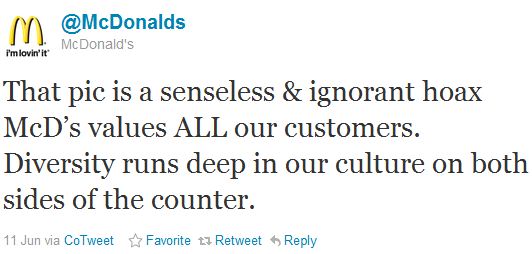
As an example, McDonald’s was recently the center of a Twitter hoax when unknown parties began circulating an official-looking image on Twitter that appeared to be from the popular chain restaurant claiming that they were charging African American customers $1.50 more due to a string of robberies. Even though this image was quickly discovered to be false (it had been circulated in 2010 as well), it didn’t stop the mass of people tweeting and retweeting the image, which led many people to become enraged with McDonald’s.
In response, McDonald’s quickly posted a tweet letting people know that the image was a senseless hoax, and that the company valued the diversity of its customers and employees. After the image continued to circulate, McDonald’s posted another, more-direct tweet saying that the image was a hoax. While this didn’t stop the image completely – it’s hard to control what people do and don’t share on the Web – it did slow down the angry tweets. And, according to Ragan.com, most crisis communications experts felt that McDonald’s handled the situation well.
So what can your organization do if it finds itself in this situation? We’ve outlined a few easy steps to follow:
- Research the Situation. It’s important to make sure you fully understand what is being passed around. You don’t want to react with incorrect information. This could cause followers to think you are being deceptive.
- Act Quickly. Once you realize there is misinformation floating around, quickly gather the appropriate stakeholders and devise a plan of action. The longer you wait to give your side, the harder it will be to convince people you are correct. For more on this, see our recent post about crisis communication.
- Post a Statement. Make sure to upload a brief statement to Twitter, where everyone can see it. If there is a hashtag being used to discuss the crisis, it would be a good idea to reference it in your response so that everyone can easily find it.
- Monitor the Conversation. Watch to see what people are saying in response to your statement, and determine if an additional statement is needed.
While it’s impossible to completely stop something like this, you can’t ignore its existence either as silence is often equated with guilt. There will always be differing opinions on many subjects. The best a company can do is to react appropriately and in a timely fashion.
Think back to the days when you were a child learning to read. At that age, most of us gravitated toward books that primarily consisted of vibrant illustrations or photos. As a young child, it was often pictures that truly helped us understand words and stories. Now, flash forward to your adult life and you’ll find that not a lot has changed.
Infographics, which are visual representations of data or information, often present challenging topics in a way that helps us digest the information quickly and clearly. While the notion of infographics has been around for quite some time (think cave drawings, or map-making), they’re an integral part of how information is accessed and absorbed on the Internet, serving as an effective medium to relay messages or concepts in a visually compelling manner. They’ve gained so much popularity over the last few years that the Huffington Post even created a news page solely dedicated to highlighting the latest and greatest infographics.
With the evolution of social media, which has helped create an environment where information is published and consumed faster than ever, PR and marketing professionals can leverage infographics as an effective way to add visual appeal to content. Here are few reasons why organizations should consider harnessing the power of the infographic:
- They complement stories. Reporters are often looking for interesting graphics and/or images to accompany their stories. Infographics can be a great tool to enhance a story by providing both supporting points and related visuals.
- They go viral. Once an infographic is published, they’re easy to share. If the content is compelling enough, other sites will often pick it up and embed the image, therefore driving traffic to the site it was originally published on and increasing search engine optimization.
- They’re multi-functional and deepen understanding. Whether you’re highlighting the latest social media stats or your own personal experiences through the latest trend in infographic resumes, infographics can be used to communicate almost anything.
- People enjoy them. Who doesn’t appreciate a simplistic visual that helps you understand a complex topic? They’re a powerful vehicle for sharing your information in a compelling way.
So ask yourself, would you rather read a five-page article that describes a complex concept such as the, “Social Media Effect,” or, would you rather digest the information from a pretty picture? I guess there’s really something behind the old adage, a picture’s worth a thousand words.
Now, in case you’re wondering how to go about creating an infographic, check out these great tips for designing infographics and free tools to help get you started.
Ever thought about a museum dedicated solely to you? Intel did, and found marketing and branding gold.
Following the concept of LinkedIn’s more basic “Connection Timeline,” Intel recently released the “Museum of Me,” (MoM) in which the viewer is able to tour a virtual museum display dedicated to his or her life – or at least that which has been posted to Facebook. While LinkedIn’s “Timeline” details your LinkedIn history visually and across time, MoM quickly and easily exhibits your online social history.
Set to the music of Takagi Masakatsu, the multimedia artist recently profiled on Apple’s website, the MoM tour guides the viewer through a virtual museum of photographs, words and video clips, all drawn from the user’s Facebook data. With the purpose of displaying the muscle and might of Intel’s Core i5 processor, Intel has succeeded in creating a widespread and truly resonating marketing campaign.
Intel’s Facebook page activity skyrocketed following the June 1 release of MoM with “Likes” jumping from one million in late May to 1.3 million on June 1, currently weighing in with 1.6 million “Likes.” Additionally, well more than half a million people currently “Like” the MoM site itself. With these “Likes” distributed to more than 500,000 news feeds, the impact of MoM is enormous for Intel’s Facebook and social media presence.
What is interesting about MoM’s success is not the concept itself but the logic that drives it. The idea behind the campaign is a basic one: consumers clearly enjoy seeing information about themselves posted online. Intel made the marketing campaign about the consumer and garnered significant interest and participation. In an arena where the average consumer is constantly projecting themselves publicly via social media outlets, appealing to the consumer’s ego is increasingly pertinent.
Successful marketing is based on establishing the relevance of a marketing campaign with individuals. In our interactive world, it is possible to not only provide direct relevance to the consumer, but to involve the consumer directly and personally, the way Intel has done with MoM. They’ve made their campaign irresistible for consumers to participate in by personalizing the experience for each participant and utilizing familiar forms of online communication, such as Facebook.
Intel showed that simple, creative and interactive strategies can be useful and attractive to consumers by appealing to their own social life and interests, while still displaying a product and increasing brand awareness. This innovative strategy marks a milestone in the evolution of interactive advertising by directly involving and catering to each unique consumer. The logic behind the MoM can be applied to any marketing campaign that hopes to drive consumer involvement. Intel’s creative concept provides tremendous insight into how to successfully involve consumers in the distribution of a marketing campaign.
When Secretary of State Hillary Rodham Clinton released her book, “It Takes a Village: And Other Lessons Children Teach Us” in 1996, it was met with rave reviews and became a modern classic. The book centers around the impact individuals and groups outside the family have, for better or worse, on a child’s well-being, and advocates for a society which meets all of a child’s needs. Much the same can be said for an organization looking to build a new category within an established industry. It takes many people including visionaries, industry analysts, partners and customers, and proven products to drive awareness and demonstrate success around an emerging category.

In a Fast Company article, Kahain Krippendorf outlines thoughts on creating a new category saying, “When a new category is created, innovators take advantage of that new niche’s competitive advantage.” So, ask yourself these questions to see if you can find a new category that you can own:
- What category does my business fit in?
- Is there a way to blend two or more categories to offer something new?
- Do I see a demand and a market that isn’t being served, and if so, how can I create a new category and gain a competitive edge?”
One of our clients, Opscode, is working to build a new category within the cloud computing and infrastructure management market called, cloud infrastructure automation. Their approach of automating infrastructure management via the cloud is changing the way enterprises tackle systems configuration enabling them to cost-effectively improve infrastructure management efficiency and quickly scale infrastructure to meet business needs.
To help elevate this shift in the industry, we worked with Opscode to develop a strategy and plan that leveraged a combination of internal survey data, customer case studies and new products to demonstrate how Opscode’s approach to cost-effectively improve infrastructure management efficiency and quickly scale its infrastructure to meet the needs of the business.
Next, we bundled three key announcements to help underscore the need for cloud infrastructure automation in the enterprise amid the widespread shift to cloud computing. These announcements included the general availability of Hosted Chef, a new product called Private Chef, and an umbrella release that outlined the key drivers behind this trend and included key proof points including survey data as well as analyst, customer and partner quotes.
We also pre-briefed media and analysts to introduce them to Opscode and garner support for the launch.
As a result of our efforts, we secured more than 20 briefings with key technology media and industry analysts such as The 451 Group, IDC, Forrester, Gartner, RedMonk and more. We also garnered more than 17 pieces of original coverage including Network World, Light Reading, Enterprise Systems Journal, ReadWriteCloud, GigaOm, SearchCloudComputing, Data Center Knowledge, among others .
We have discussed how to launch a new product in a new category, but in order for media, analysts and potential customers to get on board with a new category and help build credibility, it is critical to outline and demonstrate how the new product, approach or solution is disruptive to the existing landscape (vis-à-vis case studies, data, third-party validation, etc.).
Twitter is one of the most valued social media platforms utilized today by organizations and brands who seek to engage and interact with their target audiences. However, if you have one of the 200-plus million registered accounts on Twitter responsible for driving more than 110 million tweets per day, it can be easy to get lost in the conversations.
It is likely that in the early days of your presence on Twitter, you watched the numbers of followers quickly rise as your employees (along with their family and friends), current customers and partners all subscribed to get the latest news on your company. But have you recently reached a plateau in which you are no longer attracting new followers? Or perhaps you have seen a dip as followers choose to unfollow you?
I recently came across a useful article on SocialMediaExaminer.com that shared “4 Tips to Maximize Your Twitter Marketing.” The tips serve as a good reminder on the basics of using Twitter as part of an engagement strategy. We thought it might be helpful to highlight some of the tips shared in this article, in addition to a few other ideas we have learned through our own engagement on Twitter.
- Define your business goals and objectives. When we develop PR strategies for our clients with a social media component, we examine what we want to accomplish by using Twitter and set metrics to measure our engagement against. It’s important that this strategy closely aligns with the organization’s overall business goals and objectives. However once you have an established Twitter presence it’s always a good idea to revisit these goals one to two times a year to make sure they continue to align with your social media strategy. Additionally it’s a good idea to analyze how the community has responded, since launching your presence, as this may also help drive any changes in the strategy.
- Create your conversation strategy. Twitter is about building a community and your success thrives on the ability to form a relationship with your followers. The article suggests “thinking through your conversation strategy and put it in place before you invest time in searching for new people to follow.” At Communiqué PR, we often develop an editorial calendar to ensure we are developing content that aligns with the company’s story arc. In addition, it also allows us to evaluate if we have the right balance of company news, conversation starters and other interesting industry news.
- Organize your community with Twitter Lists. Twitter provides this functionality for a reason – to make it easier for you to focus your engagement with your followers. By breaking up a community into lists, you gain a better understanding of what they are up to and the conversations that are meaningful for them. If you are not familiar with this feature, Twitter provides a great tutorial on how to create them.
- Nurture your Twitter community. It is important to recognize that it takes time and commitment to build a community. The article makes a great recommendation to keep your engagement in perspective and to “start small and build over time” by following a handful of people each week. When we have new followers on our own Twitter channel, we often spend a few minutes to get to know each of them by reading their profile and tweet stream. It provides us with a greater sense of what type of information they value and share with their followers.
What has worked well for you when building your community on Twitter? Do you find the Twitter Lists feature helpful to engage with your community?
Adoption of social media platforms including Facebook, LinkedIn, Twitter and YouTube has been significant, and according to CMO.com it is anticipated that “CMOs will invest more in social media this year than ever before.” Earlier this year, CMO.com launched its 2nd Annual Guide to: The Social Landscape in an effort to capture the social media landscape.
While the CMO.com guide offers tips on nine social media platforms, new platforms continue to emerge and attract attention and members everyday such as Quora, Empire Avenue and Ning. For a complete list of active social media networking sites check out Wikipedia – but be ready, the list is extensive. It is easy to reach platform overload.
For most marketing professionals, the social media platforms with hundreds of millions of active members continue to draw the majority of their resources and attention, and the benefits of even the most popular networks differ greatly. Just last week, we wrote about how LinkedIn compares to several other networks and outlined the different pros and cons (The Value of LinkedIn vs. Other Social Media Networks).
Clearly, as communicators, we need to stay up to speed on these new platforms and understand which networks will be most effective and efficient in reaching our target audiences in order to support an organization’s business objectives. Is the best platform the one with the largest number of active members? Or is there a niche platform that may not have reached the masses yet, but specifically caters to a critical target demographic?
Ironically, we utilize some of these same social networks to stay informed of new entrants. We also look to resources such as Mashable, TechCrunch, Soshable, and Social Media Examiner to become aware of changes in the landscape.
How do you stay up on the changing social media scene? What platforms are you investing in today?