
Insights for Leaders Navigating
Visibility, Credibility, and Growth.
From media strategy to reputation management, we explore the trends shaping public perception and share the approaches that drive measurable results for growing brands.
A few weeks ago, the American Red Cross – and its Twitter account, @RedCross – became the target of a number media blog posts and articles. The reason wasn’t another natural disaster response or a direct push for donations (although it did turn into a push for donations later). The attention was due to this rogue tweet that appeared late one evening:
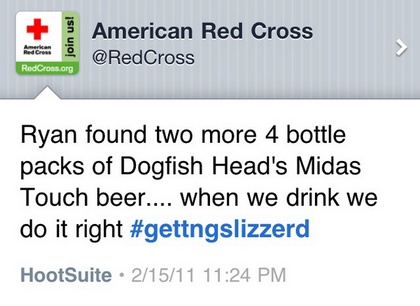
Most people immediately assumed this tweet was not the official viewpoint of the Red Cross, but rather that they were witnessing a simple public error made by one of its employees. Instead of being chastised for allowing such a tweet to happen, the Red Cross was ultimately praised in the articles and posts for the way it rapidly addressed the mistake, using both honesty and humor to diffuse the situation. As James Plafke of GeekoSystem noted, “The Red Cross handled the situation pretty entertainingly–something that doesn’t happen much these days–and released a charming follow-up tweet.”
Those of you who utilize social media on behalf of your company probably already know this: Since social media is run by humans, it is susceptible to human error. It’s just a fact of life, and you can’t always prevent it from happening. The key takeaway from this revelation is simple – be prepared. Many companies have a crisis communication plan for all types of unlikely scenarios that they may have to face, so why not employ one for your social mediums as well?
What the Red Cross did was take the most appropriate action it could: It took ownership of the mistake, embraced it, addressed it quickly and moved on. It’s easy to forget that people follow companies on Twitter and Facebook because they enjoy the feeling of having a personal connection with them. Consumers are looking for genuine human interaction, and they know that mistakes do occur.
Mistakes, however, don’t have to catch you off-guard. Set up a plan and make sure all stakeholders in the social media process are aware of how to handle a situation, should one occur. In the plan, you should outline who will be responsible for deleting or addressing the mistake, set a goal for how fast you will realistically respond, and determine who will speak with media or journalists, if necessary. Once you have thought through this list and agreed on a plan of action, your company and team will be able to handle any situation calmly and methodically.
If you need tips for creating a crisis communication plan, check out our blog post here. We wish you happy planning, and remember it’s always better to be prepared.
We are all aware that the world of media is constantly changing and that it can sometimes be challenging to keep up with the latest innovative tools and resources available to us as PR professionals. We continue to work at lightning speed to not only meet our clients’ objectives but also the accelerated deadlines with which our media contacts are faced. To help us get our work done faster, more efficiently and achieve the best possible results for our clients, we often rely upon the tried and true industry tools such as Cision, BusinessWire and HARO.
However, a number of other new tools and resources exist that enable us to uncover editorial opportunities, build relationships with reporters and develop social media releases. We have shared a few of these tools in a previous post, but there is one in particular that I have been hearing a lot of buzz about from other industry professionals and that I wanted to try.
PitchEngine is a publishing platform that enables users to create social and search optimized content that is consumer-facing. Its website states that it’s “Co-op SEO” would provide “exceptional indexing in major search engines” and since they offer a free 30-day account, I recently leveraged the platform to compliment my outreach efforts to introduce Bookbyte’s latest eBook, Words of the Presidents: Speeches and Letters from 1776 to 2011 to journalists and bloggers.
PitchEngine makes it easy to incorporate PR assets like video, audio and images directly into your press release and share it with your media contacts via e-mail or post it directly to Twitter and Facebook. For Bookbyte’s announcement, the platform allowed for me to create a social media newsroom complete with the company’s logo and visuals from the eBook in addition to adding keyword tags to enhance search engine optimization.
As we have shared before on our blog, SEO rankings are critical to help drive more traffic and business as customers often become familiar with a company through a search on the Internet. According to data from analyst firm iProspect, “62 percent of search engine users click on results within the first page of search results and 36 percent believe that companies whose websites appear at the top of the search results are leaders in their field.”
Within the first week, the announcement received more than 100 views and it only continues to climb. Unfortunately, PitchEngine’s free account doesn’t provide an analysis of who has viewed the release unlike BusinessWire and other wire release services, which are paid services that we often use. However, I was impressed that when searching with keywords “Bookbyte,” “eBook” and “Presidents,” the social media newsroom on PitchEngine was found on the first page of Google and on the second page of Yahoo! and Bing search.
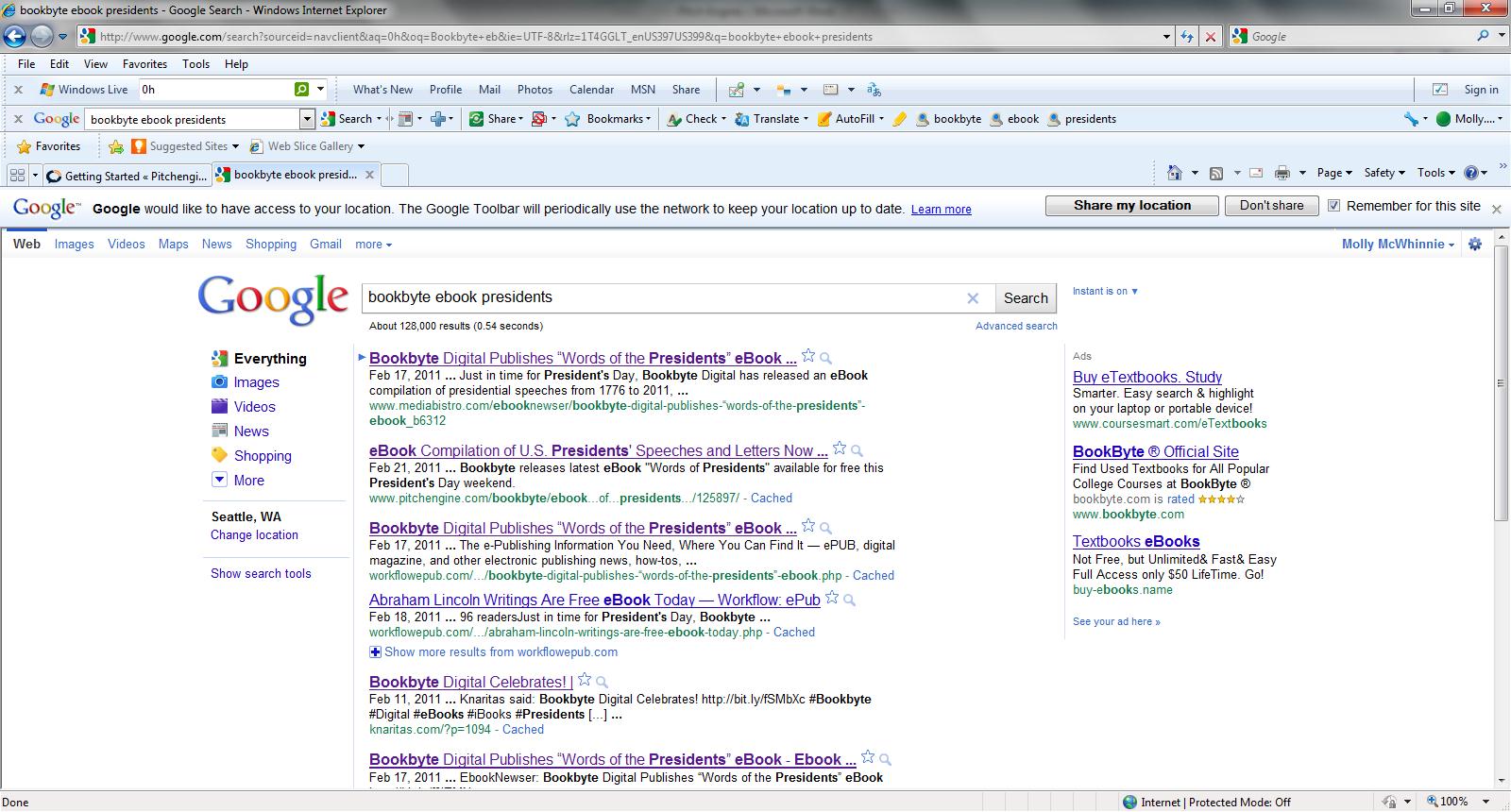
In addition to using PitchEngine, I had also targeted a specific group of media outlets and bloggers to share the news of Bookbyte’s latest eBook including Dianna Dilworth, editor of Mediabistro.com’s eBookNewser, who featured the news twice. This particular media placement appears as the first result across all three search engines proving that nothing will usurp the power of knowing the right media targets and contacts for your client’s announcement.
To be successful, it is important that we continue to learn, adapt and utilize the latest tools that are made available to us. While each may vary in their purpose and functionality, every PR professional should consider utilizing a few to test how they can efficiently and effectively add value to your PR campaigns and initiatives.
When our clients announce new products or services, they also consider whether to make the announcement on a global scale or keep it to the U.S. This was especially true for one of our clients who wanted to make an announcement at the recent Mobile World Congress in Barcelona, Spain. In order to ensure they were reaching as broad an audience as possible, they enlisted the support of a European agency to complement our efforts on the U.S. side.

While we do provide services to our clients that span all geographical industry lines, this client felt it would be beneficial to have representation from an agency in the same time zone as the show. Having multiple agencies work on the same project takes thoughtful planning and management to ensure the roles are clear and there is no overlap in activity.
If your company is considering employing a similar, dual-agency communication strategy, here are a few tips for you to help assure the entire campaign runs smoothly:
- Introduce the team leads – During this introduction, it might be helpful to recap the goals of the project so that each team is clear on the objectives. By ensuring everyone is familiar with each other, your communication teams can work out the minutia together, without using you as a middleman.
- Clearly define roles – It’s critical that each team knows what their role is within the project. For example, for the Mobile World Congress announcement, we were the lead agency responsible for materials creation, while the European agency tackled localized outreach within Europe. Clearly defining roles helps make certain that no one does duplicative work.
- Share materials and outreach lists – Reporters hate getting pitched twice. To avoid this, it’s important to make sure both agencies have shared their contact lists and reviewed them to avoid any duplication. Any messaging or branding materials should also be shared and utilized because it’s important that everyone communicate the same messages throughout all materials and outreach.
While these steps seem simple and straightforward, it’s important to employ them to alleviate any confusion or duplication of work. Coordinated outreach and the distribution of announcements takes a lot of time and effort behind the scenes, but all a consumer or journalist sees is the end product. Employing an open, cohesive communication strategy is key to achieving a smart, successful and seamless product launch. Additionally, with smooth collaboration between agencies, communication professionals can ensure they are getting the most value for their money.
One of the things I love about my job doing PR is working with companies with whom I feel a personal connection, and with the recent cold spell in Seattle, I could not be more pleased to have had the opportunity to work with management team of Triple T Trading and its Northside brand. The company makes affordable, high-quality footwear – including winter boots – for families. Northside’s reasonably-priced shoes are sold by many retailers, such as Fred Meyer and Amazon.com.

Last September, we met with Triple T Trading President Jack Wolfin, and brothers Bob and Jeff Thayer. Bob is vice president of design, development and sourcing, and Jeff is vice president of sales, operations and systems. We were impressed with their vision for the Northside brand as well as their commitment to customers and retailers alike. After learning more about their specific business and communication objectives, including the revamping of their brand, we developed our communication plan and began work to help them unveil the new brand at the Outdoor Retailer Winter Meeting (ORWM) in Salt Lake City.
Journalists were eager to share news about the company’s rebranding activities, preview the fall 2011 collection of shoes and boots, and understand the teams’ perspective about manufacturing costs. As a result of our outreach, Northside was featured in local and trade publications including:
- Outdoor USA, “Triple T Trading Invests in its Northside Brand: The Affordable Footwear Company Offers Families ‘More for the Adventure.’”
- Footwear Plus, “Snow Bunnies: Designers Tie in Warm and Fuzzy Feminine Details to Utilitarian Boots.”
- Seattle Times, “Raising Prices Coming Back in Fashion” by Amy Martinez
In addition to helping them secure this editorial coverage, we also helped them get started on Facebook. If you have a minute, we’d encourage you to check out the company’s fan page. They have a small, but growing group of loyal supporters.
We anticipate the company will continue to see strong demand for its footwear as consumers remain price conscious and continue to look for opportunities to economize on clothes, gasoline, food and many other goods or services. Northside provides average families with significant value by making quality, comfortable footwear, which is fashionable to boot. It was an honor to have had the opportunity to support the company in its recent PR activities.
Earlier this year I read Paul Kimmage’s interview of Floyd Landis, a retired cyclist. I had watched Landis win the Tour de France in 2006 and followed the subsequent doping controversy, which included him being stripped of his Tour de France win. So I was interested to learn about the chronology of events and actions that kept the controversy in the media for roughly four years.

The article is quite extensive and details how ill-prepared Landis was to handle the crisis. Many journalists and bloggers will focus on the doping itself, however, as a communication professional what fascinated me was how poorly the communication was handled and as a result extended the crisis, further damaging Landis’ credibility.
There were many missteps in how Landis responded to his failure of a drug test in 2006. These gaffes illustrate the importance of crisis communication planning. Consider the impact of the following lapses:
- Failure to plan. Like most companies that fail to plan for a crisis, Landis knew there was always the potential for his doping to be discovered. Yet, he never thought through the basic steps he would take or even who he would look to for counsel if his actions were discovered. When the crisis hit, Landis was physically and emotionally exhausted, and was ill-prepared to handle communication with the media. At a minimum, in advance of a crisis, companies should define potential types of crises, outline the communication objectives, and identify the crisis communication team.
- Lack of experienced counsel. When faced with a crisis, and ideally in advance of a crisis, it is important to secure seasoned, professional communication counsel to develop a crisis communication plan and help execute that plan. As a result of Landis’ failure to plan, he had not sought out or identified experienced crisis communication counsel. In the heat of the moment, Landis was referred to Spanish lawyers, who then led his communication activity – apparently without a thoughtful strategy or plan. While Landis may have needed legal counsel, they should not have been driving the communication strategy. Instead his legal team should have been part of his crisis management team, working hand-in-hand with one another.
- Lying to the media. One key to successful communication is to be truthful and not misleading or evasive. Landis responded to a reporter’s question about whether he had ever taken performance enhancing drugs by stating, “I’ll say no….” His response came across as disingenuous and dishonest. Landis then went on to lead a campaign based on a lie. This set Landis up for the next crisis – when that underlying lie was uncovered – further damaging Landis’ reputation.
Clearly, the best approach to crisis communication is to anticipate potential crises and take steps to prevent those situations from materializing. While not all crises can be prevented, it is important to be as prepared as possible. Obviously Floyd Landis could have prevented this crisis by not doping in the first place. Furthermore, he should have been aware his doping could be discovered, and prepared for that possibility.
In retrospect it appears Landis’ judgment was flawed and perhaps he was naïve enough to believe he wouldn’t get caught, that his actions were justified or simply, that the rules were for everyone else. Regardless he made a series of decisions that ultimately ruined his career.
While most companies follow the laws and try to act with more integrity than Landis, there may be areas where they operate in a similar state of denial. A few simple steps in preparation can help ensure your company is ready when the crisis does hit. With the right planning, companies can effectively mitigate a crisis and perhaps even prevent a potential crisis from developing.
Below are links to previous blog posts regarding crisis communication:
- “Crisis Communication Planning and the Impact of Social Media”
- “So You Made a Mistake? Now What?”
- “Social Media & Damage Control”
- “Crisis Experts Share Perspective on Tiger Woods”
If we can be of assistance as you develop a crisis communication plan for your organization, please contact us at [email protected].
Last night Colleen Moffitt, Jennifer Gehrt, Jeanine Dellinger and I attended the Washington Technology Industry Association’s (WTIA) Industry Achievement Awards at the Showbox SODO in Seattle. The annual event recognizes the accomplishments of companies, individuals and students within the vibrant technology community in Washington state.

The finalists in categories ranging from best early-stage company and technology innovator of the year recognized some of the region’s most innovative and successful companies including Isilon Systems (a Communiqué PR client), Concur, Swype and newcomer SPARQCode. Click here for a complete list of winners.
New to this year’s awards, the WTIA recognized teachers from the state who were nominated for the National Presidential Awards for Excellence in Mathematics and Science Teaching (PAEMST) Awards. The PAEMST honors outstanding teachers of mathematics and science from around the country. The honorees included Barbara Franz, Moses Lake School District; Nancy Pfaff, Lake Washington School District; Debra Strong, Everett School District; and Dawn Sparks, Thorp School District.
Overall this was one of the best WTIA award events in recent memory and it was a great opportunity to network and catch up with current and past clients and former colleagues including Laurie Myer, Marty Roberts, Kevin Hartz and Jim Herd. We also enjoyed the opportunity to make new connections, such as Sean Macleod and Rebecca Dawson with Stratos and Greg Bannick of Kimball Electronics Group.
We heard from several people that their companies are growing and are looking to fill numerous positions. Swype’s CEO even took time when accepting his award to mention that the company is hiring. Despite the economic conditions that have plagued every industry over the past couple of years, it’s wonderful to see that technology innovation is surviving and thriving in Washington.