
Insights for Leaders Navigating
Visibility, Credibility, and Growth.
From media strategy to reputation management, we explore the trends shaping public perception and share the approaches that drive measurable results for growing brands.
Just two days after his retirement from professional baseball, New York Yankees legend Derek Jeter made perhaps the biggest media splash of his 20-year career by launching The Players’ Tribune, an online media outlet that allows athletes to publish first-person articles on the topics of their choice. Several heavy hitters have contributed articles in the first four weeks following the website’s launch, ranging from Super Bowl-winning quarterback Russell Wilson to NASCAR driver Danica Patrick and NBA All-Star Blake Griffin.

Jeter’s new venture has certainly grabbed the attention of fans and journalists alike, and it’s clear that it will have an impact on how we produce and consume sports media going forward. But will The Players’ Tribune ultimately change the traditional sports-media landscape for better or for worse?
At first glance, the fan and PR sides of me are excited about the idea of enabling professional athletes to deliver unfiltered messages directly to their fans. By having a trusted vehicle to deliver their messages, these superstars produce articles with heightened intimacy that, in many cases, reveal characteristics that were largely unknown by the general public, establishing a stronger, more authentic relationship. It’s a great way to bridge the gap between fans and their idols, removing the guard to unveil the true identity of the person behind the jersey.
Creating this authentic relationship with the public is no easy task, but is highly effective in building a personal brand. Athletes have tried this before, communicating directly with fans on Twitter or penning articles in external media outlets such as Sports Illustrated.
The Players’ Tribune takes this one step further. There is no 140-character restriction. No “middleman” reporter or editor. Just a space for athletes to have full control over their media engagements, from creating the original message to approving the final posting and headline.
Having full control over your message is important, especially in the sports arena where there are well-documented cases of mistrust between athletes and media outlets. Even the most well-established outlets are guilty of this mistrust – just ask Chicago Bears wide receiver Brandon Marshall about his experience with ESPN’s popular E:60 show.
The benefits of providing a platform that eliminates the media member are clear for the athlete and fan. But are these benefits healthy for the growth of an industry that depends largely on external media? Leagues, teams, and players all depend on external media as the main source of revenue, as evidenced by the NBA inking a new $24 billion deal with Turner and Disney for broadcast rights. If external media are eliminated from the equation, there may be an unintended backlash that stunts the rapid growth of professional sports.
Jeter argues that his website does not make the sports writer obsolete, but instead works in conjunction with traditional media outlets to continue to increase exposure, stating that his goal is to “ultimately transform how athletes and newsmakers share information, bringing fans closer than ever before to the games they love.”
This revolutionary idea may not be so groundbreaking outside of the world of professional sports. In many ways, The Players’ Tribune is to the professional athlete what LinkedIn has become to the business professional. With LinkedIn’s long-form publishing, business leaders can communicate directly with their target audience without working through external media, which is perhaps best utilized by Richard Branson, who was more than seven million followers reading his posts.
But in an industry so heavily dependent on external media, it will be interesting to see how The Players’ Tribune will affect the sports media landscape. If it follows a similar path to its business counterparts, it will likely benefit all parties involved, driving further interest and engagement from fans across the globe.
In business, there seems to be a common theme—companies are continually looking for new ways to attract customers and differentiate themselves from competitors, all while trying to lower expenses. Though valid and often the recipe for success in a business, finding and implementing those methods can be tricky on a day-to-day, cost-effective manner.
I recently read an article in AdAge titled “How JetBlue Makes Every Employee a Marketer (and Avoids Doing What Delta Would Do),” which outlines a creative business solution to this problem. In the article, Jack Neff highlights some interesting thoughts and tips from Marty St. George, senior VP-Commercial at JetBlue, on leveraging employees as marketers for a company.
St. George’s innovative approach involves creating a culture of brand marketers among all employees at JetBlue. With each employee promoting the brand, the company is able stay top of mind with its customers, while continuing to enhance JetBlue’s brand image.
The company begins this process at employee orientation. In fact, St. George referred to the process as “brand orientation.” Below are a few of his tips for cultivating a culture of brand marketers:
- Include all employees in company successes. Celebrate victories and recognize those who helped the company accomplish its goals.
- Hire people who love the company brand. Hiring the right people from the beginning ensures that employees will continue to share the correct brand story. Hire people who believe in the company values and want to be a part of the brand’s story.
- Differentiate. Every business decision should have differentiation top of mind. Challenge the competition.
- Make company values a priority. All employees should embody the company culture and values. St. George pointed out that JetBlue’s company values— safety, caring, integrity, passion and fun—come up in everyday conversations among employees.
Like most other business, we are always looking for new ways to lower expenses, which can become tricky as marketing and other media spending add up quickly. Creating a culture of brand marketers where employees act as representatives of the brand at every point in a business, as JetBlue has successfully done, is an easy and cost-effective way to differentiate against competition.
Did you know that today there are more than a half- million adults in the state of Washington living with diabetes? And that by 2025 experts say this number will grow to nearly 1 million? Neither did I.

To raise awareness around diabetes and celebrate the work that the American Diabetes Association, Benaroya Research Institute, Camp Leo, and several other organizations are doing in the Pacific NW, Novo Nordisk will hold an unprecedented event at the Pacific Science Center for World Diabetes Day (WDD) on Nov. 14, 2014.
WDD is a global campaign to spread awareness about the growing diabetes epidemic. Since 2007, iconic buildings and sites all over the world have been lit blue to unite for diabetes awareness on World Diabetes Day. In Seattle on this day, many building managers will be lighting their buildings blue.
The Seattle event at the Pacific Science Center will provide a profound opportunity to support those in our local community with diabetes and celebrate the astonishing research conducted locally that is making an immense difference worldwide. Here’s an overview of what to expect at WDD Seattle:
- The event will commence at 6:30 p.m., in the Professor Wellbody’s Academy of Health & Wellness at the Pacific Science Center with giveaways and music.
- Next, Gov. Jay Inslee will address the crowd, before we move outdoors to view the ceremonial lighting of the arches and march with Seahawks band Blue Thunder to the Experience Music Project (EMP). Throughout the event, Blitz the Seahawk will join us.
- The event will close with an interactive jump-roping activity and Zumba performance with Blitz, and the opportunity to win a signed Cliff Avril Seattle Seahawk jersey. The Cliff Avril Family Foundation is dedicated to encouraging healthy living through nutrition and exercise for youth, specifically those diagnosed with juvenile diabetes.
In addition to securing the Seahawks’ support, Communiqué PR is working to ensure there is broad community awareness for World Diabetes Day Seattle. We have secured calendar listings of the event on a variety of websites, including the following:
- 425 Magazine
- Auburn Reporter
- Bellevue Reporter
- Capitol Hill Seattle Blog
- Courier-Herald Newspaper
- Kent Reporter
- Kitsap Sun
- Lake Stevens Journal
- Marysville-Globe/Arlington Times
- My Ballard
- Peninsula-Getaway
- Redmond Reporter
- Seattle P.I.
Stay tuned for more articles and broadcast coverage later this week or early next week.
Communiqué PR’s Christy Melby also created a Facebook page with complete event information about World Diabetes Day. If you have a minute, we hope you will visit our page and like us. You can RSVP your attendance here.
And finally there is Twitter, where we have been busy promoting WDD Seattle from our handle @WDDSeattle. We have had fun engaging with journalists and business leaders, including KING 5’s Dennis Bounds, Seattle Seahawk superstar Richard Sherman, and John Legere, CEO of T-Mobile, among many others.
We hope to see you on Nov. 14 at the Pacific Science Center, where showing up means showing support.
Did you know that today there are more than a half- million adults in the state of Washington living with diabetes? And that by 2025 experts say this number will grow to nearly 1 million? Neither did I.
To raise awareness around diabetes and celebrate the work that the American Diabetes Association, Benaroya Research Institute, Camp Leo, and several other organizations are doing in the Pacific NW, Novo Nordisk will hold an unprecedented event at the Pacific Science Center for World Diabetes Day (WDD) on Nov. 14, 2014.
WDD is a global campaign to spread awareness about the growing diabetes epidemic. Since 2007, iconic buildings and sites all over the world have been lit blue to unite for diabetes awareness on World Diabetes Day. In Seattle on this day, many building managers will be lighting their buildings blue.
The Seattle event at the Pacific Science Center will provide a profound opportunity to support those in our local community with diabetes and celebrate the astonishing research conducted locally that is making an immense difference worldwide. Here’s an overview of what to expect at WDD Seattle:
- The event will commence at 6:30 p.m., in the Professor Wellbody’s Academy of Health & Wellness at the Pacific Science Center with giveaways and music.
- Next, Gov. Jay Inslee will address the crowd, before we move outdoors to view the ceremonial lighting of the arches and march with Seahawks band Blue Thunder to the Experience Music Project (EMP). Throughout the event, Blitz the Seahawk will join us.
- The event will close with an interactive jump-roping activity and Zumba performance with Blitz, and the opportunity to win a signed Cliff Avril Seattle Seahawk jersey. The Cliff Avril Family Foundation is dedicated to encouraging healthy living through nutrition and exercise for youth, specifically those diagnosed with juvenile diabetes.
In addition to securing the Seahawks’ support, Communiqué PR is working to ensure there is broad community awareness for World Diabetes Day Seattle. We have secured calendar listings of the event on a variety of websites, including the following:
- 425 Magazine
- Auburn Reporter
- Bellevue Reporter
- Capitol Hill Seattle Blog
- Courier-Herald Newspaper
- Kent Reporter
- Kitsap Sun
- Lake Stevens Journal
- Marysville-Globe/Arlington Times
- My Ballard
- Peninsula-Getaway
- Redmond Reporter
- Seattle P.I.
Stay tuned for more articles and broadcast coverage later this week or early next week.
Communiqué PR’s Christy Melby also created a Facebook page with complete event information about World Diabetes Day. If you have a minute, we hope you will visit our page and like us. You can RSVP your attendance here.
And finally there is Twitter, where we have been busy promoting WDD Seattle from our handle @WDDSeattle. We have had fun engaging with journalists and business leaders, including KING 5’s Dennis Bounds, Seattle Seahawk superstar Richard Sherman, and John Legere, CEO of T-Mobile, among many others.
We hope to see you on Nov. 14 at the Pacific Science Center, where showing up means showing support.
When practicing public relations and striving to drive awareness on behalf of clients, it can be easy to lose sight of the notion that quality, in many cases, is more important than quantity. Let’s be honest: Unless you’re working for Apple, Amazon, Boeing, or another major brand, it’s unlikely your news announcement will appeal to—let alone reach—the masses. However, when your small- to mid-size company’s news is considered “disruptive” to an industry, and thereby newsworthy by press, there can be exceptions to the rule.

Many companies operate in niche industries providing innovative services and solutions to other businesses. However, because this work is behind the scenes rather than consumer-facing, these company’s brands are largely unknown to the general populace. Our client Delta-Q Technologies is a good example of this.
Delta-Q Technologies is a leader in battery-charging solutions that improve the performance and durability of electric-drive vehicles and industrial equipment. In other words, the company develops discrete, highly efficient chargers for electric vehicles and machines and has become the supplier of choice to manufacturers of electric golf carts, aerial work platforms, industrial floor cleaners, and other utility and recreational vehicles.
Delta-Q’s innovative power technologies, realized in the form of compact and reliable battery chargers, equip more than one million electric vehicles, and is well regarded by the manufacturers of industrial equipment.
Recently, Delta-Q released a white paper, “On-board Charger Reliability for Electric Drive Vehicles and Industrial Machines,” which shared new insights into on-board industrial battery charger reliability and validation testing. Drawing on the company’s design and validation expertise, the paper details how original equipment manufacturers (OEMs) can improve integration of on-board chargers into machines such as lift trucks, aerial work platforms, and floor machines.
While the benefits of this research are undeniable—higher charger reliability is leading to improved machine availability and productivity gains by increasing charging convenience—the target audience for this news is limited when compared to a general business or consumer audience. However, we did want to drive awareness of Delta-Q as an industry thought leader with a highly targeted audience of design engineers and decision makers at OEMs of industrial machines and equipment.
We discussed the news value of the announcement and set reasonable expectations of coverage with our client contact. Additionally, we worked together to develop a strategy to focus our attention on securing placement in specific industry publications within Delta-Q’s vertical markets.
To support this news, we managed distribution of the release via a wire service—not with a goal to achieve numerous media hits, but to ensure that the information was available in the public domain. In addition, we shared the news and details on how to access the report directly with a highly targeted list of outlets serving readers for whom the news would be relevant.
The Results
As expected, Delta-Q’s announcement garnered only a few articles. However, the articles were placed in publications that reach exactly the audience for which the news was meant. And because Delta-Q created a landing page on its corporate web site specifically to deliver the research to interested parties, they have visibility into the frequency of white paper downloads, as well as evidence that visitors are coming from OEMs with whom Delta-Q is working to establish relationships.
By setting realistic expectations and focusing on the quality of coverage rather than quantity, we were able to deliver on our promise to reach the audience that matters most to Delta-Q. As a result, a small number of articles in the right publications has helped raise awareness of the company and generated increased engagement with Delta-Q’s website.
For more information about Delta-Q’s power conversion solutions, visit the company’s website, where you can also access the white paper. Following are the articles that resulted from our outreach on Delta-Q’s behalf.
“White Paper Gives Insight into Onboard Battery Chargers,” Lift and Access
“Delta-Q Technologies Provides Insight Into On-Board Charger Reliability,” Industrial Lift & Hoist
“Delta-Q Technologies Releases New Insights into On-board Charger Reliability for Electric Vehicles and Industrial Equipment,” In Compliance Magazine
“The Delta-Q ruggedized industrialized battery charger,” EDN Network
This week has been a very exciting one for our client Smartsheet, a leading provider of a collaboration project management tool. On Monday, Oct. 20, 2014, Smartsheet announced its new tool, Workmap. Workmap allows users to visualize work and the various people contributing to it in Smartsheet.
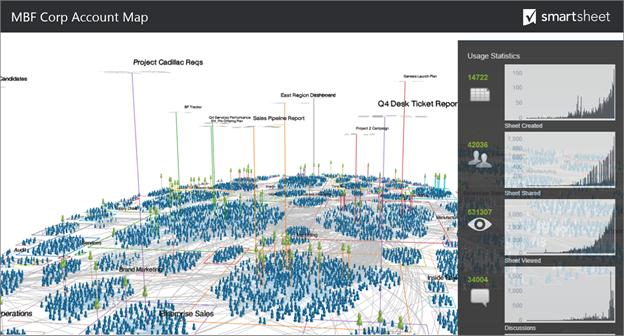
By breaking down the traditional organizational chart view of work management, the Smartsheet visualization shows how internal employees and external contributors form work clusters around certain processes to drive work forward. One feature is an enterprise-wide Account Map, which provides organizations with a high-level view of their usage of Smartsheet to identify patterns in work or team collaboration across the organization, visualize hubs of activity, and map it to corporate priorities.
Joshua Greenbaum, a principal at Enterprise Applications Consulting said, “Having this level of visibility into how work gets done and how people internal and external to the enterprise collaborate is uniquely valuable to an organization.” Clearly, Smartsheet is at the forefront of visualization data and we are excited to see how they continue to stay at the forefront of enterprise technology.
We are not alone in our enthusiasm regarding Smartsheet’s Workmap tool. Listed below are links to articles about Smartsheet’s announcement:
- CIO—Smartsheet, the project management tool cloaked as a spreadsheet, adds visualization—10/20/14
- Forbes—Smartsheet Wants To Help Enterprises To Visualize Their Work—10/20/14
- TechCrunch—Smartsheet Helps Businesses Visualize Themselves—10/20/14
- ZDNet—Smartsheet steps up visualization game—10/20/14
- PC World—Smartsheet, the project management tool cloaked as a spreadsheet, adds visualization—10/20/14
- IT World—Smartsheet, the project management tool cloaked as a spreadsheet, adds visualization—10/20/14
- BetaNews—Smartsheet launches new work visualization tool for enterprises—10/20/14
- VizWorld—Smartsheet Launches Work Visualization for Enterprises (DATAVIZ)—10/20/14
- Telecom Reseller—Smartsheet Launches Work Visualization for Enterprises—10/20/14
- IT ProPortal—Smartsheet work visualisation tool gives presentations a facelift—10/20/14
- Fierce Content Management—Smartsheet amps up visualization tools in collaboration platform—10/20/14
- Workforce Management—Smartsheet Work Management Seeks to Show How Businesses Operate—10/21/14