
Insights for Leaders Navigating
Visibility, Credibility, and Growth.
From media strategy to reputation management, we explore the trends shaping public perception and share the approaches that drive measurable results for growing brands.
You’ve heard the old adage: A picture is worth a thousand words. In PR, this saying still rings true when it comes to storytelling. Visual assets can make your message memorable, bring complex data to life and draw more attention to the most important parts of your story, as we explained in our post about infographics last year. Plus, more and more outlets are looking for visual aids to enhance stories.
Infographics
In recent years, the popularity of infographics has skyrocketed. Whether they are used as a timeline, as an editorial, or as data visualization and design, infographics can be a great way to turn convoluted or humdrum information into an easily digestible, exciting image. Last year, Medical Billing and Coding released a compelling infographic called “Sitting is Killing You,” and the Washington Post often boasts impressive interactive infographics, such as this one from the 2011 census.
Benefits: Infographics, when done well, can go viral, spreading your story through various social media and traditional channels. Infographics are a great way to make complex information fun and easy to understand.
Downfalls: Infographics can fall flat unless you have strong data and a talented graphic designer by your side. Also, that talented graphic designer will require additional budget.
Videos
Whether high-budget or home-made, online videos are wildly popular. According to a study by Pew Research earlier this year, 71% of online adults have watched videos on websites such as YouTube and Vimeo. Even more surprising is the fact that over 48 hours of video is uploaded to YouTube every minute. Well-made videos also have the potential to go viral, such as the Volkswagen Passat Super Bowl ad featuring a child dressed as Darth Vader – it was one of the most viewed videos on YouTube last year.

Benefits: Usually, creating a channel and uploading your content is free. Most video websites also enable embed codes and direct links to your videos, making it easy for your employees, customers or reporters to share your content with their extended social networks.
Downfalls: Videos can be a costly project, particularly if your company is looking for something scripted and high resolution with high production value.
Photos
Images still remain the most popular and cost-effective visual storytelling conduit. In fact, over 3,000 images are uploaded to Flickr, a popular photo-hosting website, every minute. A good photo can go beyond language barriers and evoke emotion in a way that reporting simply cannot. Many news websites now feature slideshows, as a slideshow can have a big impact with few words.
Benefits: Photos are widely accessible and easily obtained. With digital cameras and photo editing software at affordable price points, it is easy for organizations to create their own high-quality images. Also, images can easily be used in both web and print stories.
Downfalls: Sometimes additional costs are required for professional photos. Also, photo shoots tend to take more time than one would think – proper lighting, a good background and good framing techniques should all be considered when staging a photo. And slideshows are limited only to web outlets.
What is your company’s philosophy on using visual storytelling methods to augment a story?
You’ve finally found the perfect editorial opportunity at your target publication – one that allows you to write the article. You spend time crafting a stellar pitch and send it off to the appropriate editor. You’re excited when the editor responds – that is until you read the email.

“Thank you for your note. We would be interested in a 1,100-word article on _________. Our editorial guidelines specify that contributed content needs to be vendor-neutral, and cannot be a product or service pitch. Are you able to work within these guidelines?”
What do you do? Is there value for your organization when writing editorial pieces that don’t mention the company or product name? The answer is simple – move forward!
There are three major benefits to contributing company-neutral content. This type of editorial:
1. Allows you to control the message. Your article should provide a means for people to make informed decisions about an issue. It may not even be an issue related specifically to your product or service, but should help identify a situation in which your company may play a role and should be an area in which you have credibility. Write the piece in such a way that readers can easily link the content and your company without you explicitly noting the connection.
For example, a hygiene products company may write about how to design a better commercial restroom, addressing issues like how to avoid slip-and-fall accidents, where to place sinks and dispensers, or other ways to improve hygiene. The company does not need to specify a particular product to use in the design, but can set the stage for a reader to envision how its products can be used to solve the problem. And in the process, it provides some useful advice for its readers.
2. Builds your credibility as a thought leader. What establishes you and the company as thought leaders is recognition from influencers outside the organization who can see that you understand and provide valuable insight on the editorial topic. By writing a balanced article that doesn’t specifically feature your company or product, you are more likely to build credibility for yourself. The article should not be an advertisement – that’s the purpose of the paid advertising section. Rather, people read editorial pieces because they are seeking factual, neutral information that allows them to develop their own conclusions based on the information presented. Most contributed articles provide a brief bio about the author, including the company name. The reader should draw the connection between the solution you suggested in the article and your company, and know where to turn for additional information.
A great example of this is shown in these articles with a byline attributed to Chris Hill at Mobidia. These pieces enabled Chris to share his perspective on network congestion and provide a point of view on different solutions operators can deploy. The articles also position Mobidia as a thought leader in the mobile wireless space.
3. Fosters positive media relationships. An editor extends a large amount of trust when allowing people to contribute articles. The editor is seeking an article to address a specific topic and has expectations about the quality of writing to be included in the publication. An editor remembers people who have provided excellent work (and those that don’t!), and will be more inclined to allow trustworthy authors to contribute in the future. In addition, the editor may reach out to you at a later time to obtain your expert opinion on a topic or share information about your company for another article.
At Communiqué PR, we have fostered a number of relationships with key reporters that have enabled us to pitch story ideas and secure byline articles on behalf of our clients. Most recently, our team reconnected with the editors at Medical Design Briefs to secure a bylined article for Tecplot on how researchers at University of California are using computational fluid dynamic visualization software to develop the first artificial heart valve designed to closely mimic the natural mitral valve dramatically and improve the quality of life for patients. The article, written by Scott Imlay, chief technology officer at Tecplot, in collaboration with Ahmad Falahatpisheh, a doctoral candidate in the lab of Prof. Kheradvar (KLAB) at the University of California, Irvine, is slated to appear in the February issue of Medical Design Briefs.
While having content that features your product and company is ideal, your company also can benefit from contributing editorial content that is “neutral” in nature. As you incorporate contributed content into your PR plan, be sure to visit our previous blog posts to read tips on how to write a bylined article and feature writing.
What are some successes your company has had with developing company-neutral editorial?
By Joni Kirk
It’s typically quiet the week between Christmas and New Year’s, offering us time to reflect on the past year as well as plan for the coming one. For us, 2011 was a busy year – with many successes and numerous milestones. Before we jump into 2012, here are some of our significant 2011 highlights, for which we feel both proud and grateful:
- We added several full service and project clients to our roster during 2011: Centri Technology, Lions Club International, Opscode, Play Mark, Rwanda Girls Initiative, RPI, SwaddleDesigns, and Verdiem.
- Earlier this year we had the opportunity to work with Lions Clubs International (LCI) to drive awareness of its 94th International Convention, one of the world’s largest annual conventions, which took place in Seattle this summer. As a result of our efforts, LCI garnered more than 50 media placements across all major television, radio, print and online media outlets in the greater-Seattle market. For a recap of the results please visit “A Lion’s Share of Media.”
- For The Shops at The Bravern, an open-air retail shopping center in Bellevue, Wash., we helped promote a variety of events in the past year, as well as work with a number of lifestyle, retail and business media outlets and bloggers. Our efforts helped secure a cover feature article in the August issue of Shopping Centers Today. Thus far in 2011, articles and posts mentioning The Bravern have generated more than 234 articles.
- In the spring of 2011, we began work for Opscode to help the company announce general availability of Hosted Chef and Private Chef. As a result of our efforts, we secured more than 20 briefings with key technology media and industry analysts. After the launch, we assisted with the development of case studies and follow-on customer announcements.
- When breaking international news about banking fraud intersected with new data from a survey commissioned by Attachmate, we developed a strategic editorial campaign. We developed a pitch for national news outlets and related banking and business publications, and reached out to media. We followed the outreach with a news release about the new survey results. As a result of our efforts, Attachmate’s survey data was included in CSO Online, Security Magazine, and Wall Street and Technology. In addition, our conversations with key reporters created awareness about Attachmate and its solutions and helped to ensure the company stays top of mind with national media that cover insider fraud.
- Verdiem, a leader in IT energy management and efficiency software, turned to Communiqué PR to develop strategic messaging and drive awareness of the company by analysts and the media. We developed a story arc to shape the way the company communicates, and implemented the messaging into its press releases. To date, we have secured four analyst briefings and garnered coverage in Environmental Leader, FierceEnergy, Green Technology News, The Green IT Report and TMCnet.
- We conducted a multi-city press tour for Tecplot to introduce its Chorus software. Journalist and analyst reaction to the software has been overwhelmingly positive with Desktop Engineering selecting it as its Editor’s Pick of the week for June 1, 2011.
- In addition, we also partnered with Seattle Children’s to help raise awareness on a number of initiatives including: the launch of the Teenology 101 blog; the opening of their new blood bank facility with Puget Sound Blood Center; and the “Stand Tall for Little People” campaign with Little People of America and Caffe Ladro, which garnered results on Q13 Fox News, SeattlePI.com and Patch.com.
Internal milestones for the year included:
- Releasing the eBook version of Strategic Public Relations: 10 Principals to Harness the Power of PR. The digital version of our book is available via Apple’s iBooks, Amazon’s Kindle Store and BarnesandNoble.com. Sales of our book increased in 2011 by more than 230 percent over 2010.
- Our team wrote more than 140 blog posts during the year. One of our blog posts (no. 4 listed below) also sparked a reporter to contact us for inclusion in an article on Ragan.com, “To April Fool or not? 6 pranking caveats. Top posts for the year included:
- Jennifer and I were interviewed for The PR Factor 2011, a special section in Advertising Age sponsored by The Council of PR Firms. We offered our insight and experience regarding the changing landscape of branded content and PR.
- As a result of our activity, our web site traffic increased by more than 60 percent in 2011.
We want to thank our amazing clients, our blog readers, those who purchased our book, and our long list of supporters! We look forward to continuing our work in 2012.
PR Trends for 2012
As we get ready to ring in the new year, it is a good time to look at the emerging trends in public relations for 2012. As PR professionals, we strive to examine upcoming trends and tailor our recommendations to maximize results for our clients.
While evaluating potential trends for 2012, I came across a number of interesting articles that highlight predictions for the new year. John Trader from PRBreakfast Club wrote a piece, “Put Away the Toys, It’s Now Time to be Accountable ,” discussing trends surrounding measurement and accountability. Ragan’s recently published an article where Gini Dietrich specifically identified “8 Social Media Trends for 2012.” Based on research and my own experience of what we are seeing, I’ve highlighted four trends.
- New social media platforms. Between Twitter, Facebook and Google +, it does seem as though another social media site may be overkill, but social media sites such as Pinterest are attracting users. Pinterest allows users to create virtual pinboards. Pinterest has the ability to influence purchasing decisions and because of this, companies are hopping on board. For example, retailers are using Pinterest to not only share information by posting fashion trends, but using it to see what style trends consumers like based on engagement. Pins can also link back to products and businesses are using the site for contests. Some companies report that Pinterest drives more traffic than Facebook. Google + is not new, but Trader writes that in 2012 “more businesses will use Google + to extend their reach.” We are seeing this trend as we work with our clients who are eager to learn about how Google + can help their business. For more information on how companies can do that, you can read our blog post, “Google Earns a +1 for Google+ Brand Pages.”
- Focus on Measurement. Both Trader and Dietrich highlight the increased focus on measurement in 2012, not only on results from press coverage, but results derived from social media. Businesses are interested in tracking the results based on dollars spent. At Communiqué PR, we strive to set measurable goals with each of our clients and look for new ways to measure how social media is impacting their businesses. For each campaign, we develop a PR plan that maps back to the business objectives for each client with anticipated results. Following execution of the campaign we provide a recap to showcase how the results measured up against our goals. For social media, we use a variety of available tools to measure the influence of the handles we manage and provide this information back to the client, including Social Mention, TweetGrader.com and Klout.com.
- Integration of all disciplines. Dietrich predicts in 2012 we will see an increase in integration of marketing, PR, social media, sales, etc. Dietrich points out that this will be crucial next year and writes, “Today we talk about mobile, social, marketing, public relations, advertising, direct mail, email, customer service, and sales as if they’re working in silos. But 2012 is the year it needs to integrate. Customer service can’t do its job without talking to sales. Sales needs the help of public relations.” Dietrich predicts you’ll see these teams work in a circle rather than a silo in 2012. We are already noticing the need for these teams to integrate. For example, when researching speaking opportunities recently for a client, we were asked to look at lead generation to help sales. All disciplines need to work together closely to meet the company’s business objectives.
- Targeted Pitching. Next year, PR will focus on a more targeted approach to pitching. This is based on brands putting higher value on smaller media that speaks directly to a target audience. This will result in stricter evaluation of media lists and developing criteria to evaluate media. As PR professionals, we always evaluate if a publication reaches our client’s target audience, but we are getting more refined in our approach as many clients are beginning to place additional value on niche publications as opposed to broader pubs that reach a more diverse audience.
Predictions serve as a good guide for the upcoming year, but as with other disciplines, PR is constantly changing and it is up to us to adapt.
If you have any predictions to add, we would love to hear from you!
Punctuation has a definite and important place in writing. When used improperly it can change the meaning of a sentence and drive your readers crazy. As communication professionals, we need to pay particular attention to punctuation as we strive to deliver clear and concise messages.
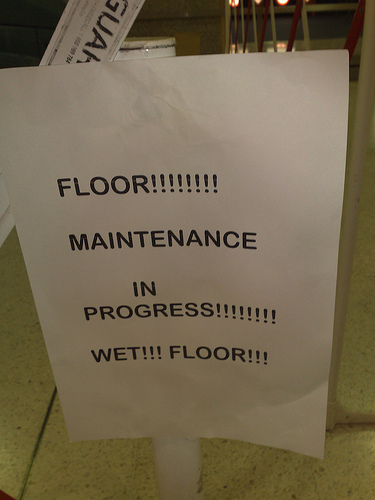
See the image on the left. It seems this person finds floor maintenance exhilarating! However, it’s easy to see that this is an obvious misuse — and overuse — of the exclamation point. Punctuation problems aren’t always this over the top, but happen frequently. So what are some quick ways to ensure you’re using punctuation properly?
Ragan.com offers some good direction in an article, “5 frequently misused punctuation marks.” The author, Rob Reinalda, discusses when and when not to use the question mark, the ellipsis, the apostrophe, the comma and the exclamation point. You need a subscription to access the article so I have summarized Reinalda’s guidance and provided complementary examples.
Consider this:
- The exclamation point. Reserve exclamation points for writing dialogue or conveying extreme excitement. It’s best to leave it out of business writing, Reinalda advises, “Or people might think you run a bit, well, hyperbolic.”
- The question mark. The question mark should be used to ask a question, but people often misuse the question mark when a period is the appropriate choice. For example, “Guess what I had for dinner?” Reinalda explains that “guess” is used as an imperative, not an interrogative. You are instructing someone to guess therefore the correct use is, “Guess what I had for dinner.” Another common mistake is, “I wonder what Mom is making for dinner?” This is a declarative statement and again should be replaced with a period.
- The ellipsis. This is another punctuation mark that is misused … frequently. The ellipsis is used to indicate a pause, gap or missing words in quoted text. However, it should replace extra information without changing the meaning. For example:
“I would like, once I finish shopping and cleaning the kitchen, of course, to cook dinner for family and friends tonight.”
This could be shortened to the following using the ellipsis:
“I would like … to cook dinner for family and friends tonight.”
However, it is not appropriate to shorten the sentence using an ellipsis that alters the meaning. An ellipsis can also indicate a pause, but a common mistake is…….too many dots.
- The apostrophe. The most common mistake using an apostrophe is to create plurals. Use an apostrophe to form possessives, such as “grandma’s famous muffins.” You also use an apostrophe in a contraction.
- The comma. Commas have a lot of uses, and because of that are commonly misused. Here is an example that shows a blend of misplacement and omission:
“My mother has recipes for delicious meals, and perhaps more important, healthy recipes, that are quick.”
Only one of these commas is used correctly. This is how it should be rewritten:
“My mother has recipes for delicious meals and, perhaps more important, healthy recipes that are quick.”
Often times commas, apostrophes and exclamation points are used randomly in writing. These are just a few tips to help you avoid the punctuation crap shoot and the mishaps that can lead to a confused or frustrated reader. There are other sites out there that offer helpful guidance and illustrate the power of punctuation like Daily Writing Tips, which shows readers “How to Punctuate References to Dates and Times,” “7 Types of Hyphenation That May Seem Wrong But Aren’t,” and even how “Punctuation Saves Lives!”
The bottom line, you want to convey a clear message to your audience, punctuation should help, not hinder.
What other common mistakes do you see? And trust us, they’re everywhere.
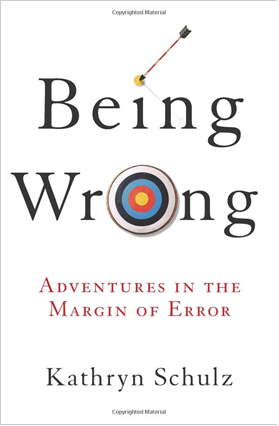
On my way to lunch in early December, I happened to catch Kathryn Schulz on KUOW’s The Conversation talking about her new book, Being Wrong: Adventures in the Margin and Error, and the value of being wrong and making mistakes. It caught my ear because in public relations, we strive to be mistake-free. In addition to being compelling, our PR materials need to be grammatically correct, free of typos and factually accurate. Deadlines cannot be missed. Information needs to be shared in an appropriate and timely manner. Our counsel to clients must be spot on and our execution in any situation or campaign flawless. Frankly, it is a lot of pressure. It’s no wonder that many folks see public relations work as intensely stressful. Just check out David Schepp’s article “10 Most Stressful Jobs of 2011,” where PR Officer is listed at number two.
So with great interest I tuned into senior host Ross Reynolds’ interview with Schulz on The Conversation. It did not disappoint. It was helpful for me as a leader as I constantly obsess about delivering quality work, crisis management and even storytelling. Here are some of the points she made which resonated with me:
- We are attached to being right and our sense of accuracy. However, oftentimes we learn the most from making mistakes. Mistakes force us to grow, they drive innovation and many times they inspire us.
- The structure of the human mind is designed so we can make swift and probabilistic judgments about the world. Probabilistic thinking means you’re probably right or possibly wrong. This brings new insight into St. Augustine’s words, “To err is human.”
- If you don’t want your people making mistakes, you need to design systems that prevent them from making them, or at least reduce the probability of them happening, because human error is inevitable. You need to consider why mistakes are made. Just getting rid of the person who made the mistake will rarely eliminate the cause or issue. (Consider the processes developed by the medical profession and airline industries.)
- Being wrong can be a powerful narrative and story-telling device. Schulz interviewed Ira Glass from This American Life for her blog on Slate.com and learned that almost all of the segments have the following structure: “I thought something was going to happen. And then it did not happen. I had a revelatory moment. My whole sense of my reality collapsed and I had to shift my thinking.” These situations of being wrong are transformative moments and make for terrific stories.
- Science and its related domains (such as technology industries) understand that mistakes help us with breakthroughs. Experiments that go wrong often help scientists develop a deeper understanding of a subject.
The primary goal of Schulz’s book is to help people become better at being wrong and learn to behave with more grace, humility, empathy and curiosity in the face of wrongness, errors and mistakes.
I am truly looking forward to reading her book. If you have a story to share about a mistake you made, or thoughts about this book, I’d appreciate hearing from you.
Jennifer